What Makes a Great Street Photograph?

It’s the question interviewers love to ask — and it’s the one that street photographers have come to expect. Their answers are usually non-committal. “It depends…” they’ll say, “…on things like style and approach, on what you’re trying to do.”

I’d like to find an answer that’s more definitive and which could be applied to most street photographs, regardless of styles and objectives. Surely there has to be some specific quality within the photo to prompt the informed onlooker to say: “That’s a great shot.”

Here’s my suggestion. A great street photograph must have an indefinable quality which cannot be expressed clearly in words. I think this is the key component and it need be the only component. The photo could lack all the other qualities we normally admire — pleasing composition, great light, an intrinsically interesting subject — if it has “that certain indefinable something.”

So that’s my definitive answer: something indefinable! Really, it’s not good enough. I shall have to explain what I mean.

Totting Up
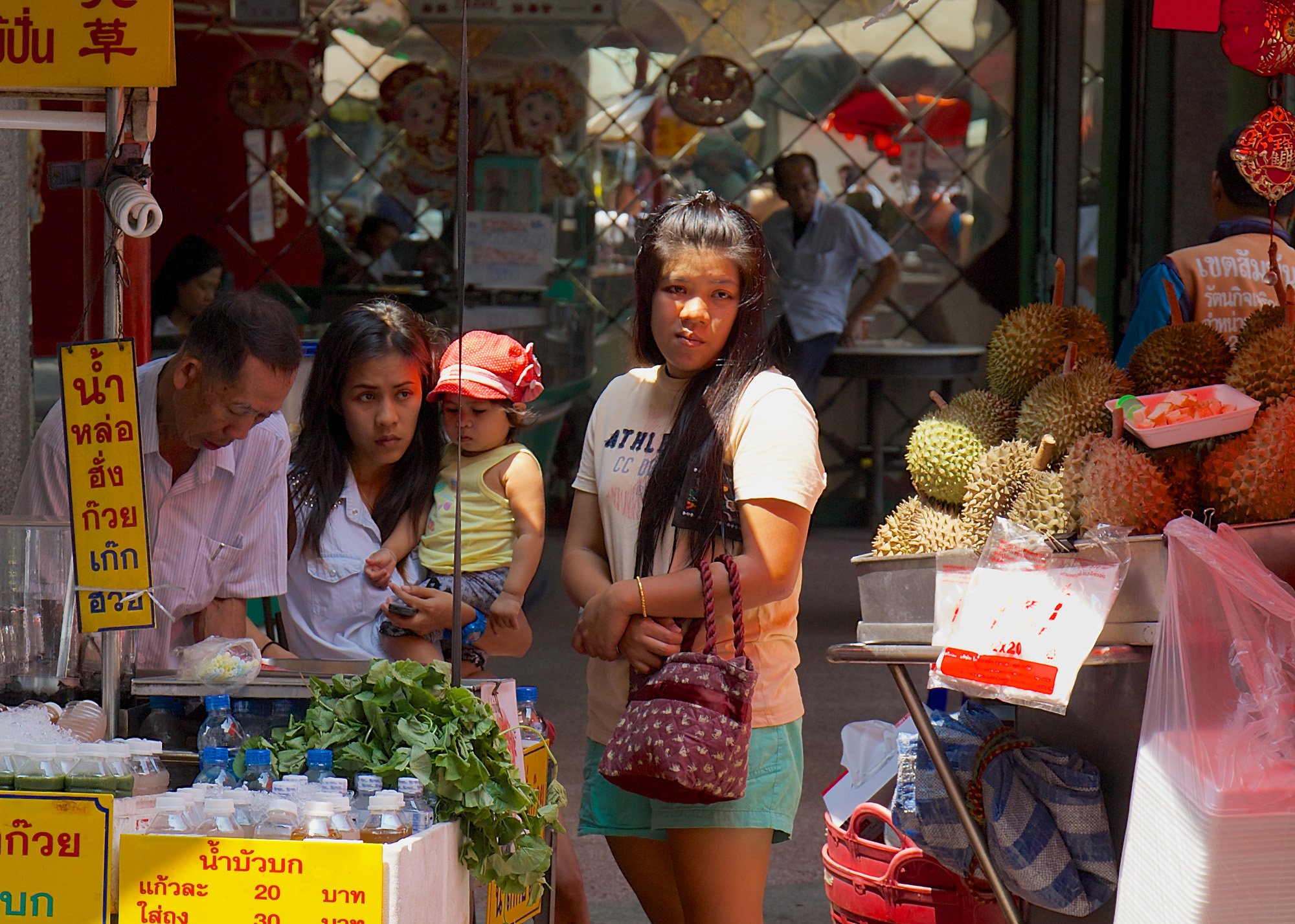
My featured image (above) is a scene from a street market in Bangkok. From a technical viewpoint it’s not one of my best photos. For example, I can’t do anything about the blown highlights or the extremes of light and shade which were already there in the scene on an intensely sunny day. But it’s one of my personal favourites. There’s something about it I find utterly compelling.

The main elements that make up the image are the central figure who stands slightly apart from the others, a young woman holding a child, a stall-holder who tots up their purchases (I’ve called this picture “Totting Up”), and another man in the background who looks towards the camera.

The main figures are surrounded on each side by copious amounts of food and cold drinks, the sight of which is satisfying when we view a street scene taken in brilliant sun. Those durians look delicious, don’t they?

Yet it’s not the props or the environment which makes the picture what it is. Its indefinable quality lies partly in the pose of the main figure and partly in the fact that each person looks in a specific direction, except for the main figure who seems to gaze in two directions at once.

When I examine the pose of the central figure I awaken a residual memory of a figure from Italian art. Who can it be? I can’t find a perfect match, but I have a sneaking suspicion it’s the figure of the goddess Flora in Sandro Botticelli’s 1478 masterpiece “Primavera.”

Could anything be less likely? Flora is the one who stands next to Venus, on the opposite side of the painting to the Three Graces, distributing flowers — the largesse of Nature. Her arms are in a similar position to those of the girl in my photo, although her hands are not actually touching. There’s also an abundance of fruit in Botticelli’s painting, which may have triggered my memory of it.

The Ambiguous Gaze
The two female figures in my photo seem to be looking at something off to the right of the frame while the stall-holder and the baby are looking down. However, there’s ambiguity in the gaze of the main figure who also seems to gaze directly at the onlooker, backed up by the man in the background.

I like the girl’s ambiguous gaze. It reminds me of the way I tend to look at every scene I photograph.

Ambiguity is a key quality of street photography, as it is in literature. I’m tempted to say it’s a quality that contributes to a photo’s overall distinction, but I can imagine an image which moves us in an indefinable way without being ambiguous.

I’m not saying that my photo lacks all other qualities. I’ve filled the frame, achieved good focus, blurred the background. There’s good distribution of colour and plenty in the image to please the eye. It’s a complex image — and again I’m tempted to say that “complexity” is another quality which makes a great street photo, were it not for the fact that simplicity can do the same.

Frequently in these articles I talk about “contrast” being a main constituent of street photography — in the sense that the image may contrast one idea with another: such as a baby sitting on a Roman wall. A sense of time and the passing of time is nearly always a factor which contributes to a photo’s greatness, especially in an art-form such as street photography where ephemerality is almost unavoidable.

Does the featured image have contrast? It does for me — because I remember the glory of Botticelli’s painting and am struck by how the ordinariness of my little market scene contrasts with the flowing beauty of the Florentine work. The contrast gives my photo an added poignancy. Can this be the indefinable quality I mentioned?

Smartening Up
I hesitate to add any more photos to this post because I can’t use up two favourite images in one article. I don’t have as many as I’d like! But here’s one, “Smartening Up,” that almost makes the grade.
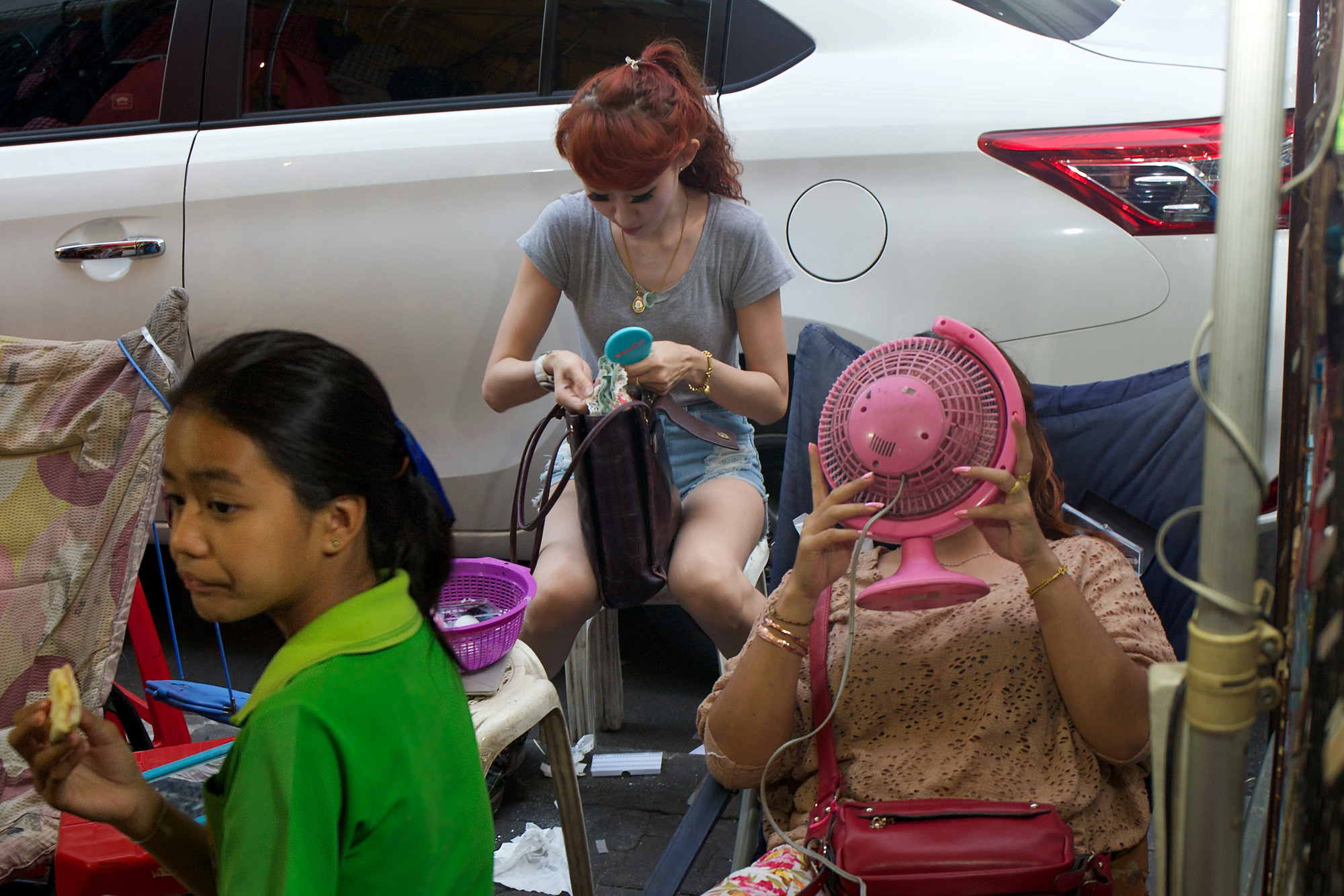
Again, it’s not technically great, but it has an indefinable something. The girl with the sandwich shows a touch of anxiety, perhaps caused by the strange behavior of her colleagues. The three figures form a nice pyramid, but that’s a fairly obvious quality of the composition. Less obvious are the circles.

There’s a pink, circular fan; a purple, circular bowl; a blue circular mirror; and a white, circular cover to the car’s fuel tank. Everyone and everything – the auburn-haired women, the stool and the car — has a circle. But the black-haired girl has none. Maybe that’s why she’s anxious.

Of course, such a suggestion is absurd, but the photo makes a point of addressing the absurd, so we’re tempted to go further and invent bizarre ideas to explain it.

Indefinable? Beyond words?
I’m not sure if anything is indefinable and completely beyond the power of language. Analysis gives us greater insight — and I think it can do so without destroying the magic of the image.

I don’t claim any of my photos to be “great” in the face of all the intense competition from other, better known photographers, but I sometimes have an indefinable feeling which tells me I’m probably going in the right direction.

Dealing With Shop Decor

For the candid photographer, shop decor is a ready-made backdrop –too good to ignore yet often out of bounds because stores prohibit photography on their premises. I can see their point of view. The interests and privacy of their customers must come first.

However, I don’t like to admit defeat. Some photographers — Michael Huniewicz springs to mind — go to North Korea and come back with hundreds of forbidden images, so I think I can grab a few shop interiors in other countries without being reprimanded.

Malls in Thailand, Singapore and Hong Kong are reasonably tolerant of photographers, providing no one gets unduly disturbed. Here, pragmatism has triumphed out of necessity, because among the best customers are tourists with expensive cameras around their necks.

The Indoor High Street
The design of the modern mall works in favour of the street photographer because the whole area is essentially a network of indoor streets. The only difference lies in the shops themselves. They blend seamlessly into the public areas with scarcely any barriers between the “street” and the interior of the shop. Sometimes it’s hard to tell whether you’re in the shop or outside it.

When there’s a physical barrier, it’s often a huge, plate glass partition separating shop from street, allowing potential customers to see the goods close-up without committing themselves to a visit. As a result, store design has become increasingly theatrical, with shops competing for attention by staging ever more eye-catching displays which many passers-by snap with their mobile phones.

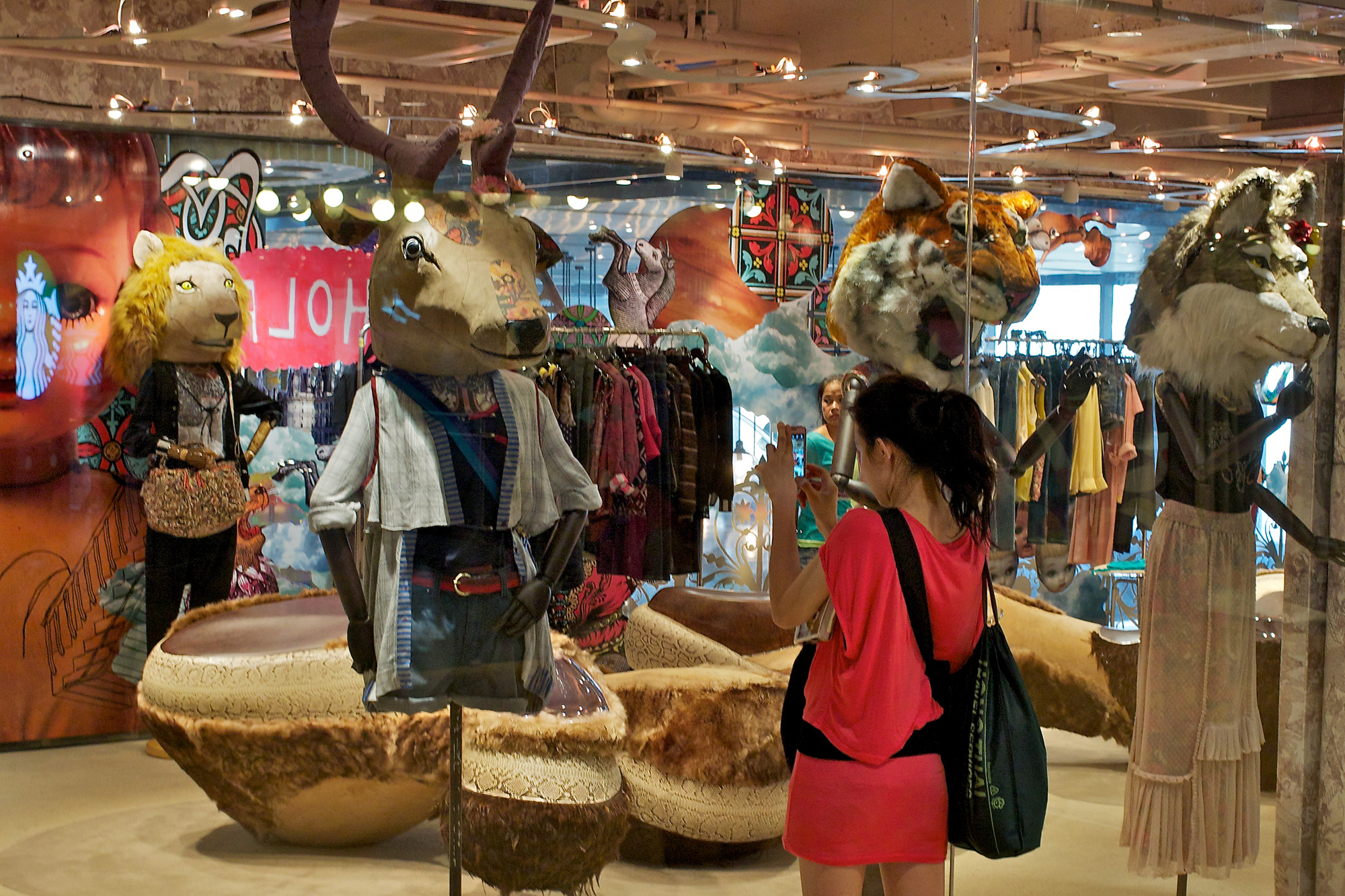
As you can see from the photo below, the passer-by does not have to enter the shop to get a picture. The heads of the beasts seem to stand guard over the privacy of the customers. If photographers were to venture inside they’d find most of the animals looking in the wrong direction.

Golden Age
We live in a Golden Age of shop decor and it’s hard to imagine what will come along next. Can it get any more inventive, any more surreal? Store designers have the whole history of art from which to borrow, including everything since Dada and the Futurists. Maybe the future of art itself belongs to these creators of new shopping environments. Once they’ve exhausted the history of art they’ll have to become truly original — as I think they already are in the Far East.

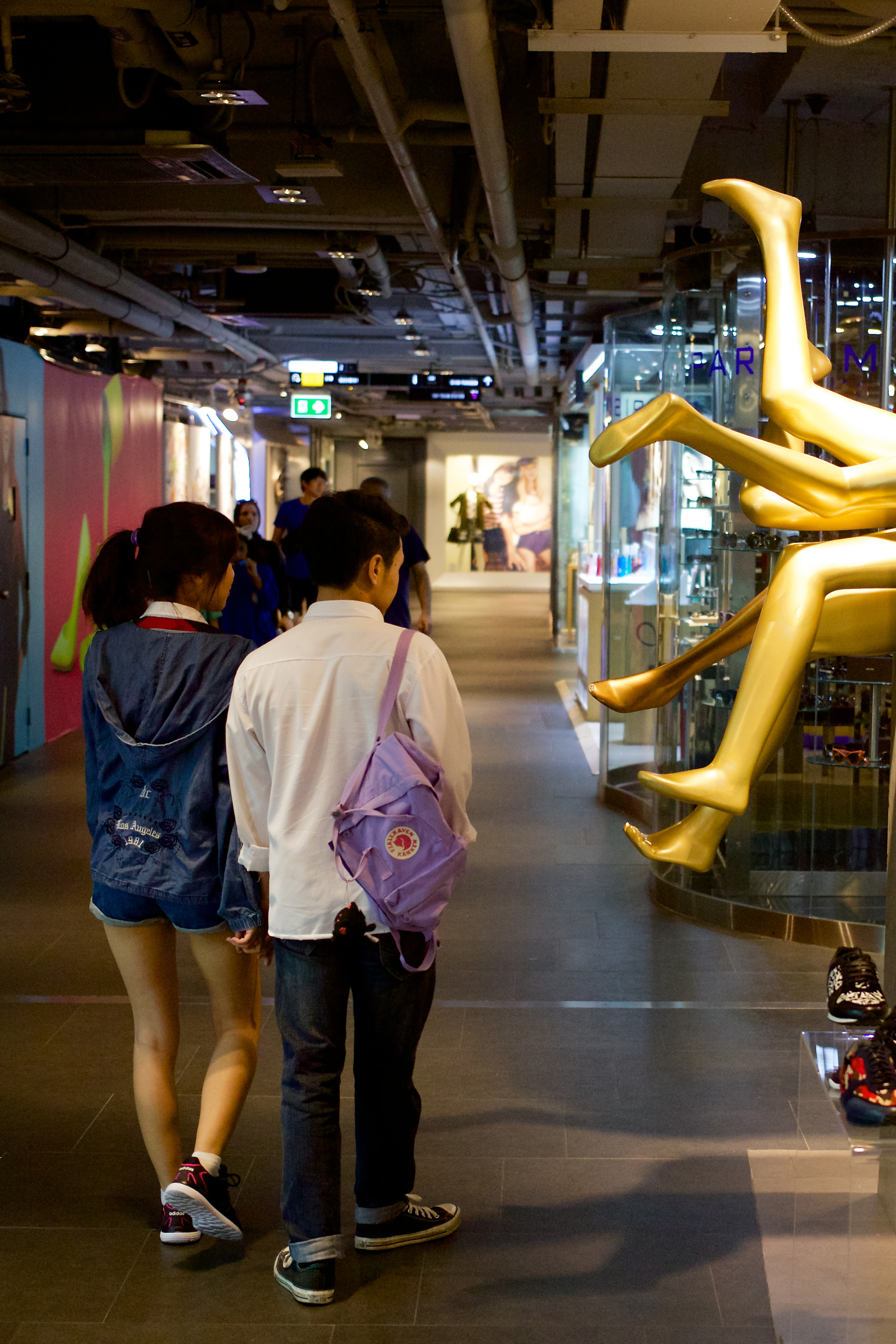
For example, I can’t think of any art historical precedent for this cluster of golden legs advertising the presence of a shoe shop. It seems to have attracted the attention of the two passers-by, one of whom could use a new pair of trainers.

Moving Inside
I took my shots of the large beasts and the cluster of legs from the public space between stores. But if you want to get a better shot — and who wouldn’t? — you need to move in a bit closer. You need to be inside the store, or at least within its entrance.

My featured photo (at the top of the page) shows you the kind of image I prefer. For a start, it’s better lit than the others. The store lights were not the most intense I’ve seen, but the translucent background added wonderfully to the overall effect.

I was actually inside the store, but only just. I’d waited a minute or so for the right moment then stepped forward when the customers were in good positions. The main figure, in particular, was approaching the camera but still looking from side to side at the clothes. She seems to be the “New Arrival” referred to by the sign. Her black and white Yves St Laurent tee-shirt is nothing like the colourful clothes in the store. Surely they can’t both be in fashion?

The danger in using shop decor as a backdrop for street photography is that it can so easily become the most important part of the image. I think this is true of my picture of the woman taking a shot of the beast with her mobile phone, but it’s not true of the featured image. There are six people in the photo, none of whom is irrelevant. They are the real subject of the image. The shop is merely their environment: in wildlife terms, their natural habitat.

So you can see where this argument is headed. It’s essential for the street photographer to get off the sidewalk and go to where people are most at home — except when they’re actually at home. And where is that? At the mall.

People spend such of lot of time at the mall they cannot be said to be visiting or shopping. They’re living there, all bar sleeping over. You can have breakfast, lunch, tea, cocktails and dinner in the mall, go to the movies, and generally hang out with your friends for hours on end. Afterwards you scuttle home — and that’s when the majority of street photographers will take your image, in black and white, when you’re tired and under stress.

Wouldn’t you prefer me to take your picture in daytime at the mall?

When the Subject Date-Stamps the Image

I love it when a subject date-stamps one of my street photos — when it mentions the day of the week, or the name of the month, or tells us the year in which the shot was taken.

The art of street photography and the concept of time are irrevocably intertwined. In all photography, time is embedded in the still image: a passing moment fixed forever in the representation of the subject. If you want to know exactly when that moment occurred you can look up the EXIF file and find out the time and date of origination, unless processing has stripped away the details and consigned them to the unrecorded past.

Yet I find it surprising that so few street photographs carry any visual information to indicate time of day, day of month, or even a reference to the current year. I guess it’s because everyone now has a mobile phone and wristwatch so there’s no longer a practical need for clocks in public spaces.

I’m not suggesting that every street photo needs to refer directly to the date. That would be absurd. But it’s good, occasionally, to remind ourselves that our images are located precisely in the flow of time, even when many of them may look deceptively timeless — at least for now.

I say “for now” because although street photos don’t look dated for the first year or two after they are taken, they do assume their place in time once a decade or two have passed. Fashions, car designs, buildings and street furniture change quite rapidly, making our photos a record of the past in less time than we care to imagine.

Landscape photographers can play with the concept of time more easily: balancing the ephemerality of changing seasons against the relative permanence of geological features such as rivers and mountains. Only when something really dramatic occurs — as it did recently with the complete collapse of Malta’s famous Azure Window — can we locate a photo of such a feature in the flow of time. Pre-2017 the Azure Window existed. Post-2017 it did not.

So if time is inextricably bound up with the photo, regardless of the subject, why is it good when the subject declares the time overtly? Why do I sometimes like to see “2017,” “Tuesday,” or “March” — or other such specific, time-related reference — within the image?

I’m not sure if I can answer that question. It just feels right.

What Day Is It?
The best way I can explain my feeling about this topic is to look at a specific example. My featured image (above) shows a girl wearing a tee-shirt that says: “Sunday, Funday.” The photo is one of my personal favourites, although I think some viewers will find it rather ordinary. I took it on a Sunday when not much was happening. The streets of Bangkok were quiet and everyone seemed a bit hung over from the night before.

Thai people are very aware of the days of the week. My partner and her friends always exchange “virtual flowers” in specific colours to mark Sunday, Monday, Tuesday, etc., on Line (the oriental equivalent of WhatsApp). In case you’re interested, the “lucky colours” are red for Sunday; yellow for Monday; pink for Tuesday; green for Wednesday (day); grey for Wednesday (night); orange for Thursday; light blue for Friday; and purple for Saturday.

My photo has a prevailing atmosphere of “ennui,” evoked by the anxious gesture of the girl on the left and the downright miserable expression of the man who is entering the frame from the right. Only the figure in lucky Sunday red seems cheerful. The central figure, the girl with the “Sunday, Funday” tee-shirt, is neither sad nor happy but just stares dreamily into the distance. She hopes for the best although her day could go one way or the other.

I’ve checked the EXIF and I can confirm I took the photo on a Sunday. In fact, I remember it well. The photo captures my own mood at that moment as well as the collective mood of the subjects. Up to that point my day hadn’t been very successful and could have gone downhill even further. But getting this shot turned everything around. Maybe those lucky colours really do work!

What Year Is It?
Time seems to pass slowly for young people but all too quickly for older people. This is mostly because we fall into regular habits as we get older and the days become less memorable as a result.

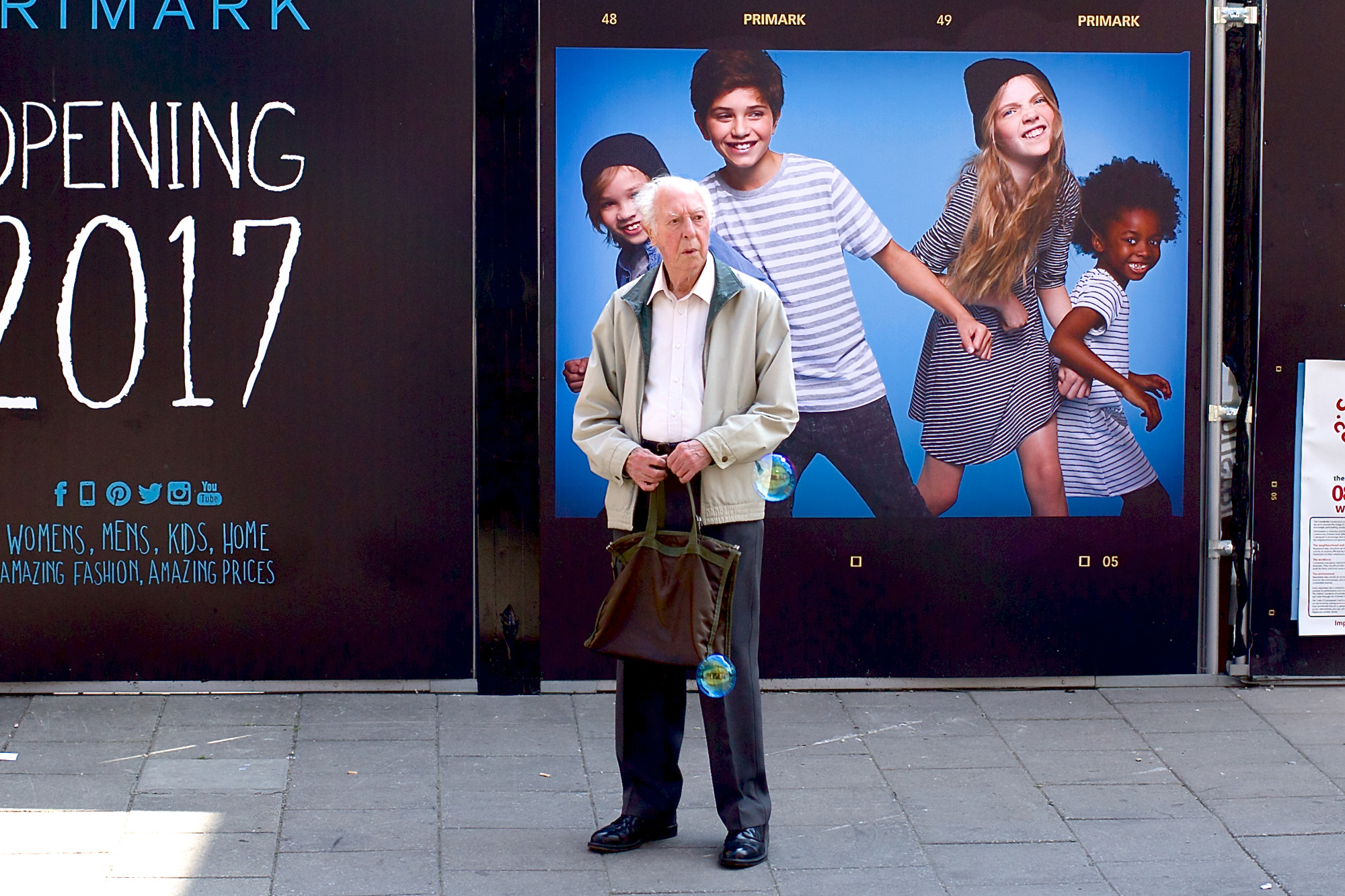
My next photo (below) shows an elderly man standing in front of a poster of four young children and looking at something which has attracted his curiosity beyond the frame. Whatever can it be?

I guess the clue is in the bubbles. A child was blowing some huge bubbles from inside a pram — it was definitely worth stopping to look. Meanwhile, my camera snaps the moment before the bubbles burst (at eight minutes to two in the afternoon). The EXIF doesn’t tell me the exact second but at least the image gives a big clue as to the year. “Opening 2017” places the photo in either 2016 or early 2017. The man’s light jacket tells us it’s summertime: hence 2016.

The photo of the man and the bubbles is not nearly as good as “Sunday, Funday” but it still has internal tensions which raise it above the ordinary. The overt mention of time — the statement of a proposed opening date the following year — is a factor that plays well when the theme is old age versus youth. But there is also the dignified expression of the man with the bag, which contrasts sharply with the cheeky attitudes of the children in the poster.

There is something disturbing about the Primark poster kids. I think some of them have been photographed separately then photoshopped together. Moreover, the girl with the long hair seems to have a huge left hand. It’s bigger than the boy’s hand in front. Can that be right? When I look at the poster I feel as bemused as the old gentlemen himself.

Time passes quickly for people, posters, shops and bubbles; slowly — but no less inexorably — for stones and mountains. With the progression of time, disorder in the universe increases. Stones and mountains eventually crumble; we’ve seen it with the Azure Window. As Professor Stephen Hawking says in “A Brief History of Time”: “The increase of disorder or entropy is what distinguishes the past from the future, giving a direction to time.”

Photographers swim against the flow of time, bringing order by representing people and places in ordered compositions. Surely it’s worthwhile to give this activity a seal of approval, now and again, by allowing the subject to place a date-stamp somewhere in the image? It can’t do any harm.

See the Whole Shot, Not Just the Subject

I’ve already written about the desirability of filling the frame in street photography (“Why It’s Good to Fill the Frame in Street Photography“) but on rereading the post I realise I didn’t explain how to do it. You can guess why.

The reason is it’s really hard to fill the frame deliberately, and even harder to explain. However, I’ll do my best to say how, on quite a few occasions, I’ve achieved it.

Here’s the secret: don’t just look for a lone subject — such as a person, a figure, an incident — look for multiple subjects adjacent to each other.

My featured image (above) is a good example. I was attracted to the scene because there was plenty of activity and it all seemed to say “green!” I’ve always liked the way the ubiquity of a single colour can unite a scene, pulling together parts that would otherwise be unrelated. Here they do exactly that.

To the male eye, the girl’s brown legs make a natural focus of interest, but they also form a pyramid that leads the eye away from them (well, momentarily at least) to the guy taking a photo and the head of the woman with the garrulous tee-shirt who is watching him. If your eye strays back to the girl’s legs you’ll see the huge pair of roller skates being worn by the man with long hair who’s checking his phone. From him, it’s a short jump to the other side of the picture where another man is writing notes on a pad. His reversed baseball cap fills the top right of the frame; the green scooter fills the bottom right.

I took the photo quickly, from the middle of a busy side street with motor bikes and taxis whizzing back and forth. In this kind of situation you need to have all your senses on full alert. The threat of being run over tends to open the “doors of perception” so you can see an entire composition in one glance. Incidentally, I don’t recommend you try this technique because there are other, safer ways of achieving it. I’m just saying…

Did I “work the scene?” No, I took a single shot and moved on. That wasn’t solely because I was confident I’d taken a successful photo. I had to get out of traffic, the bus was waiting and my partner was calling.

How to Practice
OK, so now you’re wondering about the “safer ways” of achieving the state of mind that enables the street photographer to see an entire frame-filling composition. The best way — the way I recommend — can be summarised in one word: practice. I practice a lot, but not in the way you might expect.

Because I’ve been shooting with a heavy Canon 5DIII I spend a lot of time walking around without it. I’m not a person who obsessively carries a camera with me at all times. What’s the point? It’s no good having a camera with you unless it’s switched on and you’re already holding it with one hand and pointing it towards potential subjects. I can’t spend my entire life in that mode of operation. That’s work! I can’t work when I’m doing something else, such as buying a newspaper or going out for lunch. Street photography needs one hundred per cent concentration.

So how do I practice finding compositions? Whenever I walk in the street I compose images in my mind’s eye. I practice with multiple subjects, saying to myself: “Now this sort of composition would be good. What camera setting and lens would I need to achieve it?”

In this way, I assemble a small catalogue of potential compositions in my head, together with notes of what I might need to record them. When I go out with the camera I’m ready for most eventualities. I can recognise those frame-filling moments when they happen in front of me.

The Old Flower Market
Here’s another example (below). I was walking through the old flower market in Bangkok (sorry, they’ve moved it!) when I saw this lady with a black and grey hat talking on the phone. I probably wouldn’t have taken a shot had it not been for the vertical arrangement of bins, decorative birch twigs and bright plastic stools immediately behind her. Thank heavens I was not using my 85mm lens (with which I took the featured image above). Even wide open, the brilliant Canon 40mm could get the background into reasonably sharp focus so that the composition — of five equal parts — would make sense.

At this point I should note that when you go out with a lens of fixed focal length you must look at everything with that focal length in mind. It’s no good saying: “Oh, I wish I had an ultra wide angle to get the whole of that elephant in the frame!” You shouldn’t be looking at the world with ultra-wides in mind, even when confronted with an elephant. Mentally frame the scene exactly as your chosen lens does, making sure you don’t leave out any essential elements. As a last resort, stand further back. You shouldn’t get too close to an elephant anyway.

The original of the lady in the flower market measures 5460 x 3640 pixels, so you can see there was virtually no cropping involved (just minor straightening/trimming). Here, I’ve reduced it to my standard 1600-pixel width as I never release my full size images into the wild!

Make Composition a Priority
I can’t help but notice that a lot of street photographers pay very little attention to composition, let alone make an effort to fill the frame. This is a pity because they could take their work to the next level if they made composition a priority.

The informal, almost casual and throwaway “look” of street photography is, of course, one of its charms. The genre offers us quick glimpses, stolen moments, photos taken “on the sly,” images à la sauvette — to use Cartier-Bresson’s expression. Yet the photographer has already made a selection, chosen to show us a particular scene at a given moment. Why not go further and be even more selective, showing only those subjects which have an inherent aesthetic appeal on account of their arrangement of shapes and colours?

If you’re coming to street photography from portraiture, landscape, wedding, or some other branch of photography, you’ll already have a number of compositional patterns in your head. Glamour and fashion photographers know a hundred different ways their models can pose, but even that’s not sufficient for the street.

I rather think that many professionals regard street photography as an opportunity to “go slumming,” and free themselves from the shackles of conventional composition. That’s OK, but actually, taking shots in the street can be a step up, not a step down on the ladder of potential merit. It can be both more challenging and more rewarding than you expect.

Fleeting Images

The most admired photographs tend to be those that are carefully composed, nicely lit and technically perfect. However, I want to put in a plea for the “fleeting image” — the photo taken rapidly “on the fly” just as the subject (or the photographer) is moving out of range.

Sometimes a subject comes out of nowhere: a skateboarder hurtling down the street, crouching low with arms outstretched. You may not hear him until it’s too late. He’s already gone past, leaving you to wonder if the shot would have captured a moment of athletic beauty — or just another scruffy youth in a hood, against a jumbled background of traffic and pedestrians.

If you pause to think twice about it, pondering whether the shot is worthwhile or not, then obviously you’ll miss it. You have to tell yourself in advance: if even half an opportunity comes along, grab it! It costs nothing to take the shot, except perhaps a loss of confidence if you consistently fail.

What’s the Message?
I don’t think a street photo needs to have “a message,” as such, but it does need to reward the onlooker for taking the trouble to view it. In the case of the “fleeting image,” the sense of ephemerality embodied in the choice of subject should be enough.

Fleeting images lack detail and tend to be very simple — perhaps too simple for the jaded viewer who sees ten thousand photos a week. Take my featured image (above), for example. It’s just a girl on a bike. What’s the big deal?

That’s the point. There is no big deal. In London you can see people on bicycles all day long, pedalling through the streets or slotting themselves neatly between gridlocked cars and buses. As a motorist I find them tiresome — difficult to see in a rear-view mirror and a constant danger to themselves and others.

When I’m out of the car and on the street, walking around with a camera, I can appreciate the fleeting beauty of a cyclist: appearing and disappearing like a brightly-coloured mayfly on the river bank. This girl, in particular, was wearing four bright colours, making her “high-viz” without resorting to an ugly orange vest. I commend her dress sense. It seems to have given her the confidence to ride at dizzying speeds through Covent Garden.

My fast shutter speed has frozen the action, apart from some blurred spokes in the wheels — and no, I’ve no idea why they’re blurred at the top and not at the bottom. Perhaps someone at MIT can advise.

In this image I like the contrast between the cyclist’s ultra-clean presentation and the worn exterior of the Lyceum Theatre. A lone pedestrian reads the words “soul-stirring celebration” and “gorgeous…(gasp-inducing spectacle?).” Everything black is in the right place, and for once I’m not too worried about the bare paving on either side of the subject. At least it’s textured.

The Passing Glance
My largely cinematic style of street photography makes the majority of my shots “fleeting images” of one sort or another. Sometimes the effect is more pronounced, at other times both my chosen subject and I are static and the result is far from being transitory.

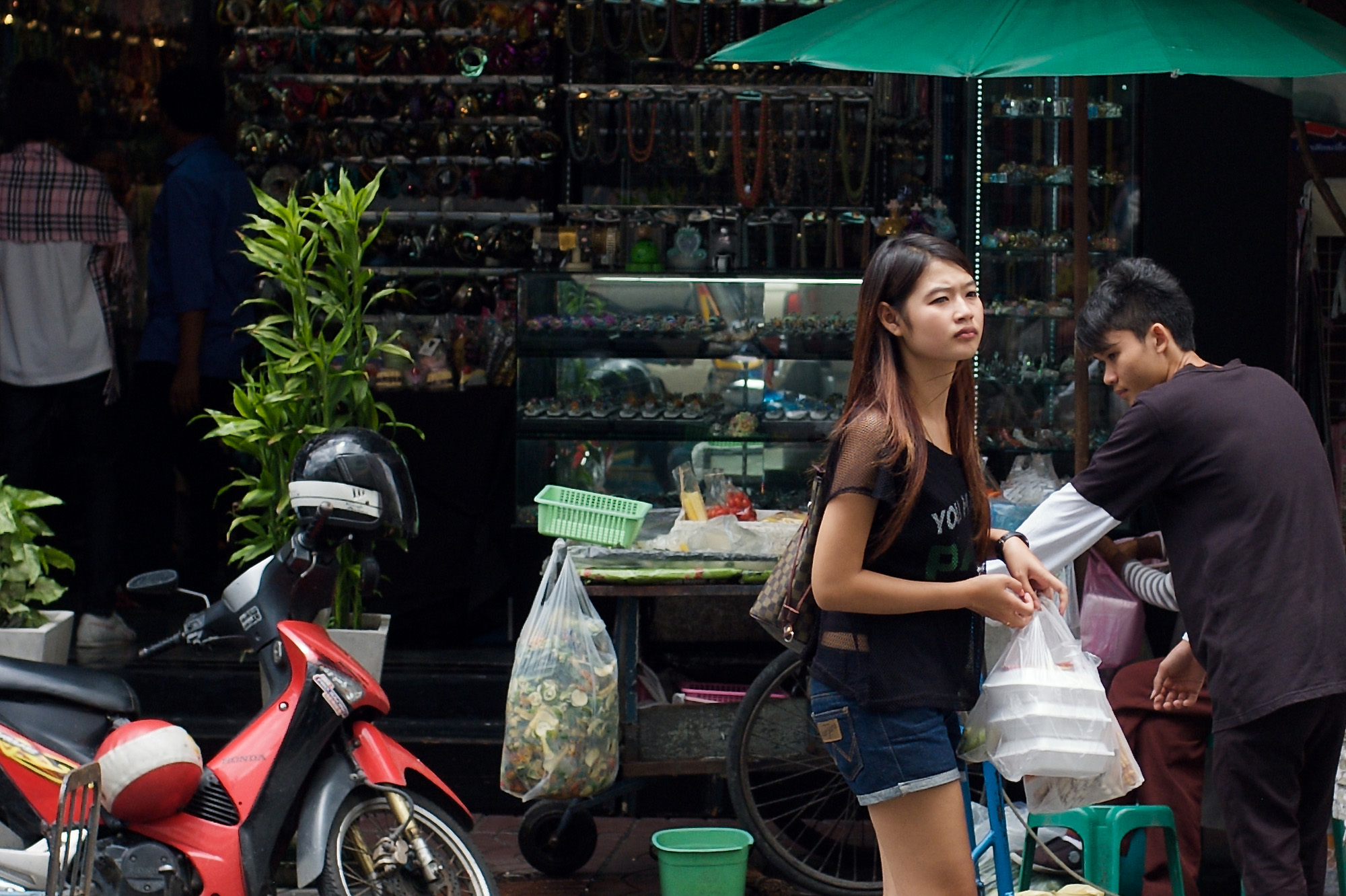
To get the full effect of a fleeting image, either you or the subject needs to be on the move. Here’s an example (below) where the subject — a woman in a black tee-shirt — is walking quickly past a stall, carrying some food in a bag. Has the man behind her smelled the food? Or has he noticed the woman herself? His look is little more than a “half glance” out of the corner of his eye. It’s all over in a split second and you’d never notice it without the help of the camera.

The Moving Photographer
Travelling through the streets of Bangkok by bus and taxi I rarely get an opportunity to take a well composed street photo. The movement of the vehicle tends to overload the senses, snatching away each composition as quickly as it forms.

You need to reduce your speed and cruise along at a snail’s pace — no, that’s too slow — at a pace not much faster than that of a normal pedestrian.

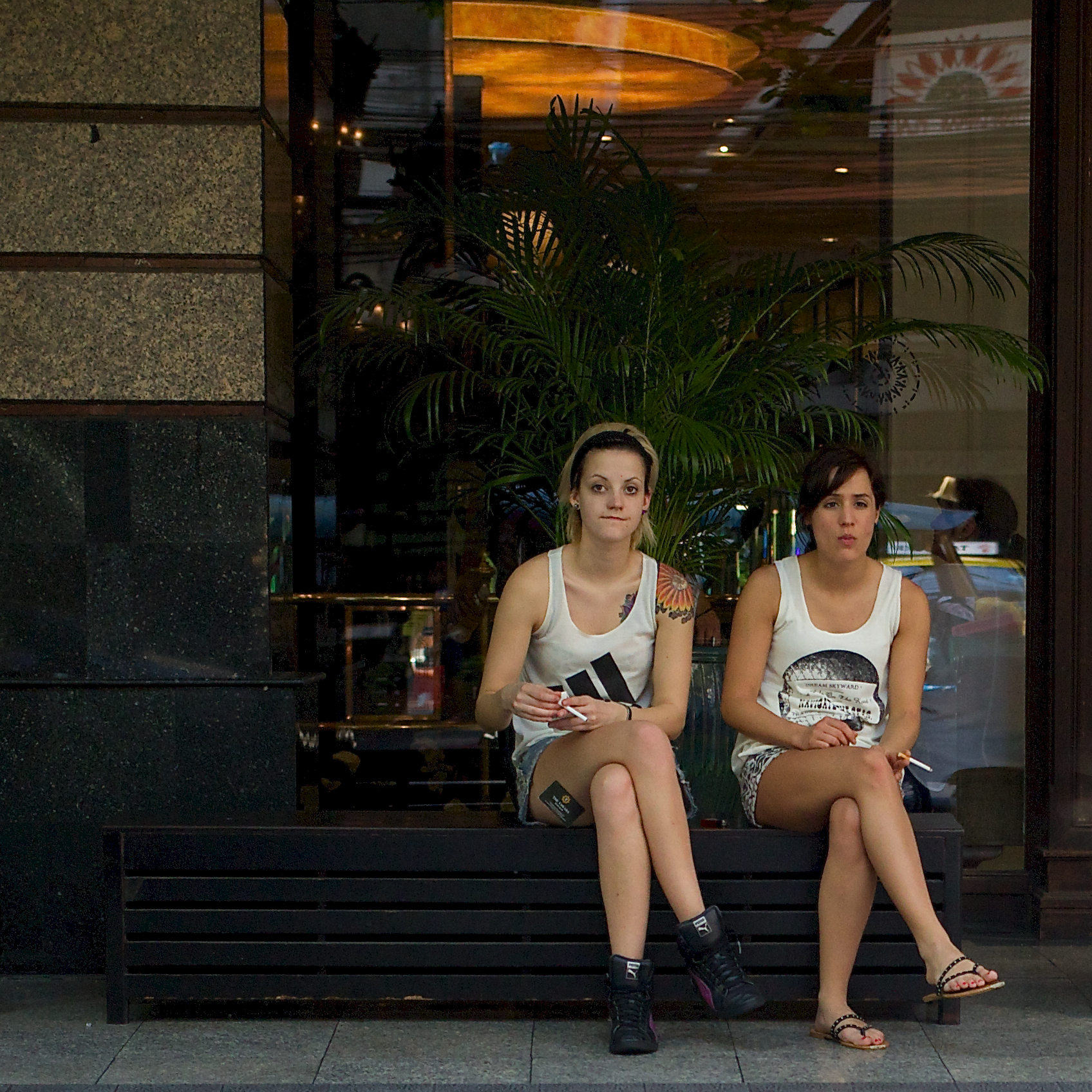
On one occasion I was riding in a “tuk-tuk” (windowless three-wheel taxi) when the driver made a perilous U-turn to avoid queuing in traffic. Before he gathered speed again I took this shot (below) of two women staring blankly into space. The late evening light was poor, but I’d had the forethought to switch to ISO 800 and succeeded in getting a sharp image.

Is it a “fleeting image”? Yes, as far as I’m concerned, because I know the circumstances under which it was taken. It couldn’t have been more fleeting! But I admit it looks almost posed, as if I’d asked the two women to light cigarettes at the same time, and to cross their legs in the same direction.

Yet there’s something odd about the image which lifts it out of the ordinary. The woman on the left — the one with a floral tattoo on her shoulder — has a beer mat stuck to the underside of her bare thigh. I can only guess that it was there on the wooden seat when she sat down a few moments previously. A second or two ago she probably crossed one leg over another and the sensation of the clinging coaster had not yet registered in her brain.

Neither of the two women looks fully awake. They seem hot and tired at the end of the day. There’s no movement, or indeed anything at all dynamic in the photo whatsoever. Yet I still claim it as a “fleeting image.” Had I been standing in front of them, pointing a camera in their direction, I would have awakened their interest. They would have reacted — and their response would have ruined the effect.

If you ask me to describe “the effect,” I’m forced to search for the right words. I can’t find them, except to say: for once I was moving more quickly than the subject and I feel as if I’ve stolen this snapshot in a hit-and-run fashion, before the subject has become aware of it. Just like the beer mat.

Hands Can Walk Away with the Photo

When I was five years old, my parents decided to pay for some professionally taken family photos. We all got dressed up, as though for Sunday church, and I looked like Little Lord Fauntleroy after his return to Dorincourt castle.

The project was a qualified success. There was only one hint of imperfection: I was doing something odd with my hands, crossing my fingers in a peculiar manner. All these years later I distinctly remember what I was thinking at the time. “When I’m grown-up I’ll recall this moment because I’m crossing my fingers.”

Hey, it worked! Maybe even then I understood something about photography. Tiny, off-key details can be the making of a photo, turning it from being a run-of-the-mill picture into something exceptional.

So do I have any shots of people making odd shapes with their fingers? I certainly do.

Dress Shop Duo
The featured shot (above) is one of my personal favourites. I used it as the basis for an art work, bleaching out the colours into two shades of monotone, turning two of them into negatives, and cutting the images into twenty-one segments while retaining the original composition.

The result was “Dress Shop Four,” a set of four, framed, limited edition prints. Alternatively, the original version (the one you see) stands on its own: capturing a moment of boredom in a fashion shop just before closing time.

The two women are engrossed in a discussion about hands. Can it be about a broken finger nail or something more serious? For the onlooker, it doesn’t matter too much. Only the action matters. Every bit of attention is directed towards the hands — not just those of the woman on the right but also those of the other woman who clasps her own hands nervously together.

Because of the contrast in the poses of the women, we’re more inclined to notice the contrast between the left and right sides of the image. On the right, on the customers’ side of the shop, stands a row of impeccably presented carrier bags dressed up with ribbon handles. On the left, in the admin area, are calendars, notepads, phones, memos, handbags, paper clips, payment systems, fax machine, internet router, scissors, glue, calculator, adapter — all on display even though such things are meant to be invisible to the customer.

Indeed, the items probably are invisible to the two women who don’t notice them because they’re such familiar objects. Yet everything else in the store is squared away, with “storage” being the theme of the design. The multiple drawers and closed suitcases are just an intregral part of the designer’s concept, not something to be appied in any practical sense. After all, three of the drawers at the top left are placed on their side so that any contents — if they had contents — would fall out.

I’m beginning to think the shop is a brilliant work of art in its own right. Perhaps the knick-knacks in the office area have been placed there deliberately to show the workings of the business — rather like the inside-out architecture of the Lloyds building in London.

The Smokers
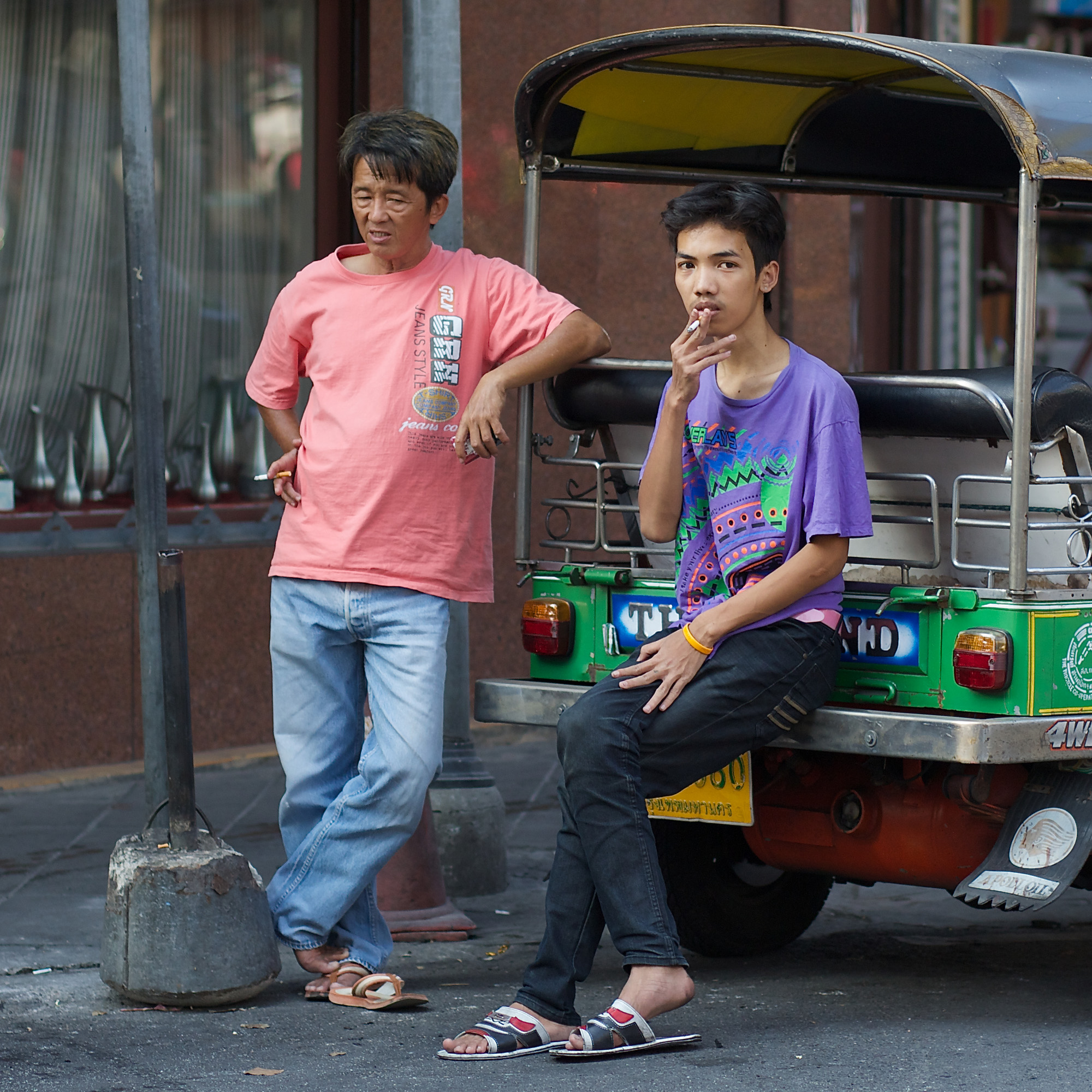
Out on the street, I found two men lighting up cigarettes. They’re as far from the world of fashion as you can get, but, like the two women, they’ve assumed poses that direct attention to their hands rather than their clothes.

The man sitting down on the right is about to draw deeply on his cigarette and I’ve caught his elegant gesture mid-movement. It would have made a good advertising shot, thirty years ago. As it is, the young smoker disrupts the photo — just as I did as a boy — by splaying the fingers of his other hand. Meanwhile, the older man looks tired and removes one foot from his sandal to stretch his toes.

I was fortunate that the colours of the tee-shirts harmonised with each other and with the green of the tuk-tuk. Nearly everything else in the image is fairly neutral — including the row of curious vases in the window on the left. The heavy concrete base of a sign that’s long since disappeared anchors the image, giving it stability. Converging verticals, for once, are not a distortion of the lens — but there in reality — and they echo the angles of the men’s legs which form a triangle at the bottom of the image.

Too much analysis? Probably, but I had to explore why I find the image satisfying.

On the other hand, maybe it holds my attention because I was once a heavy smoker myself. You can never really kick the habit entirely.

Window Shopping for Street Photos

Sometimes I like to go window shopping for street photos. Well, why not? If I see a shop window with a particularly intriguing display I like to match it with a real-life subject of equivalent interest.

I need hardly add that this technique works a lot better in London than it does in Bangkok: the two cities where I take most of my pictures. London teems with glass fronted shops, their windows packed with the latest fashions, from elegant to quirky. Bangkok, on the other hand, is a city of malls; its street shops tend to be open at the front, with all the goods further inside.

If you’re a street photographer you can’t really ignore shops altogether — they’re too ubiquitous — so you’d better make the best of them. The potential variations on “person walking past” or “person standing in front of” (the shop) are pretty much endless.

For example, you can have people arguing in front of, canoodling in front of, reading, stretching, yawning, crying (and doing all those things that people normally do elsewhere) in front of the shop.

They could be going into a shop or coming out of it or simply lingering inconveniently in the doorway, much to the annoyance of everyone else. I very much like the idea that life carries on, despite the attempt of shops to persuade us that theirs is the only show in town.

The Good and the Bad
For the street photographer, shop windows have both good points and bad. In their favour is the fact that they’ve mostly been put together by a professional window dresser with a good sense of colour and design. They’re sometimes stunning, often original, and nearly always visually striking in one way or another.

The only big disadvantage of using shop window displays in street photography (apart from them becoming a cliché) is that they tend to be about two feet higher than the sidewalk. The effect is to give all the mannequins a godlike appearance, so that anyone browsing the display will see a race of superbeings, unwilling to stand alongside the common crowd.

Disassembled Mannequins
In one photo (my featured image, above) I’ve solved the problem by selecting a display which has yet to be installed. I loved the way the disassembled mannequins had been arranged — one torso revealing an unusual shade of grey.

I’d noticed the two pedestrians a minute or so previously and saw them approaching the window. Getting a shot without them looking directly at me — yet turning their heads in my direction — was possible because they’d emerged from the other side of a parked van. It was natural for them to look around it, but hard to see anything specific in the first split second. As you can see: you need several strategies to work in your favour if want to get a satisfying shot.

In the above photo, the pedestrians appear to be higher (and hence more prominent) than the figures in the window. There’s also an absence of colour, except in skin tones and from the warm light at the back of the window. The stonework is not entirely neutral and for once looks less severe than it normally does in photos.

The Avoidance of Cliché
As I say, it’s vital to avoid cliché when you combine real people with shop windows. If you can’t avoid it altogether — because “shop window + real people” is itself a cliché — you need to find an original variation.

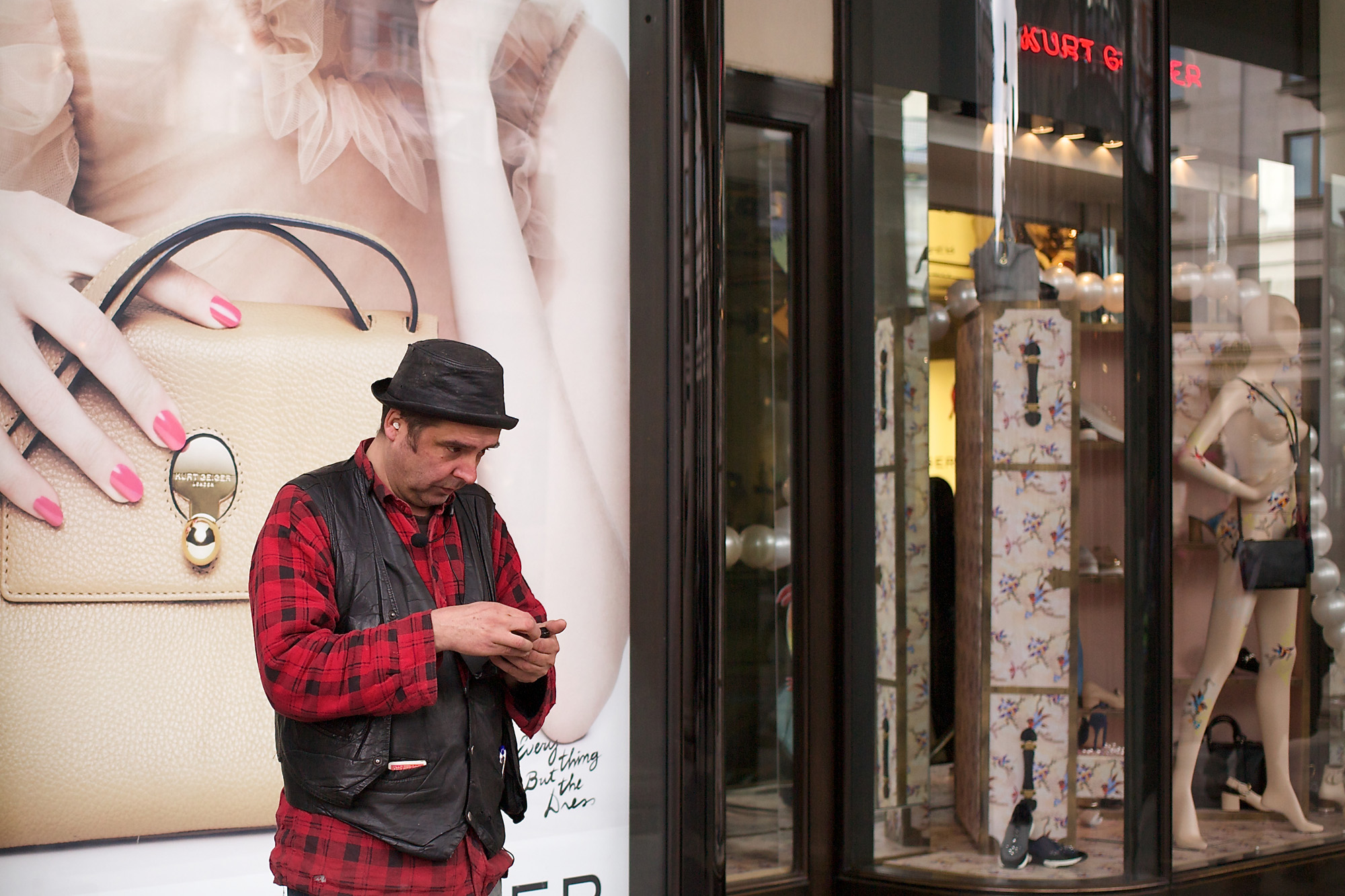
I think I’ve done this in the next photo (below), partly because the man is himself highly individual: leather hat, matching leather waistcoat, chewing gum in one ear (or is that a hearing aid?). However, what makes it slightly out-of-the-ordinary is the fact that he’s not looking at his phone (if that is indeed what he’s holding) but at something else, out of frame.

In both of these pictures the subjects are looking beyond the frame, having spotted something of interest in the wider world.

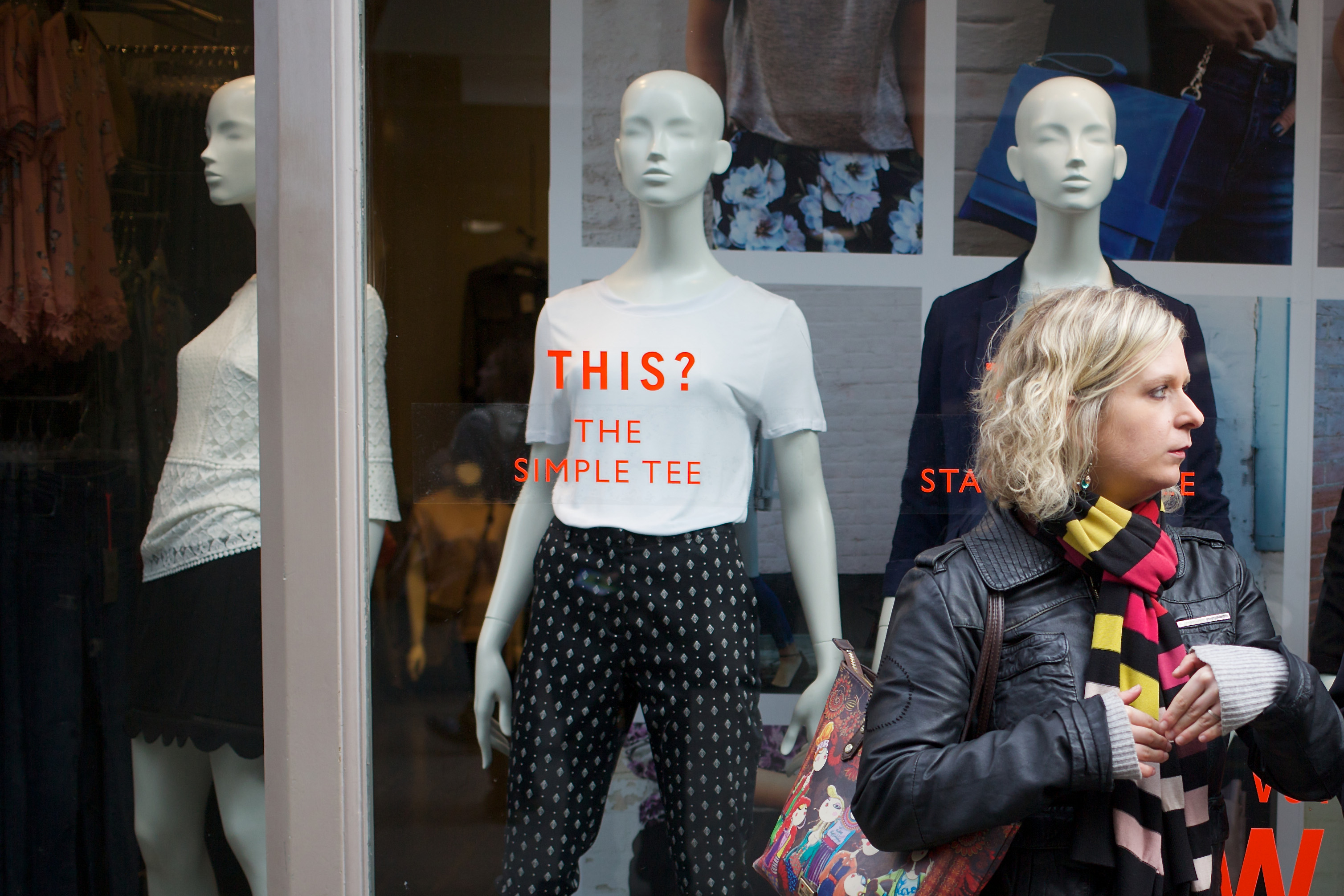
I often like to show people gazing, staring into the distance, or simply looking at something other than what I’m looking at (i.e., them). The same is true in the next picture (below), where I’ve tried to make good use of the greater elevation of the sightless mannequins, their non-existent eyes contrasting with the intent gaze of the real woman standing in front of them.

Here I’m drawing attention to the difference between the idealised world of visionary ideas (our many possible futures) and the individualised reality of the human race (our “here and now”). The mannequins are like a race apart, with their distended necks and identical faces. Amazingly confident in their stance they seem to herald the future: robotics, androids, artificial intelligence.

“But no” — the real woman appears to be saying — “the future really belongs to me.”

I hope she’s right.

What’s at the Centre of Your Street Photo?

When a street photo has a central core, you can take liberties with the rest of the composition. A central core establishes a pivot point around which other elements can dance.

Can you make a great composition without such a pivotal object? Yes, of course, but it certainly makes life easier.

I’ve spent more time than I care to calculate on thinking about composition and what looks right and what looks wrong. I don’t expect everyone — or indeed anyone — to agree with me, but I can honestly say I’ve explored thousands of possibilities.

My conclusion is: the central core is the one element that’s most likely to give the onlooker a sense of rightness, even when there’s a jumble of other shapes and colours around it.

Returning from a recent trip to London I discovered that a high percentage of my photos had an “object of interest” right in the centre — or at least somewhere along the vertical line that divides the image into two halves.

Big Earring
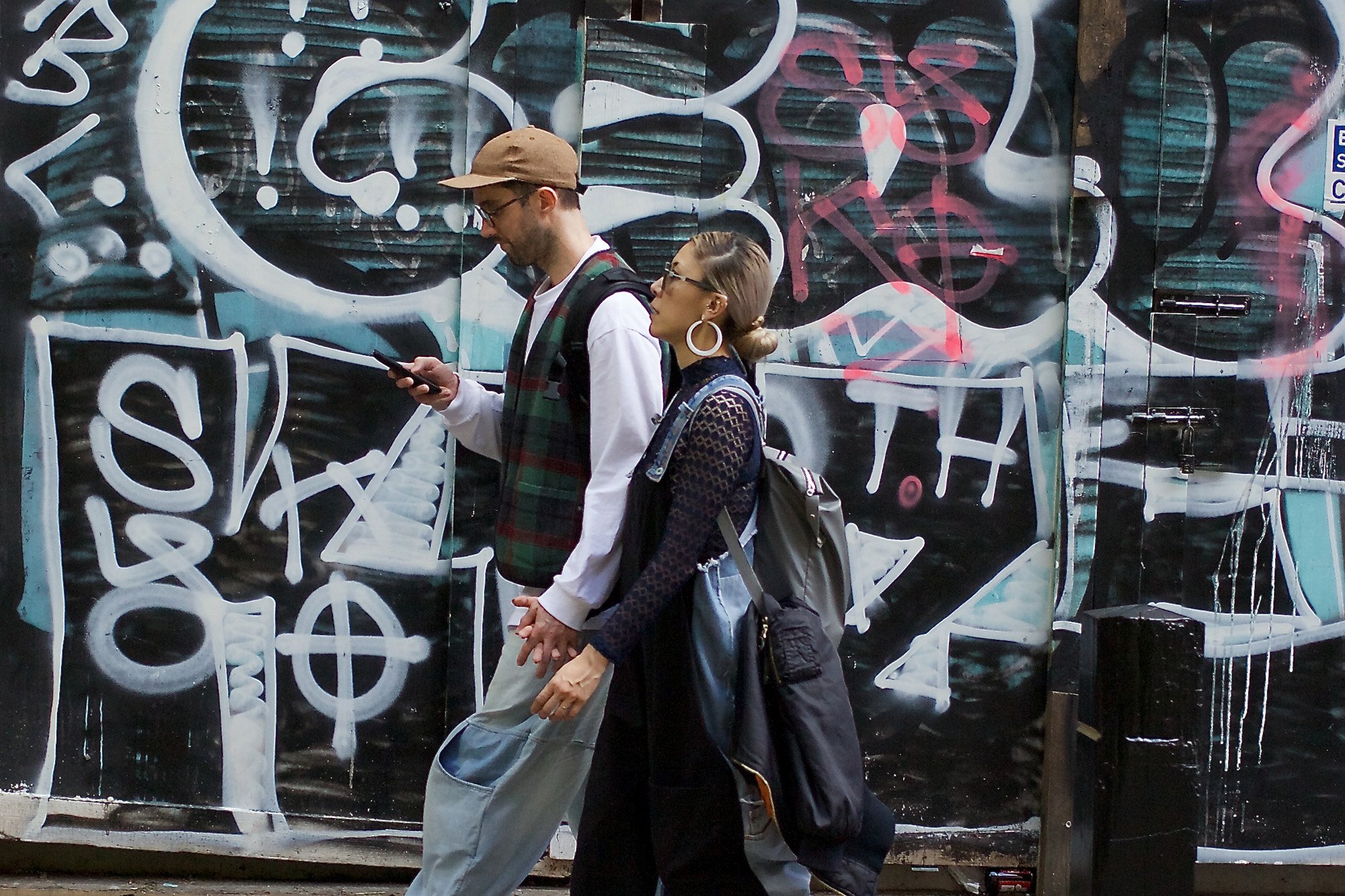
Take the featured image (above), for example. The object of interest is the woman’s large, circular earring which catches the light and seems to echo the swirls of the graffiti wall in the background. In fact, it’s this correspondence between the two that pulls the image together and makes it worth showing, despite the somewhat hackneyed concept of “people walking past graffiti.”

The earring is not dead centre, either vertically or horizontally, but it’s close enough to become the pivot of the composition. I’ve deliberately placed it slightly to the right because the two people are walking from right to left. The eye anticipates their direction of travel and compensates for the offset.

Now I need a good excuse for not having the earring exactly halfway up the picture. This is an entirely different issue. This object looks better above the central point rather than below it because the main subjects are people. When you include an entire, upright, human figure in the image, the onlooker’s attention has a bias towards the head (in the absence of interest lower down). We expect the head to be in the upper half of the picture.

Incidentally, the two subjects in question seem to form a pyramid shape, with their elaborate backpacks and floppy trousers. This is all to the good because the pyramid points to the earring (and the woman’s eye-catching hairstyle).

Rainy Colour
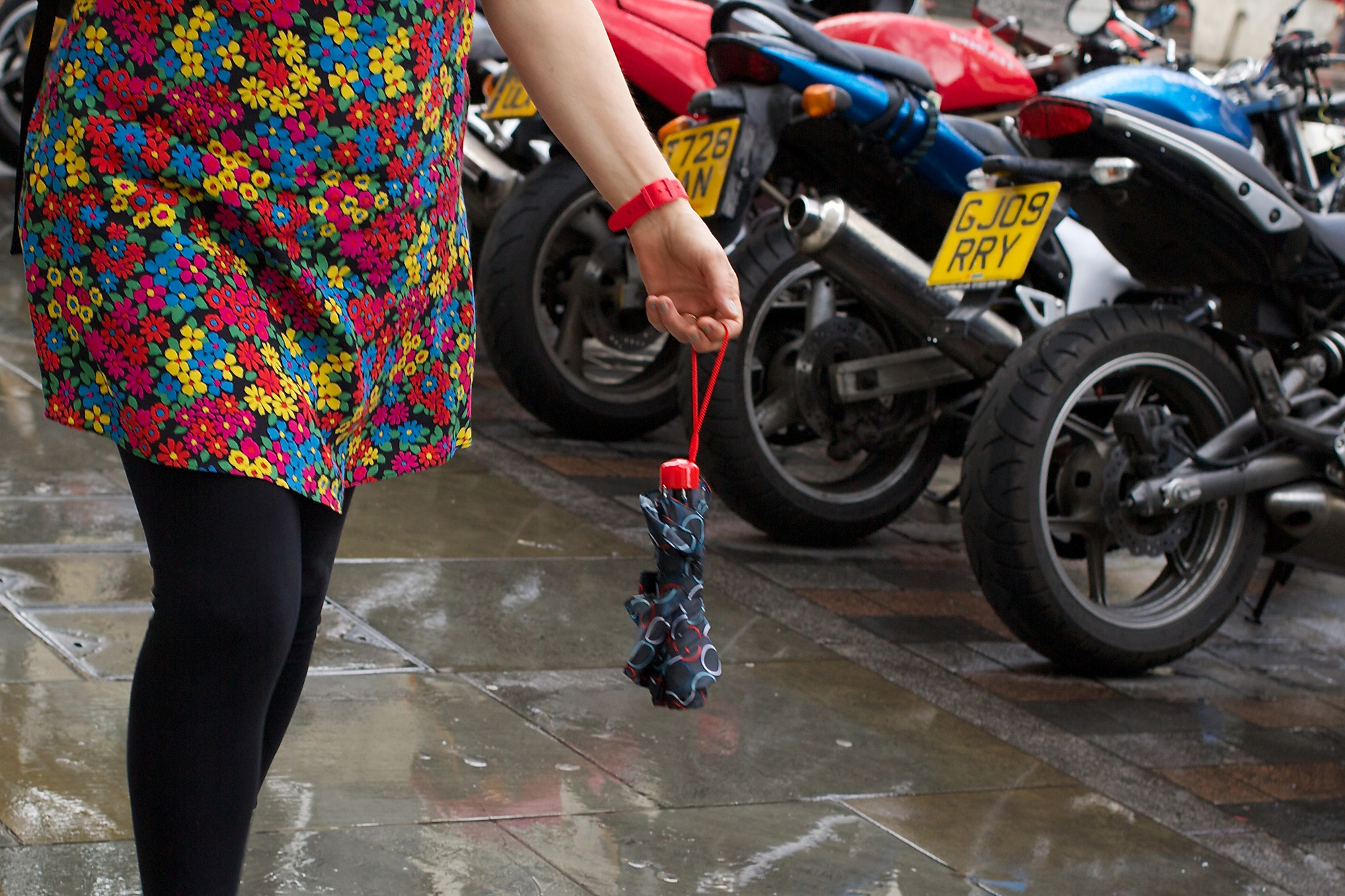
Shortly before the day brightened up and enabled me to take the above image, there was a rainstorm which flooded the streets and attracted my attention to the pavement. A woman in a vivid dress walked towards me, carrying a red-handled umbrella (below). Her dress in primary colours matched the colours of the motorcycles in the background. I picked up focus from the pavement and hoped for the best.

The shutter speed of 1/500th sec. has not quite frozen the swinging umbrella, but at least some of the subject’s hand is in sharp focus. Fortunately, the red wristwatch goes perfectly with the colour scheme. The reflected hues from the rainy pavement create a mood of “the storm is over, there’s a bright day ahead.”

And so it proved. For much of the day I had to cope with sunlight washing out the highlights while condemning everything else to deep shade. It’s not my favourite set of conditions, but I tried to find strategies to cope with them.

Where’s the Drama?
Central to my coping strategy was to focus on figures or objects in sunlight against a dark background. After all, if you can’t beat the conditions you have to join them: try to enjoy the high contrast and seek out dramatic subjects to make use of it.

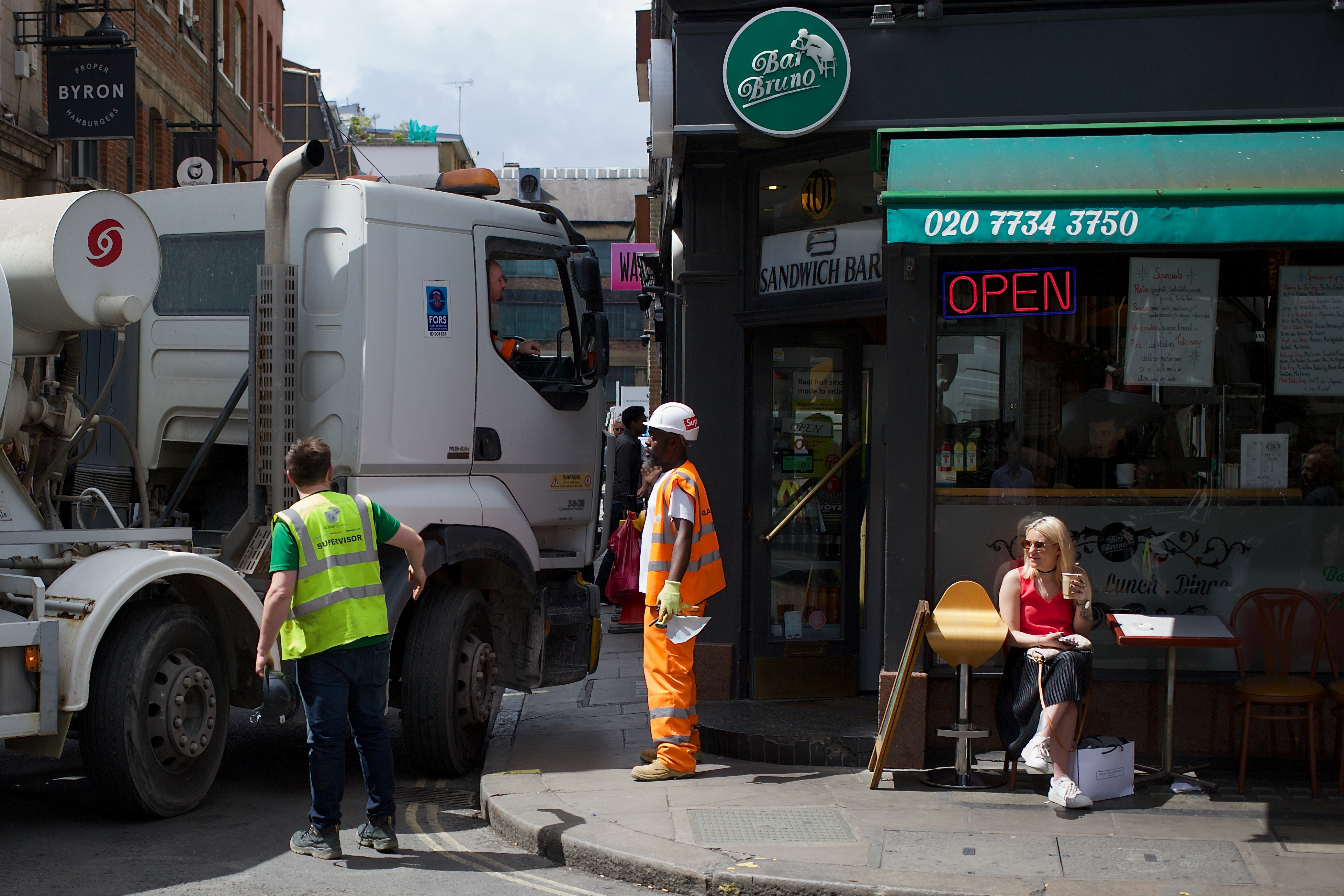
In Soho I headed towards an area where several lorries were delivering liquid concrete (below). If I could play you the soundtrack to this image you’d be amazed. It’s completely at odds with the calm, orderliness of the composition! Two or three men were yelling instructions at the tops of their voices as the driver revved his engine and reversed his truck towards some expensive limousines with only inches to spare.

I took a dozen pictures — “working the scene,” as they say. I’m glad I did because only two of them had decent composition: one of a fashionably dressed passer-by and this one with the woman who seems to be enjoying a quiet cup of coffee despite the cacophony going on around her.

OK, you can argue about its merits, but I think it works because of the central figure: the man in the white helmet. Everything in front of him (to our left) is work, movement and action, whereas everything behind him (our right) is a world of leisure, stillness and relaxation. He stands between these two worlds, dressed in tough, working gear but assuming a calm, unflustered attitude — as if he were a guardian angel to the woman at the table.

Going to Extremes
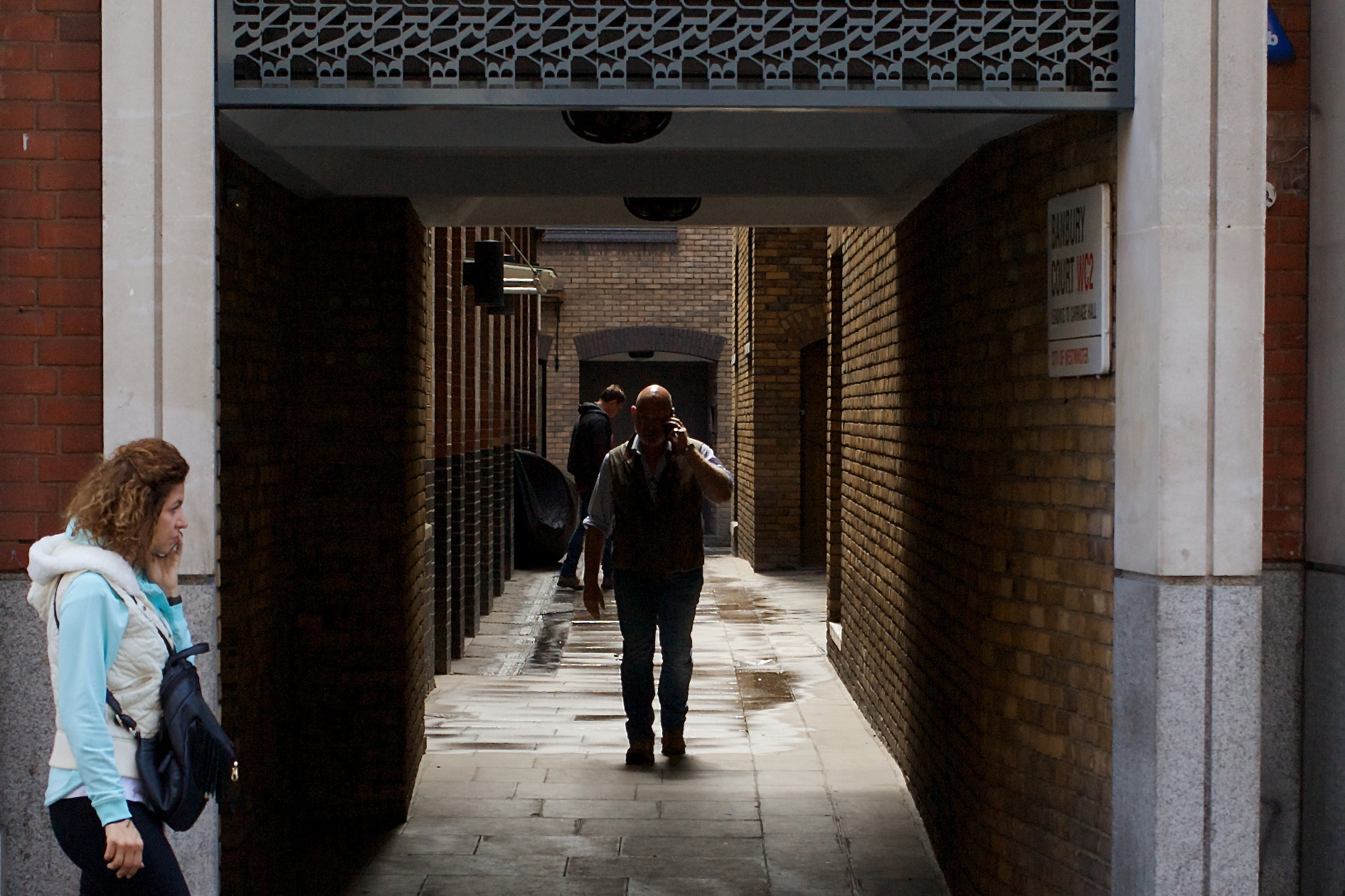
Here’s another example, from earlier in the day (below). I’m know I’m pushing my luck with this one. There’s a woman in the foreground on the extreme left of the image and very little to balance the composition on the right. Yet I insist it works, chiefly because of the strength of the mysterious central figure.

I spotted the man coming towards me from the other side of a busy street. There was no time to lose. I got as close as I dared and took the shot before he moved into the dark passageway.

Now here’s the trick. The woman’s profile is set against the narrow pillar on the left. I delayed the shot a fraction to make sure this would happen. As luck would have it, the angle of view makes the pillar on the right look wider (we’re seeing two sides of it instead of one). As a result, it helps to balance the picture without destroying its disturbing quality.

So there we have four, very different compositions, each with its own feeling and atmosphere. Yet all four pictures have a central core that holds them together. It’s a technique anyone can use. I thoroughly recommend it.

They’re Dancing in the Streets

On blistering hot days, American city kids like to cool off by opening up the fire hydrants and dancing in and out of the water jets. Songwriter William “Mickey” Stevenson saw them doing this one summer in Detroit. It gave him the idea for the song: “Dancing In The Street.”

The song (written in conjunction with Marvin Gaye and Ivy Jo Hunter) became a classic right from the start when Martha and the Vandellas recorded it in 1964. Since then, many more have covered it: notably the Mamas & the Papas, Van Halen, The Everly Brothers, Grateful Dead, Black Oak Arkansas, The Kinks, and, in an improbable double-act, David Bowie and Mick Jagger. It’s been a hit nearly every time.

So what’s makes the song so popular? Is it the words, the music or the subject? I think it’s all three, but the subject should take most of the credit.

Think about it: what could be more cool? The song was inspired by underprivileged city kids doing something harmless and joyful but nonetheless rebellious and illegal, literally keeping cool as well as being cool. Now, on hearing the song, the posh kids in the suburbs — playing in their parents’ swimming pools — want to do the same. They want to dance in the street.

Great Subject, Whenever
Whenever it happens, dancing in the street is a great subject for the street photographer. Normally a place of trade, passage, or quiet reflection, the street comes alive when people start dancing in it. For this to occur, some degree of organisation is necessary, as only rarely do people dance spontaneously in places where no one else is even thinking about it.

Dancing and photo ops come thick and fast at street parties, carnivals, and public holidays like Thailand’s Song Kran, or “water throwing” festival. Because water splashing seems to provoke people into dancing, maybe city planners should provide fountains designed specifically for this purpose. The ones we get (at places like Somerset House in London) seem to be purely decorative.

Organised Dancing
A photograph of organised dancing can never be a fully fledged street photo, no matter where you take it. For that, you need to find a spontaneous outbreak of dancing, which certainly happens now and again, although I’ve not yet found anyone who’s chosen to dance in front of an uncluttered background.

However, there’s one big advantage of an organised event: people expect you to take photographs, so you can bring out your biggest and best lens, such as a heavy zoom. On these occasions, zooms can be ideal, even essential. And unlike attending an indoor performance in a theatre, you can walk around the subject and find the best composition.

My featured image (above) is a shot I took when a salsa dancing club held a session in our local park. I was expecting to get at least a dozen good shots, but the subject proved to be more difficult than I anticipated, despite the advantages I’ve mentioned.

Why? Because many of the dancers were beginners, the background was cluttered, and the light was too strong. However, two of the dancers were terrific — and seemed to retain the spontaneity which is so easily lost when performers are trying to impress an audience. I hope my picture caught some of their grace and informality.

In Costume, Too
A performance by some costumed dancers at another local event (below) was more formal — but the setting made up for it by being overwhelmingly urban. Does this bring it closer to being a street photo, in spite of the fancy dress? I don’t think it does, but the town’s name, writ large, leaves no doubt about the location.

As far as I’m concerned, I don’t care if the dancing is organised (as above) or disorganised (as below), if someone’s dancing in the street I’ll take their picture.

“Callin’ out around the world,
Are you ready for a brand new beat?
Summer’s here and the time is right
For dancin’ in the street.”

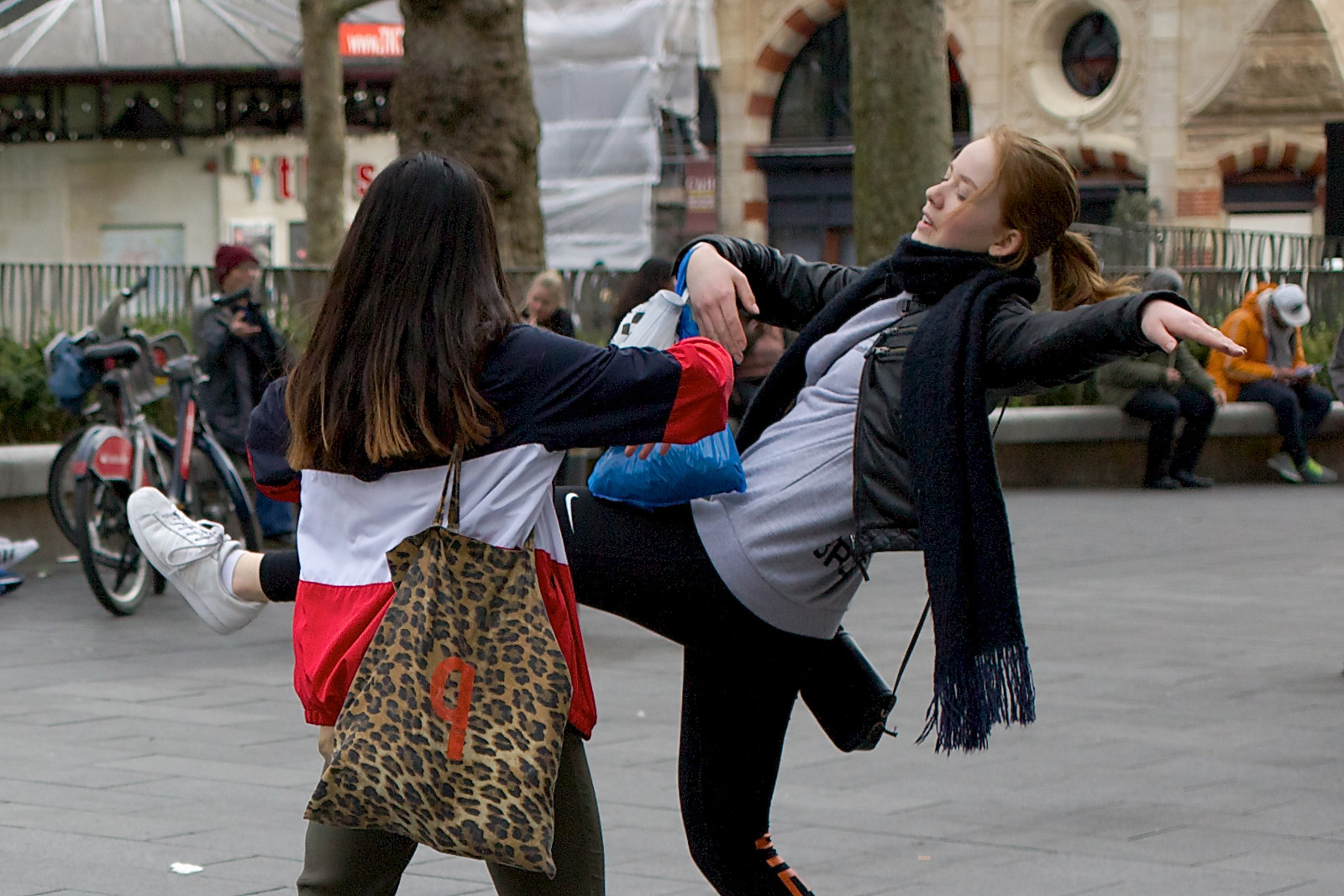
(They were still doing it in February, in London’s Leicester Square, below).

Celebrating the Ordinary

Is anything ordinary? Sometimes I look at the world and everything seems in some way exceptional or out-of-the-ordinary. I once looked at the large black telephone on my desk at work and felt as though I were seeing it for the first time, even though I’d used it every day for a year.

Seeing the world afresh every time you go out to take street photos would be a useful knack, but it’s not easy to turn on and off at will. You need to wake up to a higher level of awareness — but not too high, otherwise you’ll start revelling in the sensation rather than taking pictures of what you see.

Elsewhere, I’ve suggested “limbering up” by taking a few shots almost at random, just to get in the mood. All you need is one lucky hit to place yourself in the right mental zone. Once there you’ll begin to see where the world deviates from the ordinary, where people and their surroundings become elevated to a plane of existence higher than you’d previously noticed.

I think it’s essential to “see” the image in reality rather than shoot first and hope something in the frame meets the criteria you’ve established. Some street photographers shoot and hope for the best, but I’m sure their hit rate is very low.

In the Mood
Of course, once you get into a mood where everything looks extraordinary, your rate of success should go through the roof. Every frame should be a winner! You may begin to wonder what’s happened, but the world has not changed. You’ve changed. You’ve begun to see the city with the clarity it deserves.

For example, have you noticed how adjoining buildings can be almost ludicrously different from each other, yet form a harmonious whole?

I shot my featured image (above) in London after a couple of hours shooting. By this time I was seeing shots I would never have attempted earlier in the day. I waited no longer than a minute or so for two dissimilar passers-by to cross at the intersection of the buildings. In the event I was obliged to settle for two blonde women, who, fortunately, differed in their style of dress while sharing two or three colours in common.

Does Anything Go?
If it were possible to “celebrate the ordinary” without really seeing it for what is — which is often extraordinary — then the street photographer could photograph anything and claim it as a celebration. That doesn’t work. A picture really needs to have some information within it that says: this is why you should look at me.

Take individual people, for example. Most people are not exceptionally good looking or physically imposing. If photographers limit themselves to beautiful subjects they’re presenting an overall picture of the world that’s fundamentally untrue. I think this is a serious problem with any personal style which cannot embrace all-comers. The same applies when you photograph the grotesque and neglect the beautiful. The world is neither one nor the other. It’s a mixture of opposites and everything in between.

Before the Parade
Sometimes I see ordinary people in circumstances that reveal their beauty, character, or a barely definable quality such as inner strength. It usually occurs during a pause in some action, perhaps in anticipation of a forthcoming event.

Here’s an example (above). I took the following image during the build-up to a Chinese street festival in the old quarter of Phuket Town in Thailand. I think these young women had been given certain duties — and were certainly not among the celebrants, as such. It was a blistering hot day and beads of sweat are visible when you view the photo at full size. Something, clearly, is about to happen.

I remember taking this image and when I look at it today I can recall my heightened awareness of the moment. I can remember noticing the matching colours of the jacket and the hanging fronds, the dark background (obviously) and the contrasting brightness of the women’s tunics.

But it’s the woman’s distant glance which makes the picture — and I’ll like to say I remember seeing that, too. If I did, I think I felt it rather than saw it. Sometimes there’s just too much going on in the ordinary life of the street to appreciate it all.