Off the Street and Into the Art School

If you walk along the street outside the Poh-Chang Academy of Art in central Bangkok you’ll see a fantastic jungle of half-completed sculptures left behind by former students. Look further and you’ll catch sight of the new intake, feverishly producing work for their diploma. Even a single glance makes you want to go inside and explore the whole building.

I’m fortunate to get privileged access because my partner attended Poh-Chang and together we walk through the studios and take candid photos of the artists in action. From the inside I can look back towards the street and see the artworks up close.

Artworks near the street

I love art schools although my own experience of one, immediately following university, was unusual, to say the least. I became caught up in student demonstrations — in fact, a full scale “sit-in” that lasted until the summer vacation, at which point the authorities took a dozen of us, including me, to the High Court for trespass. (The judge let us off).

Mightier Than the Sword
In Bangkok, by contrast, art students usually get on quietly with their work. It’s their counterparts at other institutions who demonstrate against whatever political party currently holds power. At Poh-Chang, there’s a sense that the brush, the chisel and the welding machine can all be mightier than the sword.

Students can choose traditional or modern art, the traditionalists working on Buddhist themes — sometimes adding to the vocabulary of designs, but keeping, for the most part, to the tried and tested ones. This sculptor (below) appears to have branched out into Christianity, with a Madonna and Child.
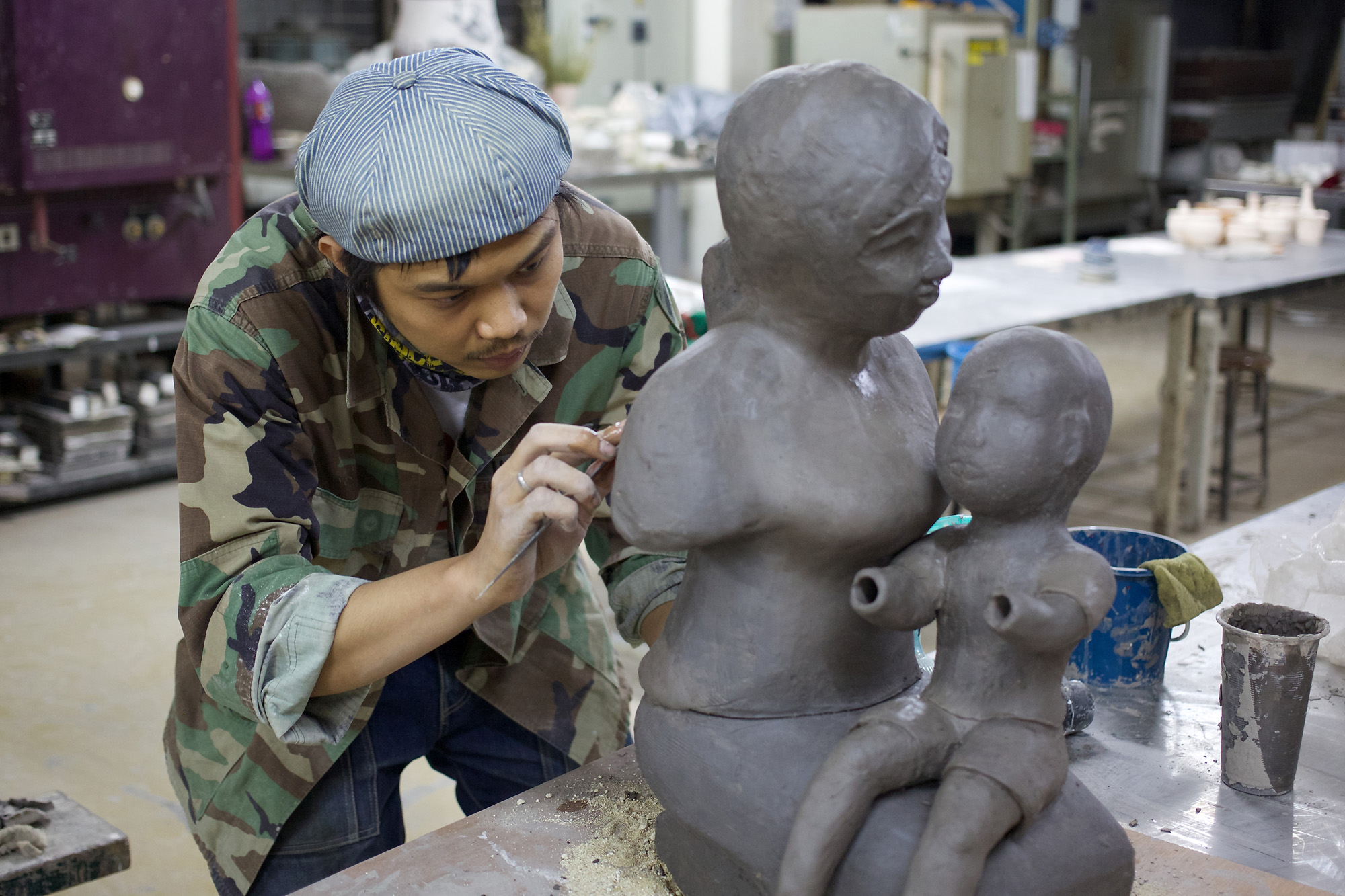
Madonna and Child

On one visit (I’ve been a few times) I came across a teacher working on a mask. I’m sure his skill will be transferred to future generations, whatever direction the modernists take.

teacher with mask

Angst, Guns and Nails
Poh-Chang’s faculty of modern sculpture tends to be more photogenic — and terrifying — with themes of death, destruction, and violence. Everywhere there’s a pervasive sense of angst and lots of guns, barbed wire and nails.
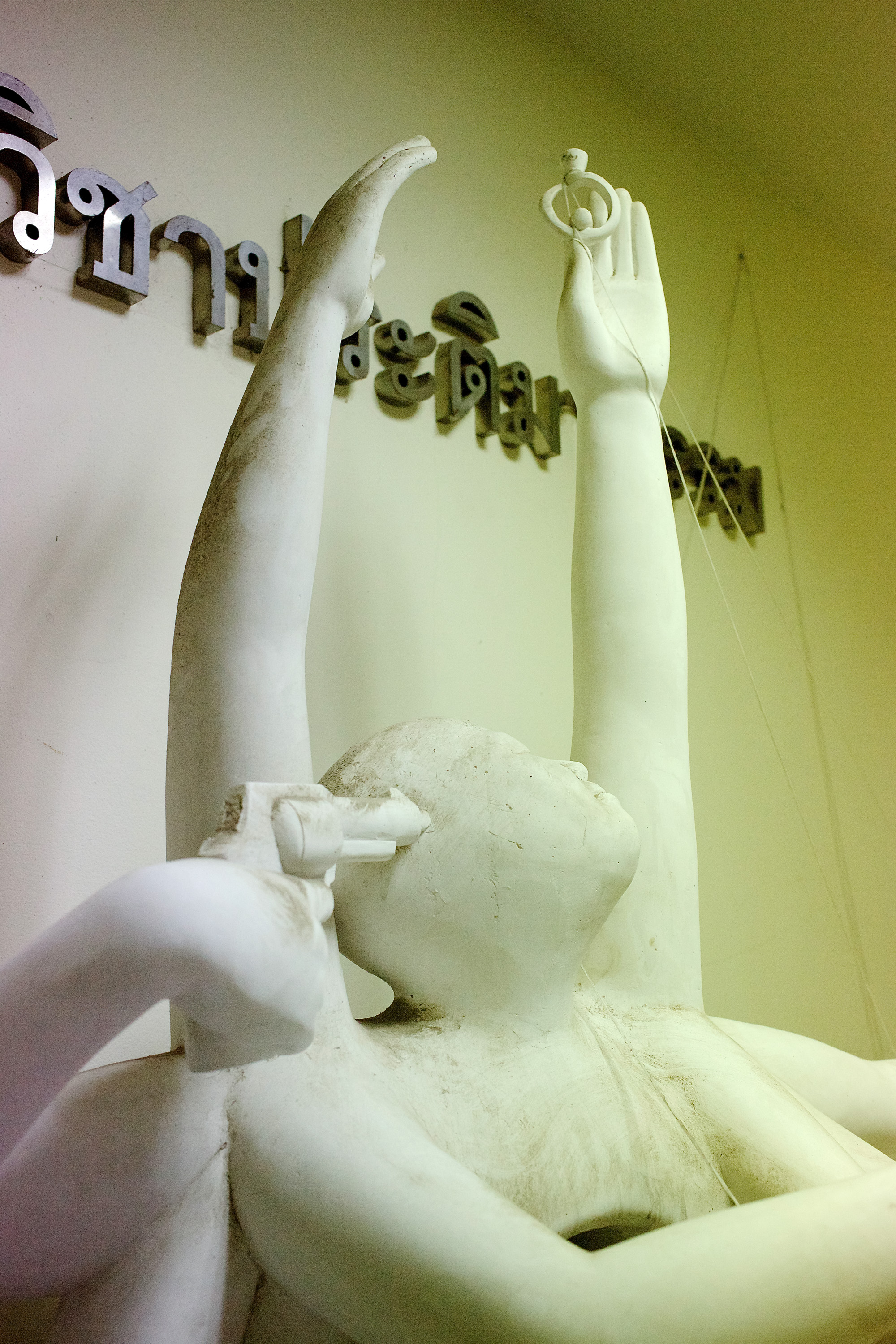
Sculpture with raised hands

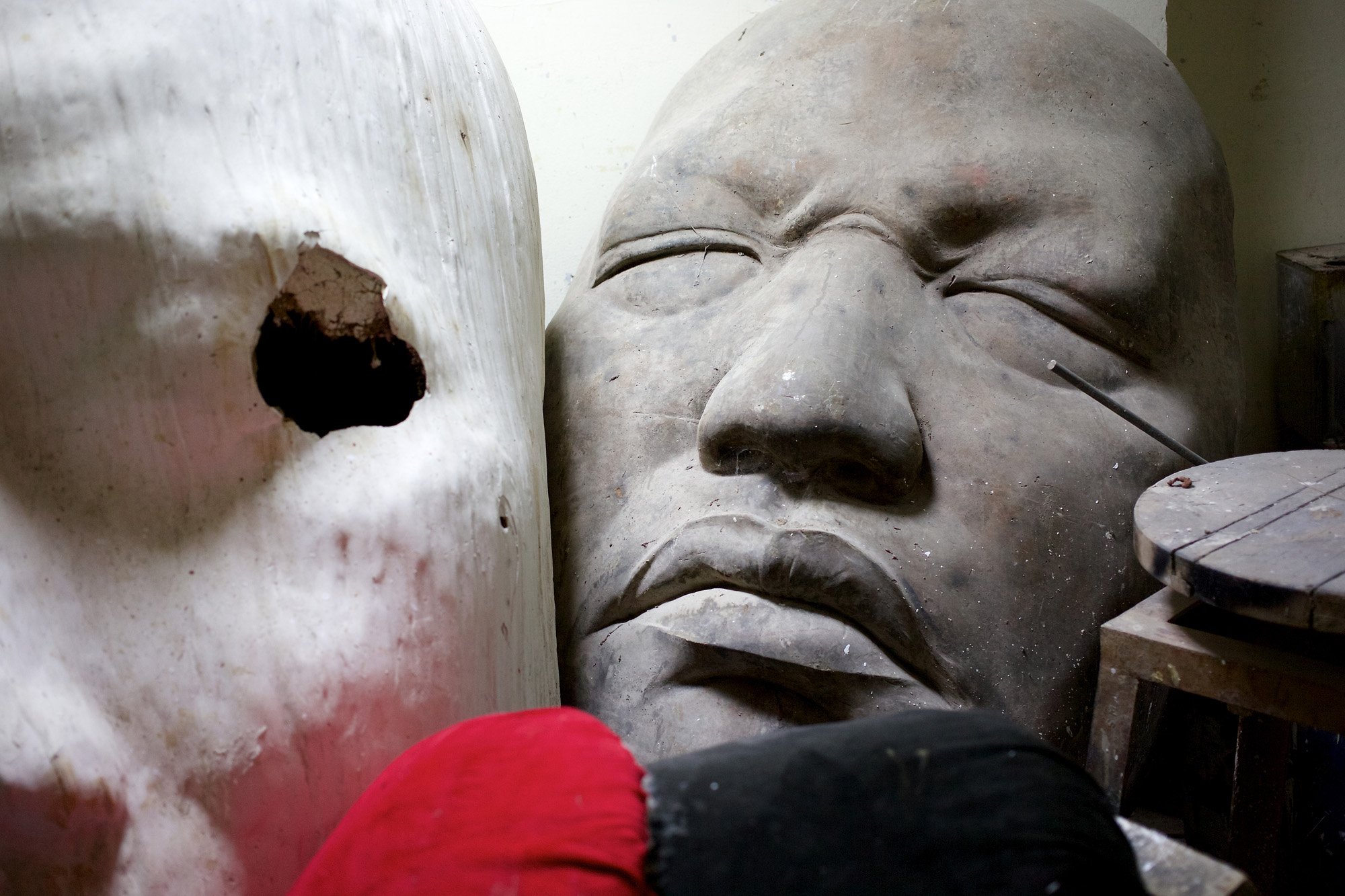
In my featured image (at the top of the post) the traditional and modern have collided to produce a gigantic head, now spattered with paint, and lying, neglected, at the end of a corridor.

I like this image. I ran it through the Everypixel neural network (which automatically evaluates the aesthetic quality of photos for the benefit of editors who need to sift through piles of dross) and was rewarded with a high score (below). I guessed it would trigger the sweet spots of a neural net!

Everypixel score

At Poh-Chang I was struck by the work of one artist (below) who seemed to be aware that I was taking pictures. Without any overt communication passing between us, he took up various poses while appearing to be lost in thought.
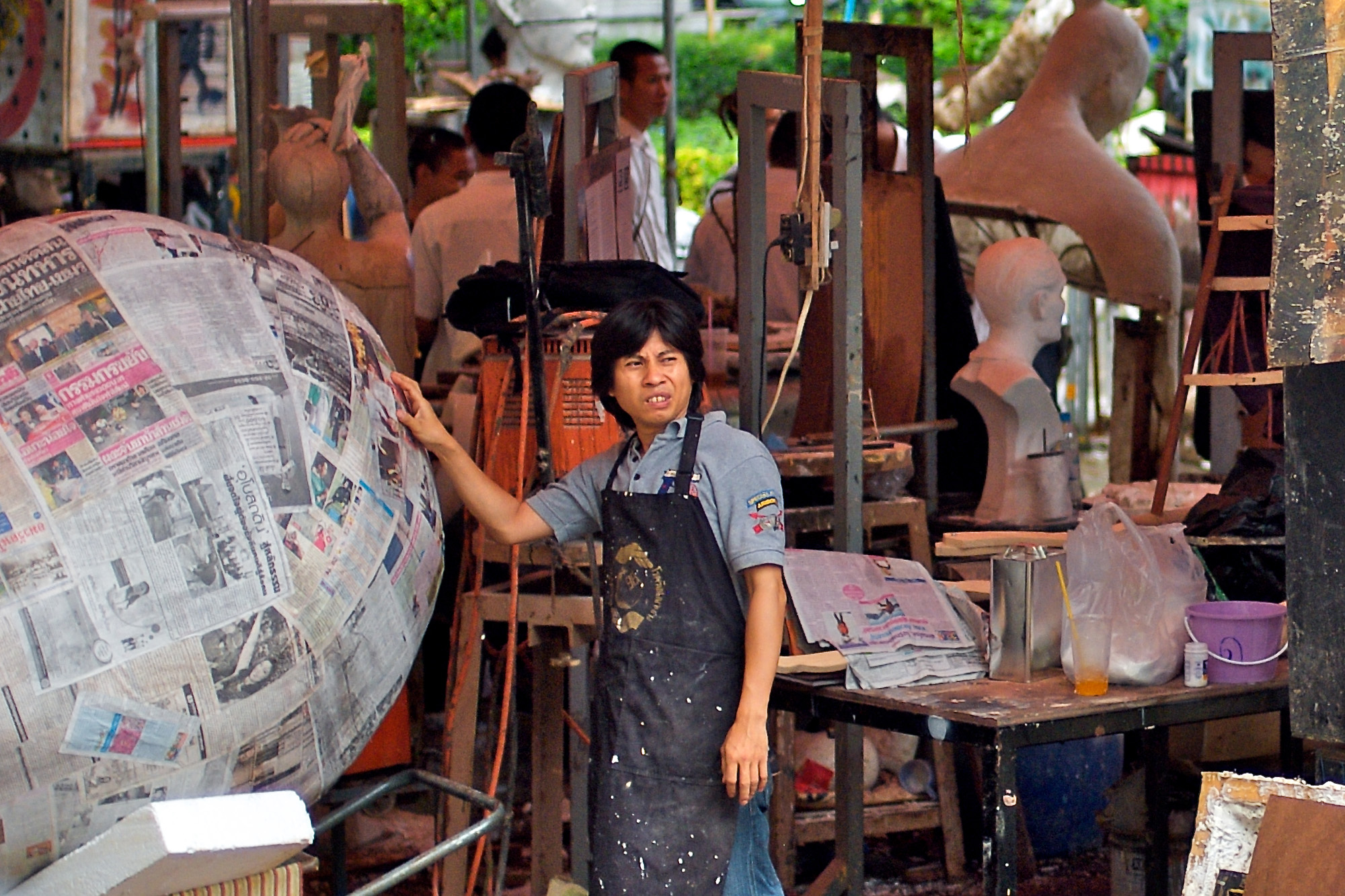
Sculptor with globe

It was perfect. To this day I don’t know whether he was posing for the camera or not. Because of this uncertainty the encounter yielded just the kind of ambiguous images I like to make.
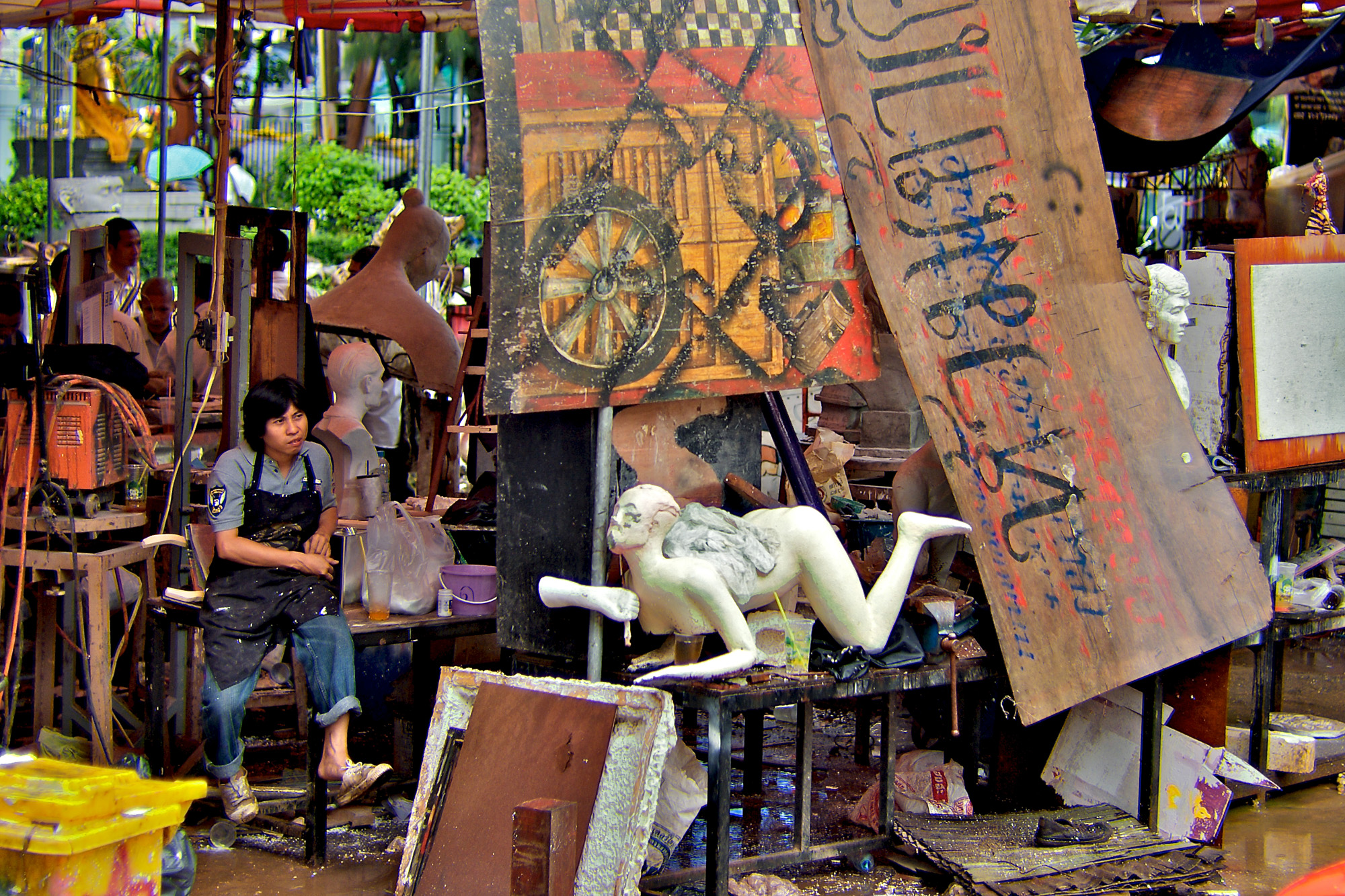
Horror sculpture, with creator

Art Is Everywhere
In Thailand, artistic expression can be seen everywhere: along the roadside, in stores and in people’s homes. Sometimes it may just be an old beer can, like this one hanging in a garden. I love it for its unassuming simplicity. It may not be as fancy as the elaborate tin sculptures you can buy in London’s Camden Market, but it demonstrates the maker’s ingenuity and genuine aesthetic sense. I admit it needs dusting.

Beer Can ornament

You don’t have to visit an art school to find art. In fact, you can sometimes find exactly the same scene — in better light — outside on the street.

Here’s an example (below). This lady was squatting on her doorstep, just yards from my partner’s family home in Ekkamai, painting a mask not dissimilar to the one being produced by the teacher at Poh-Chang.

woman painting mask

Back at Poh-Chang itself, the modern sculpture department is in full swing, erecting a roomful of free-standing figures, each one supported by an uncomfortable-looking wooden insert. A skeleton, missing a shin-bone, dangles from a hook in the middle of the room — presumably to remind students of the internal structure (or the mortality) of human beings.

I don’t work with flash — or even fill-flash — so I have to grab whatever images are possible in the variable light of the art school. The big studio is well lit, so the result this time is not too bad.
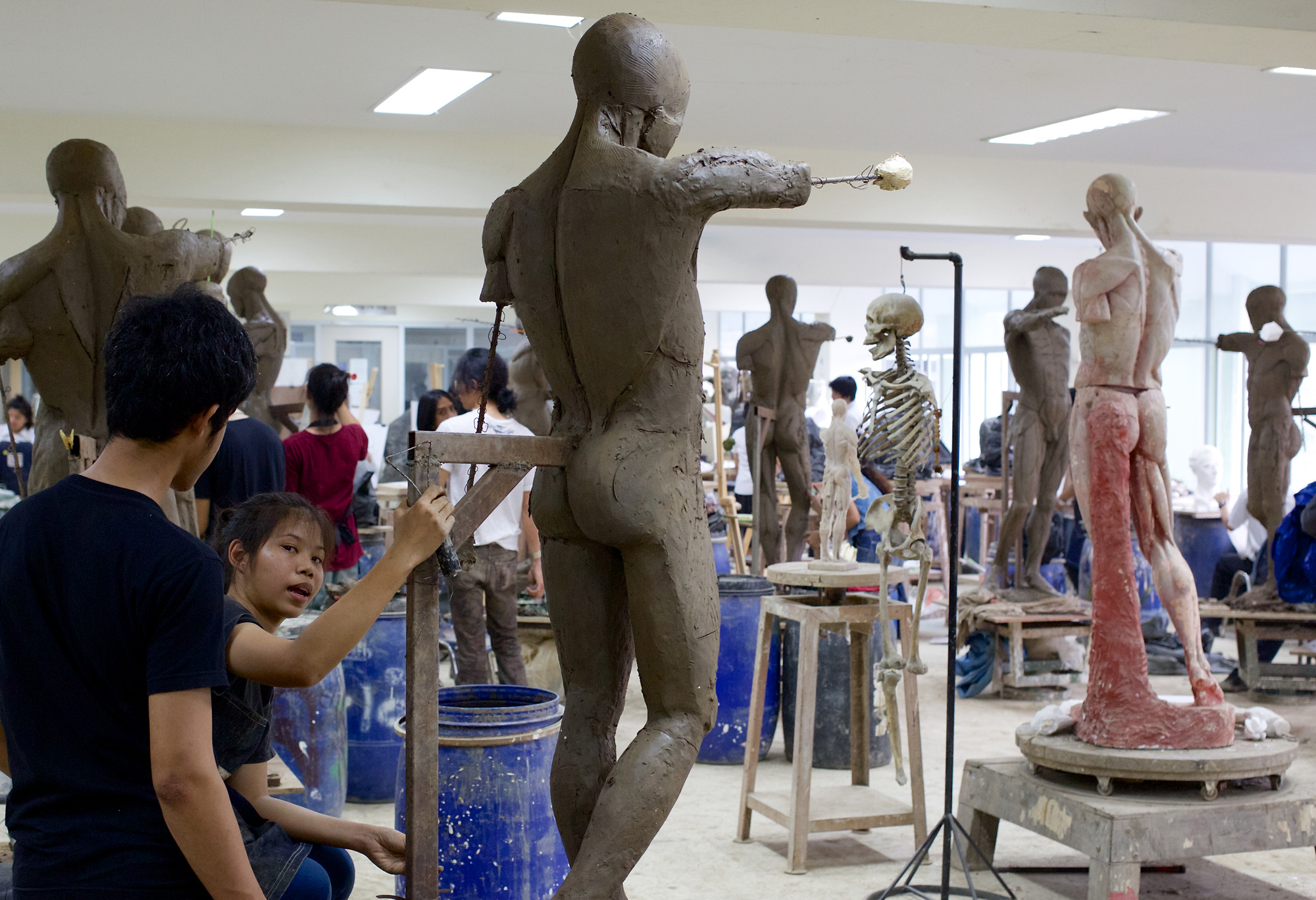
Sculpture room

Moving back outside, in the brightly lit area near the street, the colours are more intense and somehow more reassuring.

There are no people in my last photo, but, at least from a technical point of view, I feel as if I’ve nailed it.

Sculptures of legs with nails

But no. The neural net at Everypixel gives it just an 89.89 percent chance of being awesome, and I’m inclined to think it’s right. Again.

Incidentally, I’m sorry for the short hiatus in this supposedly weekly blog. I’ve just returned from Bangkok, having caught measles (yes, measles) which delayed my return. I hope this longer-than-usual article makes up for it!
Unsmiling Is Good

When aliens arrive from outer space, a million years hence, they’ll find traces of us in the trillions of selfies we leave behind. “What a cheerful species they were!” the aliens will exclaim. “They grin from ear to ear in every picture. Whatever were they laughing at?”

It’s true. People have fallen into the habit of smiling for the camera whether or not they really feel like doing so. It’s become a formality, a way of saying: “This is how I want you to see me. I’m saying ‘hello’ to you with a smile.”

But who are we greeting? Is it our friends and family? Is it the world at large? Or the aliens a million years hence?

All the Extras
To the smile has been added the “rabbit ears,” the ubiquitous victory sign originated by Winston Churchill in World War Two. It’s hard to escape from this one, even if you take candid photos on the street. If someone sees you taking their picture you’ll get the rabbit ears, unless they’re super-cool about it.

I read somewhere of a travel photographer who journeyed to a remote part of China to take portraits of people of exceptional age in a mountain village. After trekking for days, he arrived at the village and found the perfect subject: two ladies who were both well over a hundred years old. Their appearance of gravitas and wisdom must have prompted thoughts of the Taylor Wessing Portrait Prize because he got to work immediately.

What happened? Well, like everyone else today, the two old ladies grinned from ear to ear (showing their toothless gums) and raised their arms in a double “rabbit ears” salute. Forget the Taylor Wessing; this one ended up on Facebook.

Good and Bad Dentistry
Back in the early twentieth century hardly anyone smiled at the camera. My friend Ken Chambers ARPS (himself a fine candid portraitist) tells me this is because people were self-conscious about their teeth. In the absence of good dentistry, no one wanted to smile. I’m not so sure. Certainly in the Victorian era, the need for long exposures must have been a major factor. Only an accomplished liar can hold a convincing smile for more than a second or two.

It’s my belief that the street photographer can use the prevailing climate of grinning to produce pictures which, in stark contrast, show a wider range of emotion.

Two girls looking moody

How about impatience, annoyance, surprise, horror, boredom, fed-up-ness, wistfulness, gloom, dejection, desolation, bewilderment, mystification, wonder, astonishment, embarrassment, panic, beguilement…and I could go on, page after page, listing emotions and reactions that can never be represented by a simple grin.

The Sinister Grin
It’s possible to see the grin as something sinister, rather like the way in which we’ve started to view clowns. Maybe clowns were always the stuff of nightmares, hiding behind painted grins and flopping around in oversized shoes. But it’s really their artificial smiles that frighten us the most.

In pre-Roman Sardinia during the Nuragic civilization (18th century BC to the 2nd century AD) the elderly were ritually killed off by being given the so-called the “sardonic herb.” This was a strong poison, probably hemlock water dropwort, which caused the victim’s face to contort into “risus sardonicus” or rictus grin, with raised eyebrows and a mirthless smile that seemed to be malevolent to onlookers.

Ughh! It sends shudders down your spine. When a smile lacks spontaneity and warmth it’s only a hair’s breadth away from the horror of “risus sardonicus.” I much prefer to see unsmiling people, caught on camera in unguarded moments, where passing moods are recorded forever in a way that’s rarely captured by a conventional portraitist and never in a selfie.

Completely Unaware
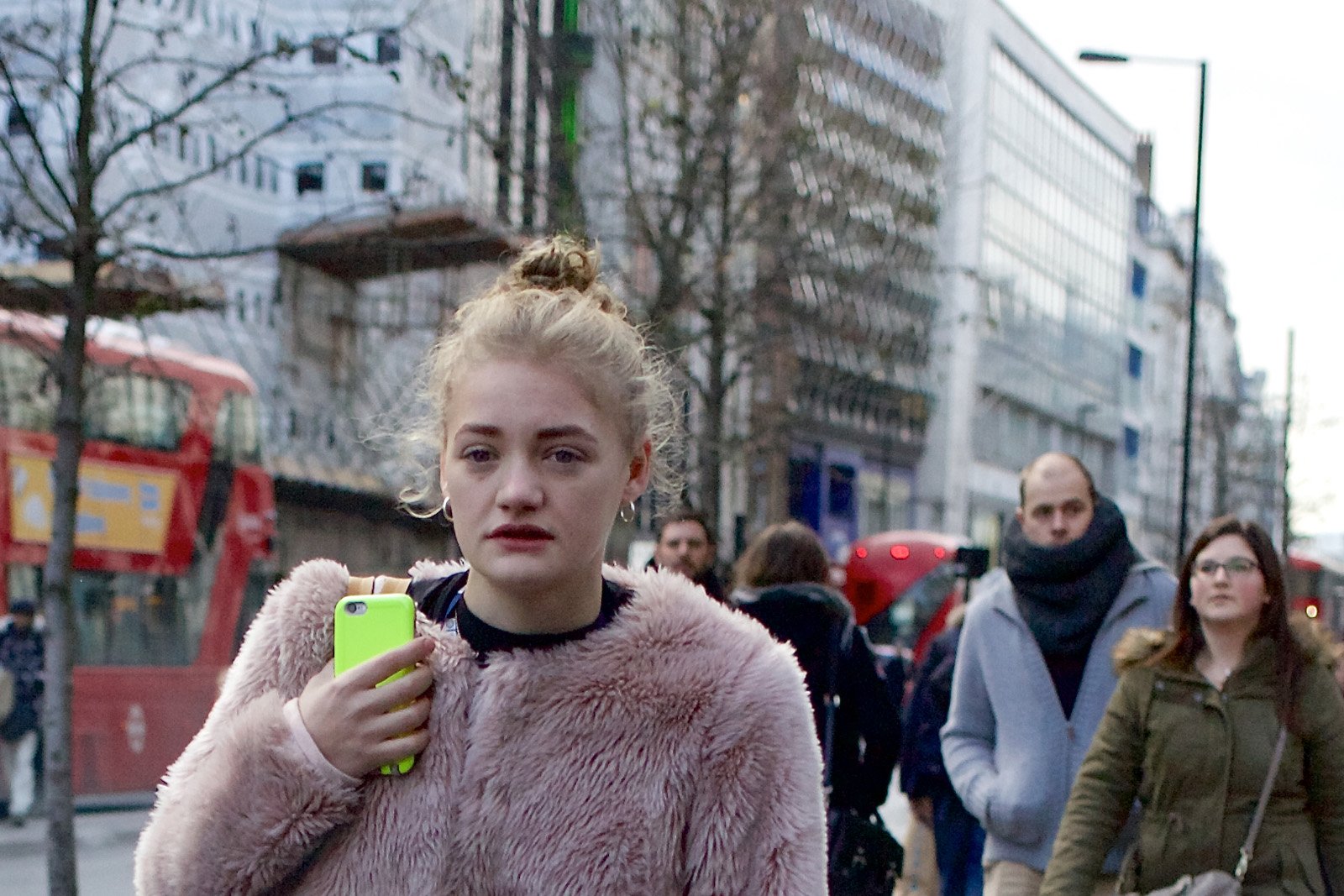
The subjects in the images I’m showing here were completely unaware of being photographed. I guess I’m gradually become invisible! Nonetheless, I still find it hard to photograph people who are lost in thought without provoking an unwanted reaction: a scowl, a look of recognition, or worst of all: a grin. The only time I can do it is when people are walking briskly past me, their thoughts fixed on something else. At those moments it’s possible to capture expressions that are so fleeting they become memorable when fixed as still images.

I wonder what the aliens will make of them?

Some People Are Larger Than Life

How do you photograph people who are larger than life? Do you sit them down in the studio, put them at their ease and flood their features with artificial light?

Maybe you deliberately make them ill at ease, forcing them into a corner, as Irving Penn did in his famous “Corner Portraits” of 1948. Such a draconian technique ought to reduce the charisma of people who are larger than life, but it doesn’t.

Truman Capote, Joe Louis, and Salvador Dali are so familiar to us from other images that we see Penn’s portraits as just one more instance in their lives. They may have been in a corner, but they were ready to spring off the page and go back to writing, boxing, painting — or just being legendary.

If a person is larger than life — if he or she has the bigness of personality that comes from being recognised for expertise in a particular activity — all you have to do is take a natural, candid portrait. All the rest will follow. For example, a quick snap of Kate Moss in wellington boots at Glastonbury can have the same photographic impact as a fashion shot on the cover of Vogue. The candid shot is supported and enlarged by the all the covers that have preceded it.

Waiting for a Natural Break

Can you do the same for an unknown person? Obviously, the task is harder. If you want to create potentially “iconic” shots you need to show people at their work, doing a job for which they may eventually become famous. You mustn’t pose them during a special photo session — as the corporate photographer usually does — otherwise you’ll break the connection between their personality and the activity that fuels it. Wait for a natural break, if you must, then fire away.

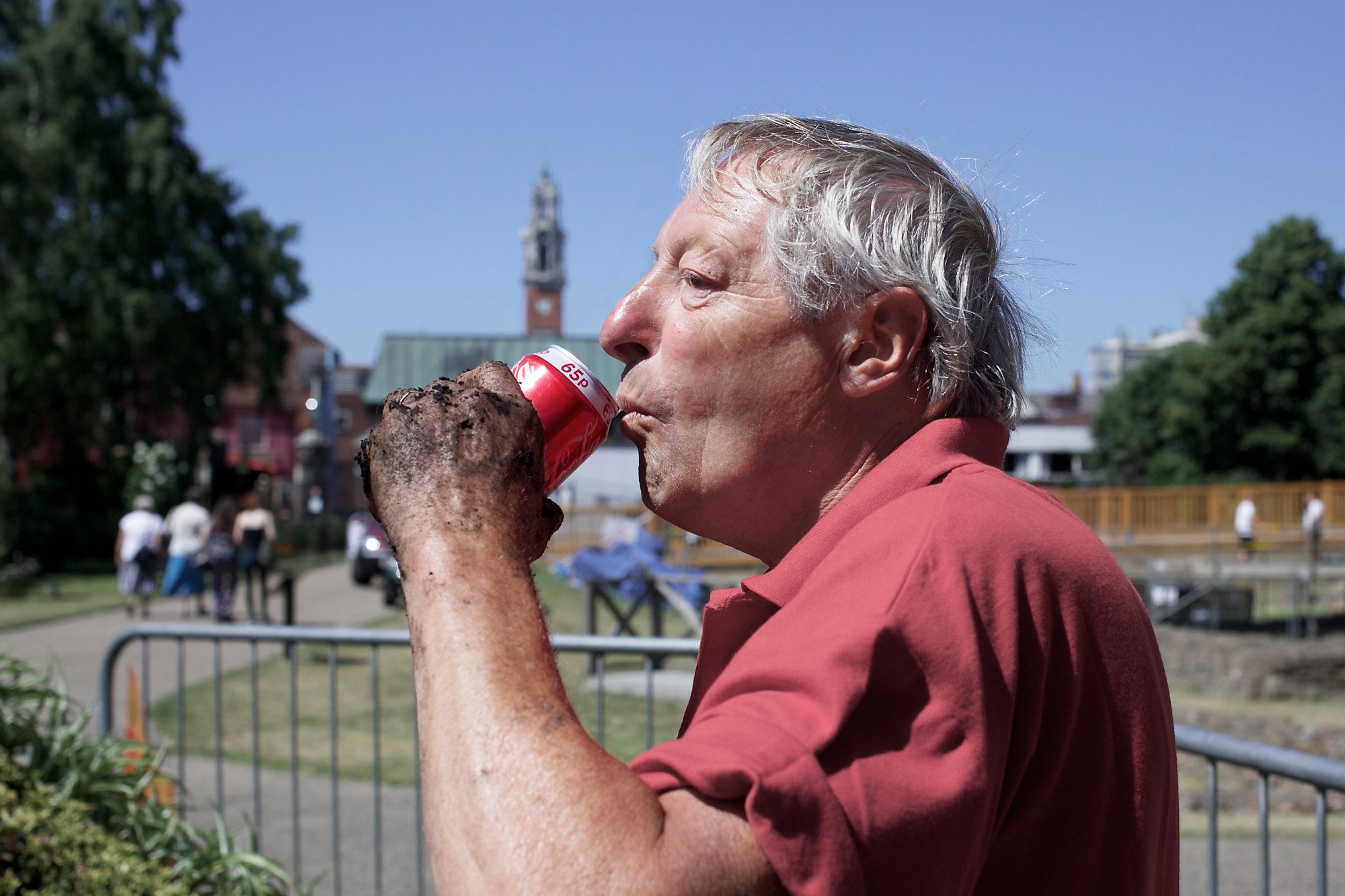
My featured image (above) shows a park gardener pausing to take a sip of cola during his morning’s work. I’d been chatting with him and admiring the huge, ornamental dragon sculpture he was creating from wires and plants. He wasn’t aware of being photographed when I took this shot — he thought he was on a break — so it’s entirely candid. I think it shows him to be larger than life.

Fashion Designer

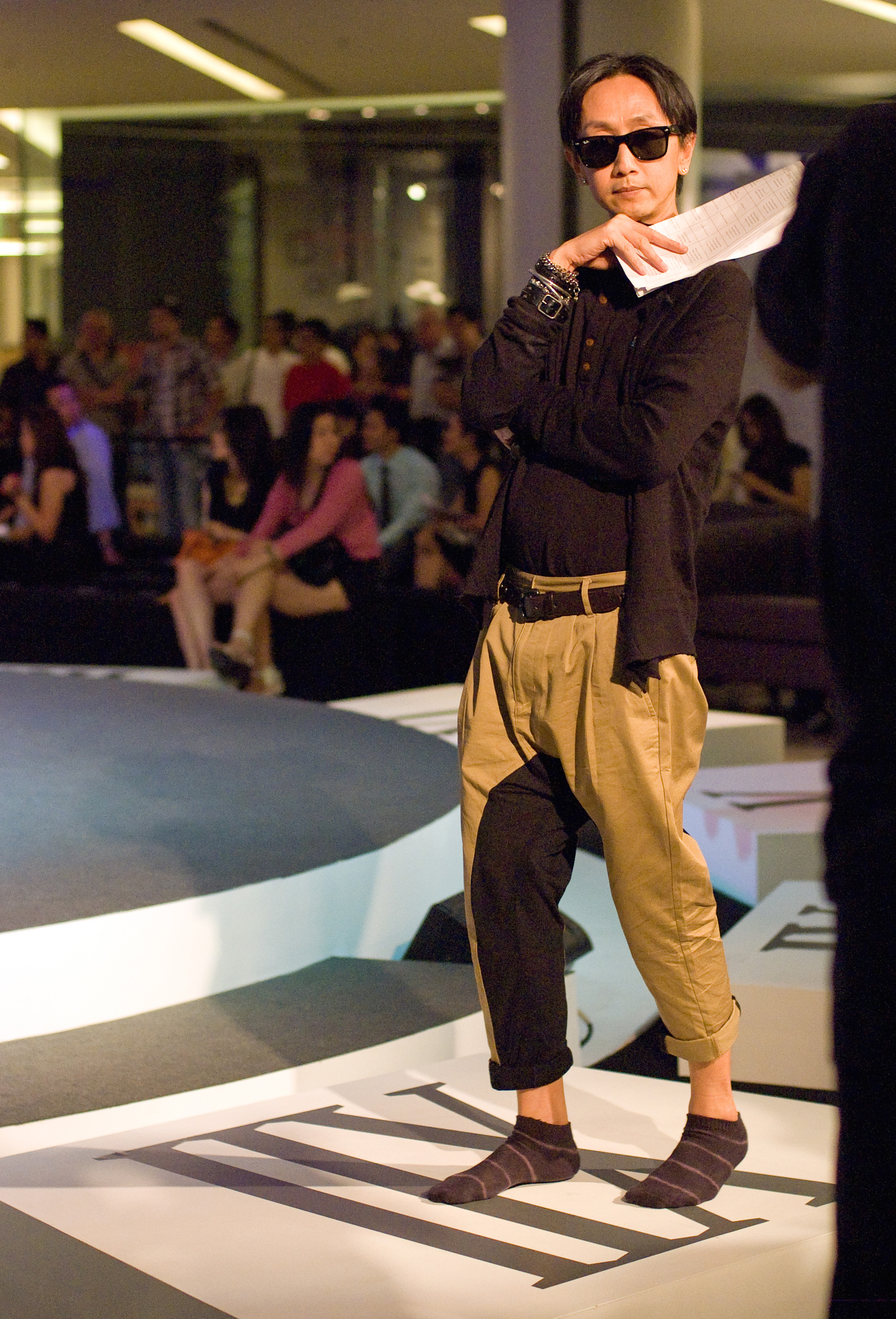
On another occasion (above), while taking pictures in my favourite stamping ground — around the malls of Bangkok — I watched a fashion designer organising a show of a new collection. Again, when people are working confidently, with a host of things on their mind — and when they pause for a moment — that’s when you can get a defining shot.

That Portrait of Che

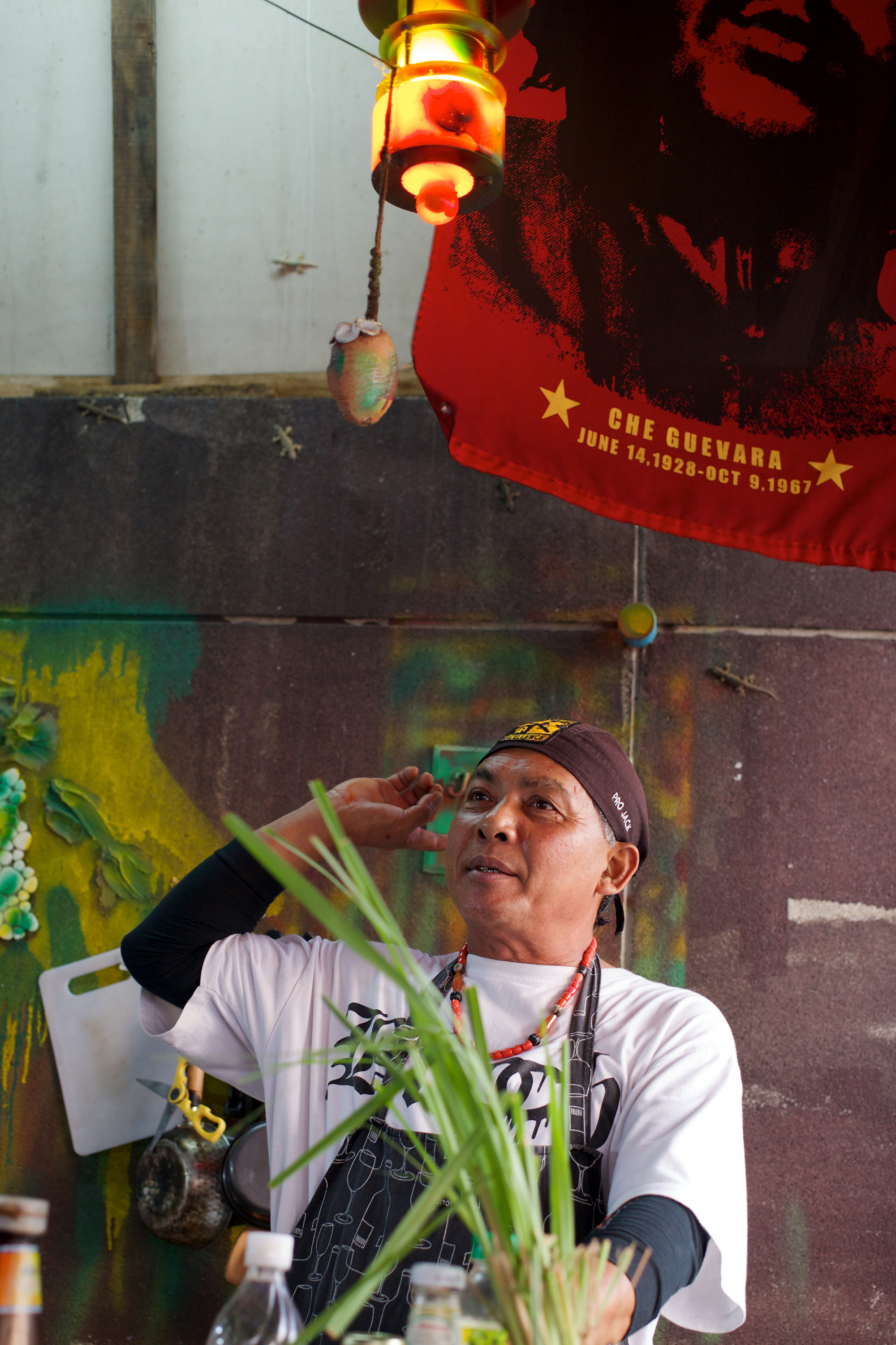
The same is true of my next image: of a man who runs a bar on the east bank of the Chao Phraya. At the end of a small side-road alongside a big hotel and a row of tailoring shops, the bar is nothing to speak of, except for its extraordinary location with spectacular views of the river. I often have a cold beer there after taking pictures in Charoen Krung, Bangkok’s oldest street.

The bar owner is a great fan of the South American revolutionary Che Guevara. The ubiquitous portrait of Che hangs above the bar. In this candid photo I was at pains to exclude Che because there’s only room for one larger-than-life character in each picture. I didn’t want the Marxist guerrilla to eclipse the cheerful — and still very much alive — person standing beneath the banner. However, I did want to establish a connection, so I compromised and cut Che’s face in half. I’ve always been a bit ambivalent about Che Guevara.

Bartender

Who was Che, really? Was he the glorious revolutionary who tried to free people from the “slavery” of capitalist systems around the world? Or was he a murderous bandit, glamourised by the Left despite having the blood of innocent people on his hands?

I’ve not had time to find the truth for this short blog post, even if that were possible, given the bias of contemporary accounts of his life and times. But I have read a little bit more about him and I don’t think anyone could deny the scope and impact of his activities. He’s like a latter-day Lawrence of Arabia, another instantly recognisable figure whose life became embroiled in myth, legend, and controversy.

The iconic image of Che Guevara is probably the world’s best known photographic likeness. It’s on tee-shirts, bags, banners and posters, mugs, mouse pads and (according to The New York Times) condoms. I’m sure an enterprising collector has thousands of other items bearing the same image. A brief account of its origin can be found in the Wikipedia article Guerrillero Heroico. There’s a more complete account in a book called “Che’s Afterlife: The Legacy of an Image” by Michael Casey.

Che Bag

Che In Brief

To summarise: Cuban photographer, Alberto Korda photographed Che on March 5, 1960, in Havana, at a memorial service for those killed in an explosion on board a French ship unloading munitions. The original image was not a whole-frame masterpiece because it showed the profile of another man on one side and some palm leaves on the other. Once Korda removed this extraneous detail the candid portrait — a street photo — became compelling, timeless and hypnotic. It did much to fuel the hero worship of Che that continues to the present day.

Che became a brand, a marketer’s dream. He was killed seven years after Korda photographed him, so there are no images of him in middle age to remove the aura of perpetual youth and idealism embodied in the image.

Even though Marxism has been discredited over and over again — wherever it has been implemented — to this day people still rally to the image of Che Guevara.

Would a Marxist system provide all the products which carry the image? Perhaps by only decree. Or the authorities might decree otherwise and demand an icon of the current leader. In fact, the only way to get rid of scruffy shopping bags bearing the portrait of Guerrillero Heroico would be to have another revolution.

Viva Che! Viva la revolución!

Awkward Eating on the Street

If Osteria Francescana in Modena, Italy, represents the top of the food chain — in 2018 it’s No.1 among “The World’s 50 Best Restaurants” — then the eating places I’m showing here are somewhere near the bottom.

I mean no disrespect. In fact, I don’t particularly enjoy eating in expensive restaurants. Getting a table is always vexatious, the food often fattening, and there’s a whacking bill at the end of the meal with taxes, tips and surcharges which sometimes leave a nasty taste in the mouth.

A Look at the Stats
There don’t appear to be any reliable statistics about the numbers of restaurants in our major cities. I’ve found references to “24,000 eating establishments in New York” (which seems a bit low) and “160,000 restaurants in Tokyo” (which seems high). Paris is said to have around 40,000 — mostly with uncomfortable chairs like the one below — and London around 22,000. These figures, from various sources, include delis, cafés, and fast-food takeaways.

Morning Beer

It’s the fast-food takeaway that feeds the majority of people on low budgets. Students, low-paid office workers (and street photographers saving up for a Leica) will tend to patronise the takeway. It’s a great and commercially successful idea, but the problem is: where do you take it away TO?

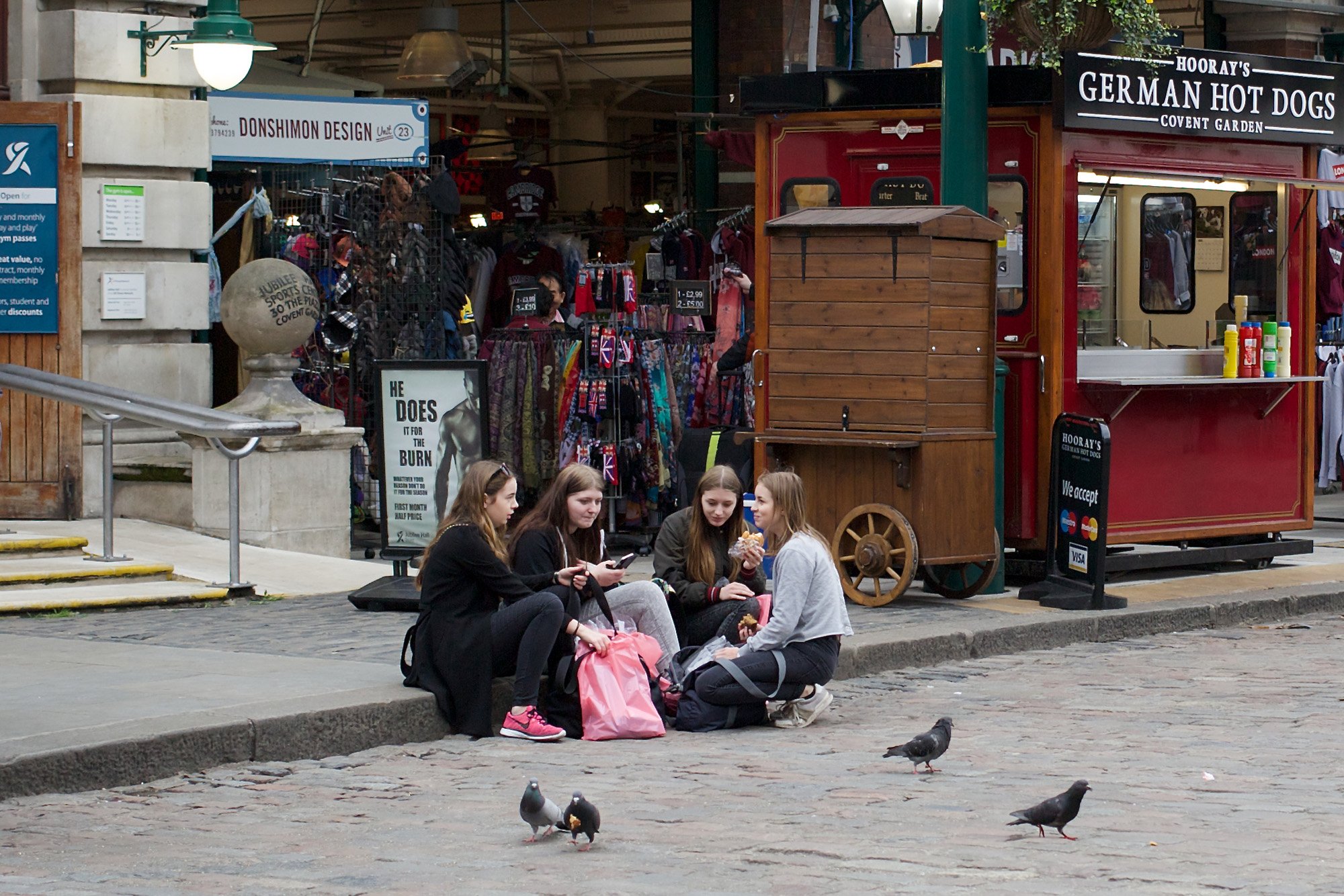
The girls in my featured photo (at the top) have decided to park themselves on the kerbside in Covent Garden’s famous square. I like this shot because the subjects look like they’re having fun. They may not be comfortably seated or having a “fine dining” experience, but at least they’re getting in touch with nature. I’ve called the picture “4 Girls, 4 Pigeons,” in recognition of the similarity between the two groups. One pigeon has scored a complete takeaway meal of his own.

Halfway House
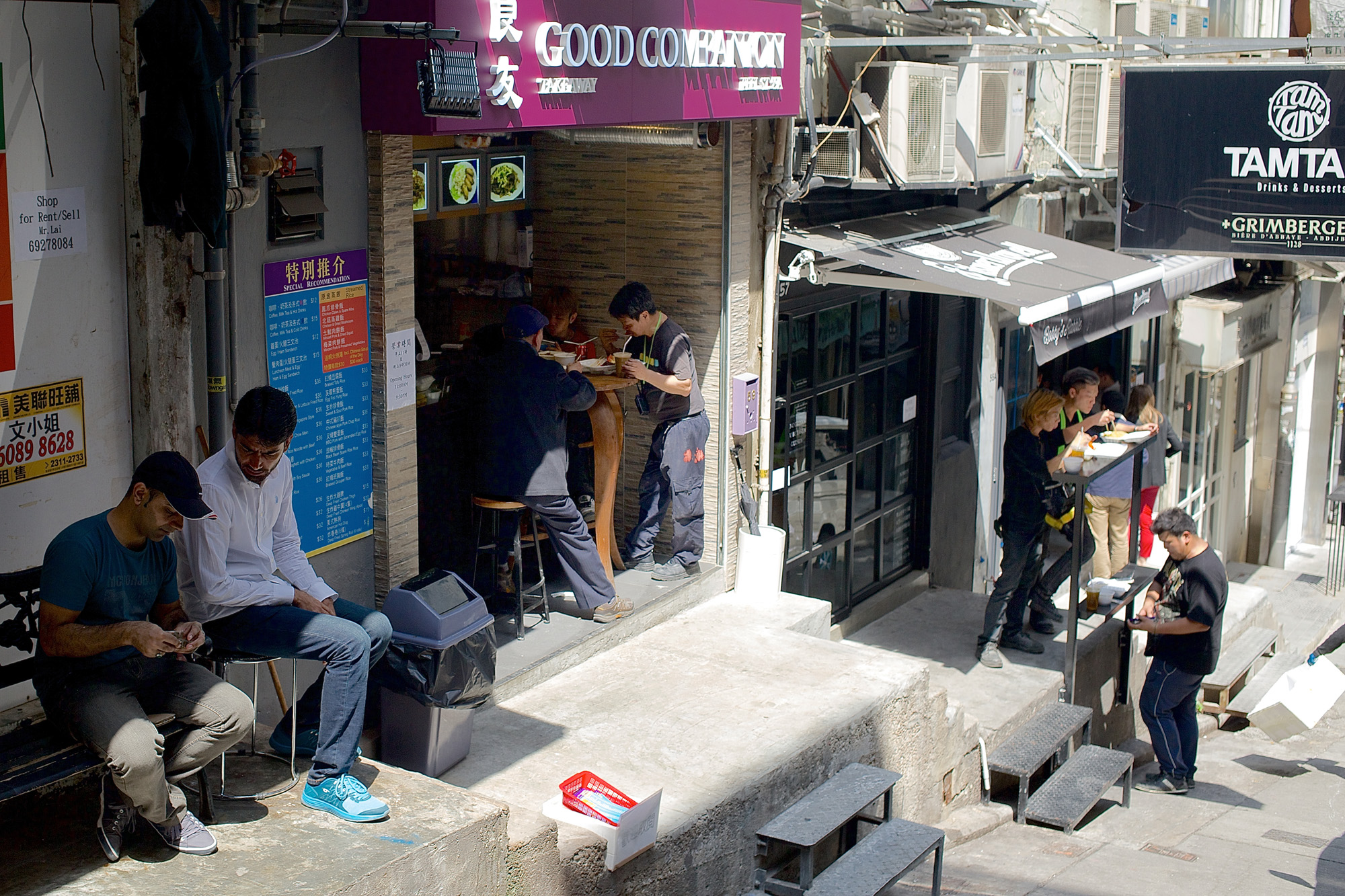
In Hong Kong (below) you can find restaurants that provide really minimal facilities for dining outside. Maybe it’s just a shelf on which you can stand a cup of coffee while you tuck into a plate of rice, but at least it’s a step up from the domain of the pigeon.

Hong Kong Lunch

The steep hills on the main island of Hong Kong pose a challenge for restaurant designers. Parisian-style tables are “out”; Hong Kong-style shelving is “in”. My photo, taken in the ever-changing environment of Peel Street, shows several levels of table which correspond to three levels of privilege: indoor table with a seat; outdoor shelf upper level; and outdoor shelf in the full sun with a crotch-eye view of the other diners.

Back in Bangkok
You could scour the whole of Asia, including China, Japan, Indonesia and the sub-continent of India, Pakistan and Bangladesh, and not find a more highly acclaimed restaurant than Gaggan in Bangkok. Chef Gaggan’s establishment was crowned No.1 in Asia again this year and is now No. 5 in the entire world.

The “Gaggan Experience” (a tasting menu) costs upwards of 4,000 Thai baht (under $120), which I’m sure is good value and about half the cost of similar sessions at other restaurants on the list. For this you can sample the restaurant’s spectacular Indian cuisine, in all its regional variations, served with impeccable presentation.

In particular, Gaggan reveals his passionate love of food, inspired (to quote the restaurant’s website) by “childhood street food memories.”

Maybe it’s time to take a look at children eating street food. Perhaps they’ll grow up to become famous chefs like Gaggan Anand.

Underprivileged? Not in the Least
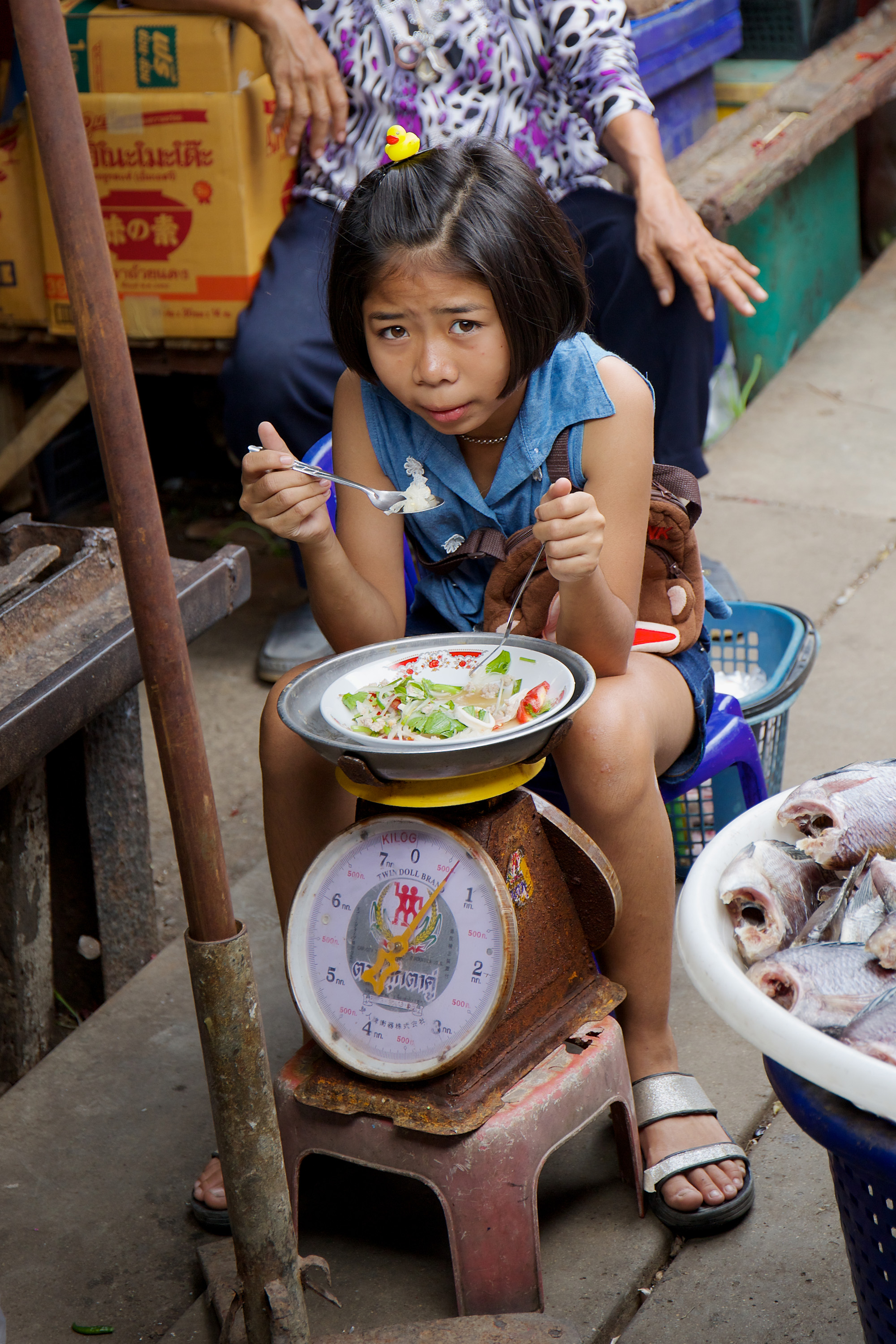
Here’s one candidate: a girl eating a healthy salad from the top of an ancient set of scales. There’s a large bowl of fish next to her, so I assume her mother sells fish in the market where I took the shot, which is actually a few miles outside Bangkok.

Salad lunch

Now, it’s easy to jump to conclusions. Some people might feel guilty seeing a child who’s obliged to eat lunch in a makeshift style, next to a pile of fish — especially when there are hundreds of expensive restaurants in the vicinity. But personally I don’t feel that way. The little girl is enjoying an excellent meal right inside one of the world’s most compelling tourist attractions: the Mae Klong Railway Folding Umbrella Market.

Every day, just inches away from the little girl’s “table,” a train passes through the market and into the station further along the line. The stall-holders quickly fold back their sunshades, move their goods from the rail track, and wait for the train to pass. Within seconds of its passage through the market they replace everything exactly as it was before.

Isn’t that enough to lay down a few “childhood street food memories,” like those which inspired Chef Gaggan? I hope so. When you’re at the bottom of the food chain there’s only one way to go — and that’s up.

Single Colour Dominating

I’ve always liked the idea of capturing a street scene in which buildings, cars and people happen to share the same colour. Likewise, I’m attracted to groups of people in the same coloured outfit, but where each person is asserting an individual personality by stance and gesture.

Why do I have this ambition? I guess it’s because I think it will say something, or at the very least will have a measure of artistic unity. A single colour can unify an image that would otherwise be ill-composed.

Yet, I have to confess, I’ve not fully achieved the perfect shot in which there’s a “single colour dominating.” Somewhere in the image another colour always intrudes — and I’m reluctant to stoop to using the hue control in my photo editor to change it.

A Little Garish
The main colour in my featured image (above) is a little garish. Indeed, I think it may even be “out of gamut” — as brilliant orange often is — if I were to make a print. For the uninitiated, “out of gamut” is what happens when you move an image from a large colour space to a smaller one. A typical example is when something in the photo lies outside the colour space of a typical CMYK printer. If you print it, you’ll get only an approximation, not what you see on the screen.

Even though here orange is the prevailing colour, two others signal their presence — the lime green bottle tops and the extraordinary shade of red used for the curved bench.

Name That Colour
Incidentally, while writing this blog I’ve found myself on several occasions attempting to look up the exact names of colours, rather than refer to them vaguely as “red,” “green” or “pink.” If you search Google Images for “colour names” you’ll find lots of useful charts which circulate around the design world. They’ll help you put a name to the colour, as Homer did with his “wine-dark sea.”

On this occasion I’ve looked at a dozen colour charts and cannot find a proper match, not even on the admirable Mental Floss Colour Thesaurus. Maybe this, too, is out of gamut. It seems to be a shade somewhere between Yahoo! Red and Flickr Pink.

Unless you photograph in black and white it’s a good thing to think frequently about colour — and even to fuss over it occasionally. Ask yourself: Can I live with a discordant mixture of colours, or do I want everything in the image to blend harmoniously together?

I think I get away with the glaring colour clashes in my image of the sales assistants on their drinks break. The one in “maximum orange” (No.10) is clearly the dominant figure. She’s the only one standing up — and among all of them is wearing the highest heels and seems to be confronting one of the others. The reddish-pink bench points towards her; and my own reflection — thankfully — is not too obvious as I was wearing my favourite blue shirt that day.

Vying for Dominance
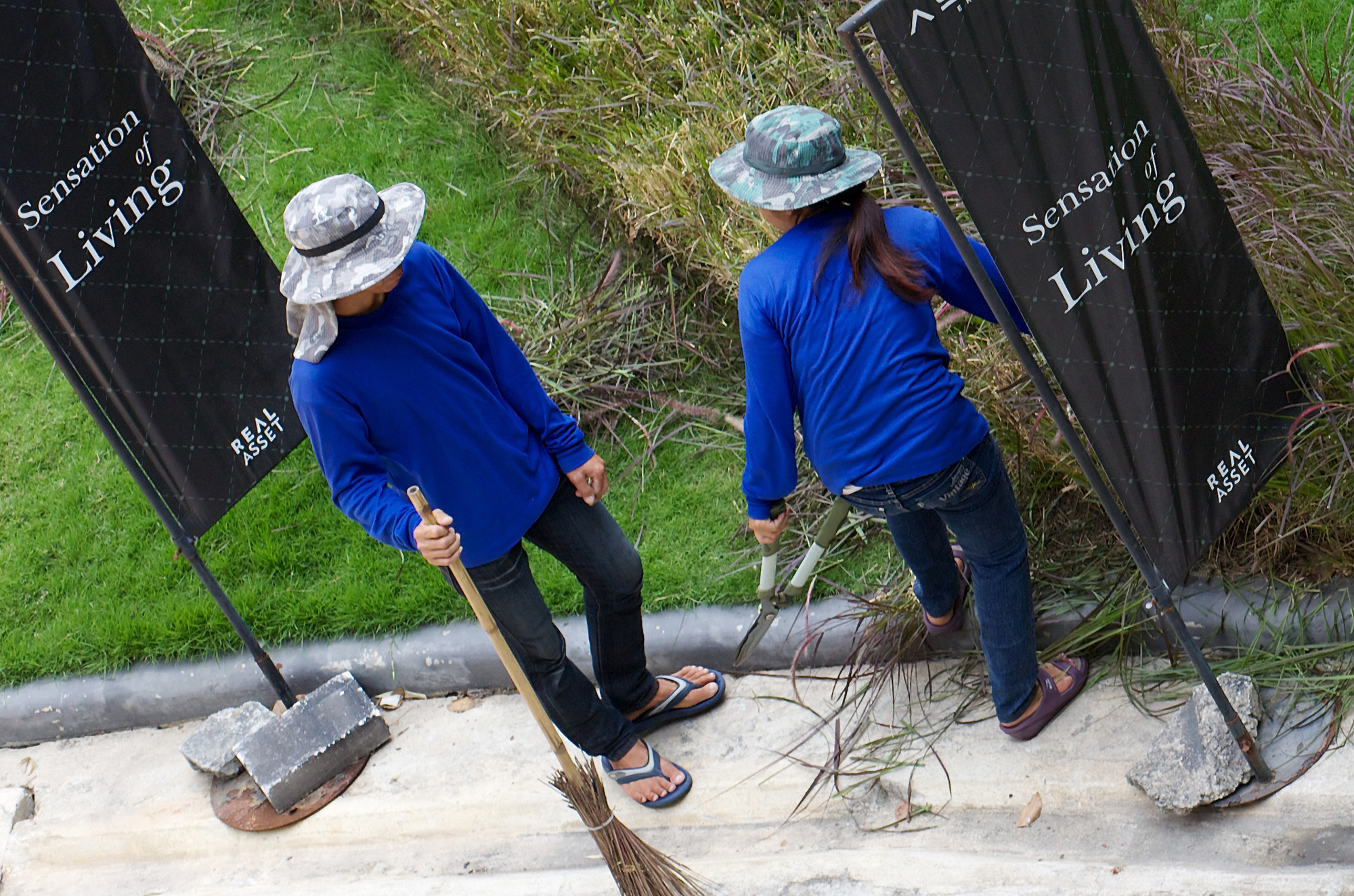
Like people in the workplace, colours vie with each other for dominance. In my next image (below) blue and black vie for dominance, with green hovering in the background, calming them down and bringing them together. Taken from above (at the Thonglor Skytrain station in Bangkok) the image is skewed so the gardeners and the flags can fill the frame completely.

In the skewed image I’ve deliberately downplayed the individuality of the figures by hiding their faces. Yet their physicality is very much in evidence. Just by looking at them in the photo you can feel the action of using a stiff broom on concrete, or clipping the grass with the shears. In this sense, the picture is all about the “Sensation of Living,” as proclaimed by the banners for a nearby condo development (although I doubt if the new occupants will be clipping their own grass).

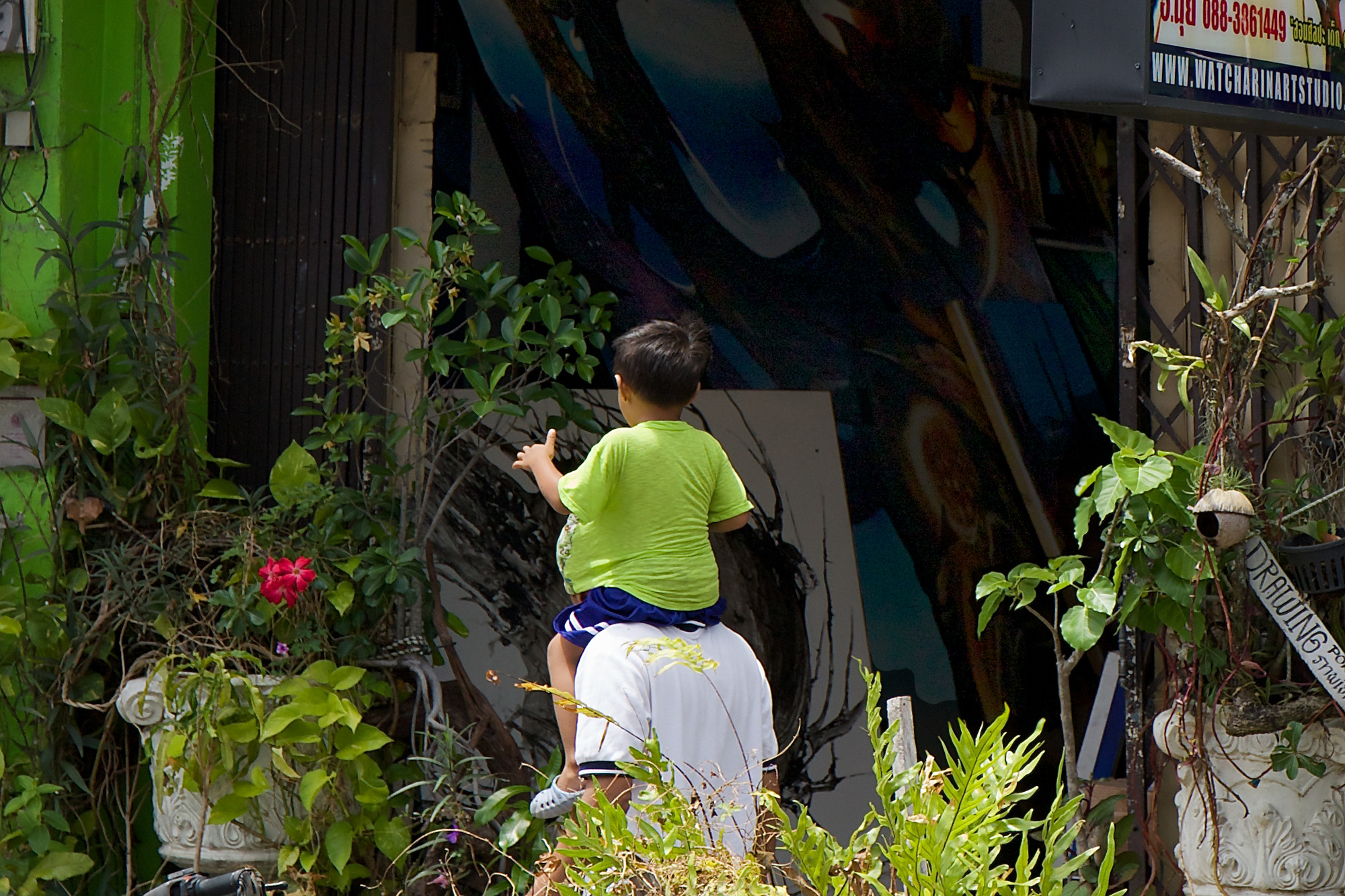
Green doesn’t always have to be a background colour. When there’s a surfeit of it you can make it the dominant theme of the image, as I do in the picture below.

Of all the colours I find green to be the most difficult to use in a photograph. It may even be one of the reasons why I turned away from landscape photography in favour of the non-green streets.

Search for “lawns” in Google Images and not a single photo looks wholly satisfactory. There are so many different shades of grass, all of which vary in their appearance according to the light, that I don’t trust any of them to look truthful to reality.

Contrasting Notes
In the image below, the studio doorway, the foliage and the little boy’s tee-shirt are all of varying shades of green. There seems to be a gigantic painting in the background, filled with blue, abstract shapes. Yet apart from white, there are only a couple of strongly contrasting “notes” — the red flower and the studio’s red telephone number in the top right corner.

Contrasting notes of colour are helpful in alleviating the sameness of an image where a single colour dominates. Red is the exact opposite of green and always strikes a cheerful note — like a Ferrari speeding through the forest on the race track at Nürburgring.

You can see why I’m not entirely happy with the “dominant colour” style of street photography, even though it still seems like a good idea. Maybe our eyes are not yet ready for it.

Although we’re fully accustomed to viewing black and white photography where colour is notable by its absence, we don’t respond well to monochrome images that are not colour-neutral. I’ve created many artworks using monochrome but I’ve always relied on alternating two contrasting or complementary monochrome hues to make the pictures work.

Meanwhile, I continue to keep a lookout for the perfect shot in which a single colour dominates. It’s out there, somewhere.


London, Under Reconstruction

There’s a fine Japanese short story by Mori Ogai called “Fushinchu” (“Under Reconstruction,” 1910) which describes the discomfort of living in the city when it’s being extensively re-built.

I was reminded of this story on a recent walk around London. Everywhere I went there seemed to be men in yellow jackets: knocking down buildings, unloading trucks and pouring concrete. Eventually I was forced to recognise that all this frenetic activity was the most prominent feature on the street. Unless I included it in my shots I’d not be telling the truth.

However, there’s a problem here. If I were to photograph builders doing all the things they normally do, I’d end up with pictures that would look as if they’d been commissioned by a construction company.

Their Own World
Construction workers live in their own world. They are usually confined to a building site which is fenced off from the general public. They labour long and hard, then they remove the hoardings and there — suddenly — is a brand new building ready for occupation. The workers then move to another site and do it all over again.

If the street photographer ventures into the constructors’ world the result is the corporate-industrial photo. Sometimes a great candid shot emerges (for example, the much-reproduced image of men eating lunch on a steel crossbeam, high above the streets of New York, taken by Charles Ebbets in 1932) but that’s an exception. You need permission to get anywhere near the action — and permission has to come jointly from the construction company, the architects and the owners of the building. Street photographers are not in the habit of seeking permission.

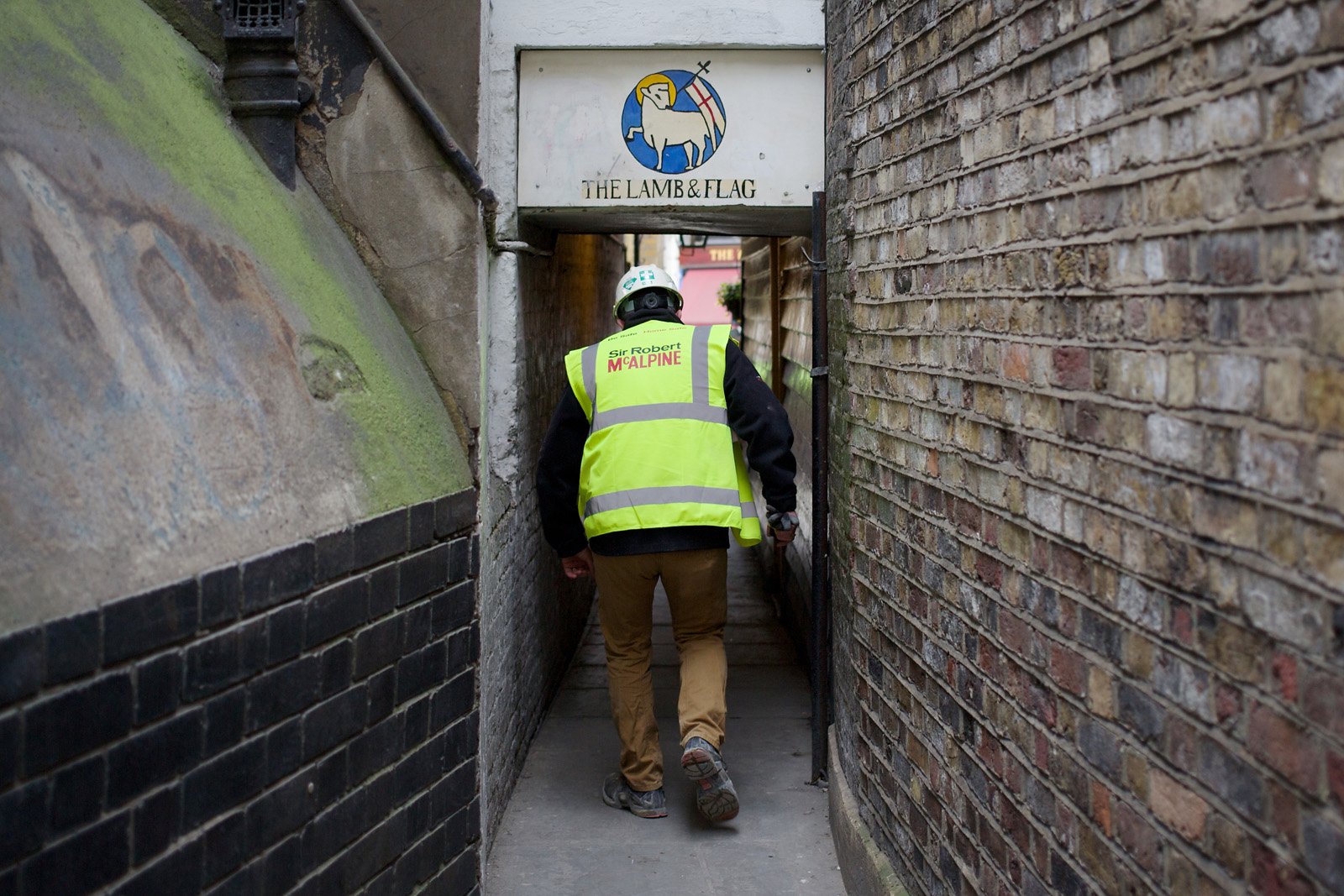
My featured image (above) shows how I solved the problem. I simply took a candid picture of a construction worker ducking his head to walk under a narrow and very ancient passageway. The contrast between the size of the figure and the narrowness of the passage says something about how the modern world is too big, too dynamic, too aggressive to be constrained by old buildings. It makes you wonder: will this man supervise the destruction of the “Lamb & Flag”? One hopes not, but you can never tell.

I hope London succeeds in finding the right balance between preservation and regeneration. The latter can be alarming when you see it happening, but the alternative — too much preservation — can be stultifying to the life of the city.

New Kid on the Block
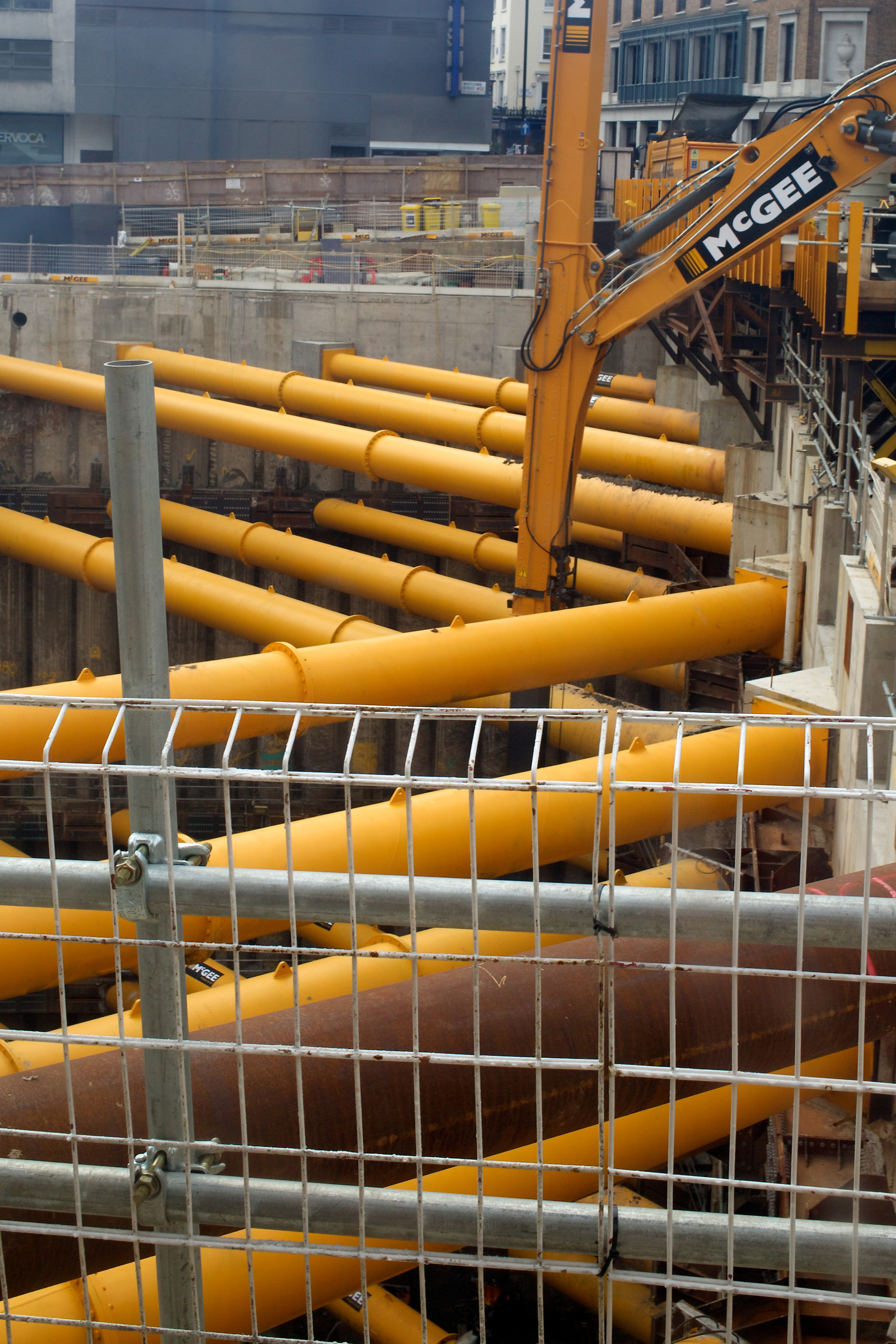
There was opposition when the misleadingly named Edwardian Group wanted to replace the famous Odeon Cinema West End with a ten-storey block consisting of a hotel, spa and a two-screen cinema. Permission was given and, at the time of writing, there’s a 30-metre hole where the original cinema once stood. People take turns to stare at it open-mouthed through a tiny viewing window.

“That’s where I saw ‘Lord of the Rings,'” I heard one onlooker say, a little wistfully.

I took a quick snap (above), just to show you what it looks like.

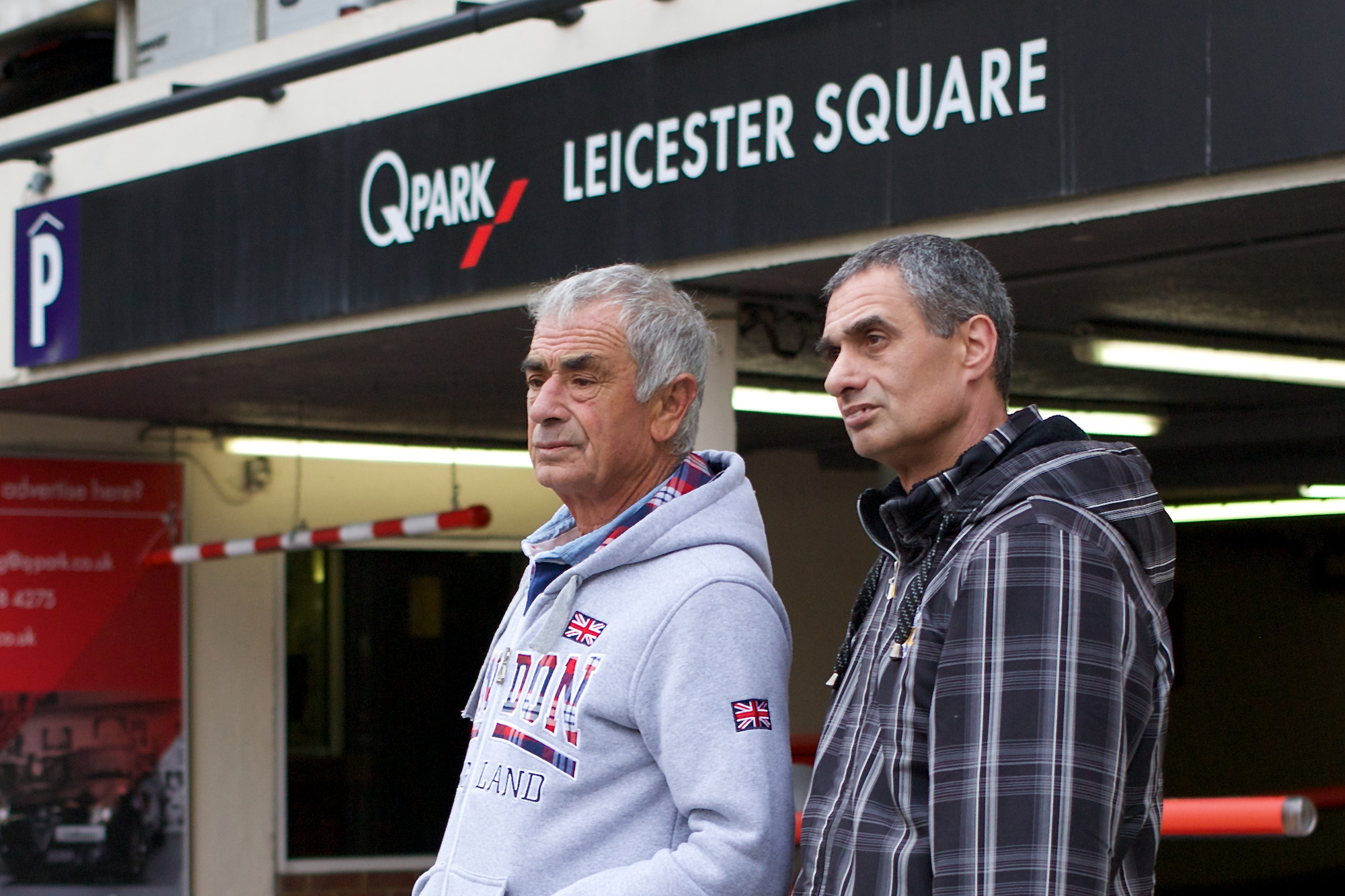
Moving around the site I found two other onlookers marvelling at the crane (below). That’s one way to tackle the existence of construction work: get some reaction shots of people who’re taking an interest in what’s going on.

Personally, I think the new building on the south side of Leicester Square will be magnificent. It will probably put the rest of the square to shame so that buildings on the other three sides will need replacing, too. That’s what happens when a city’s “under reconstruction.”

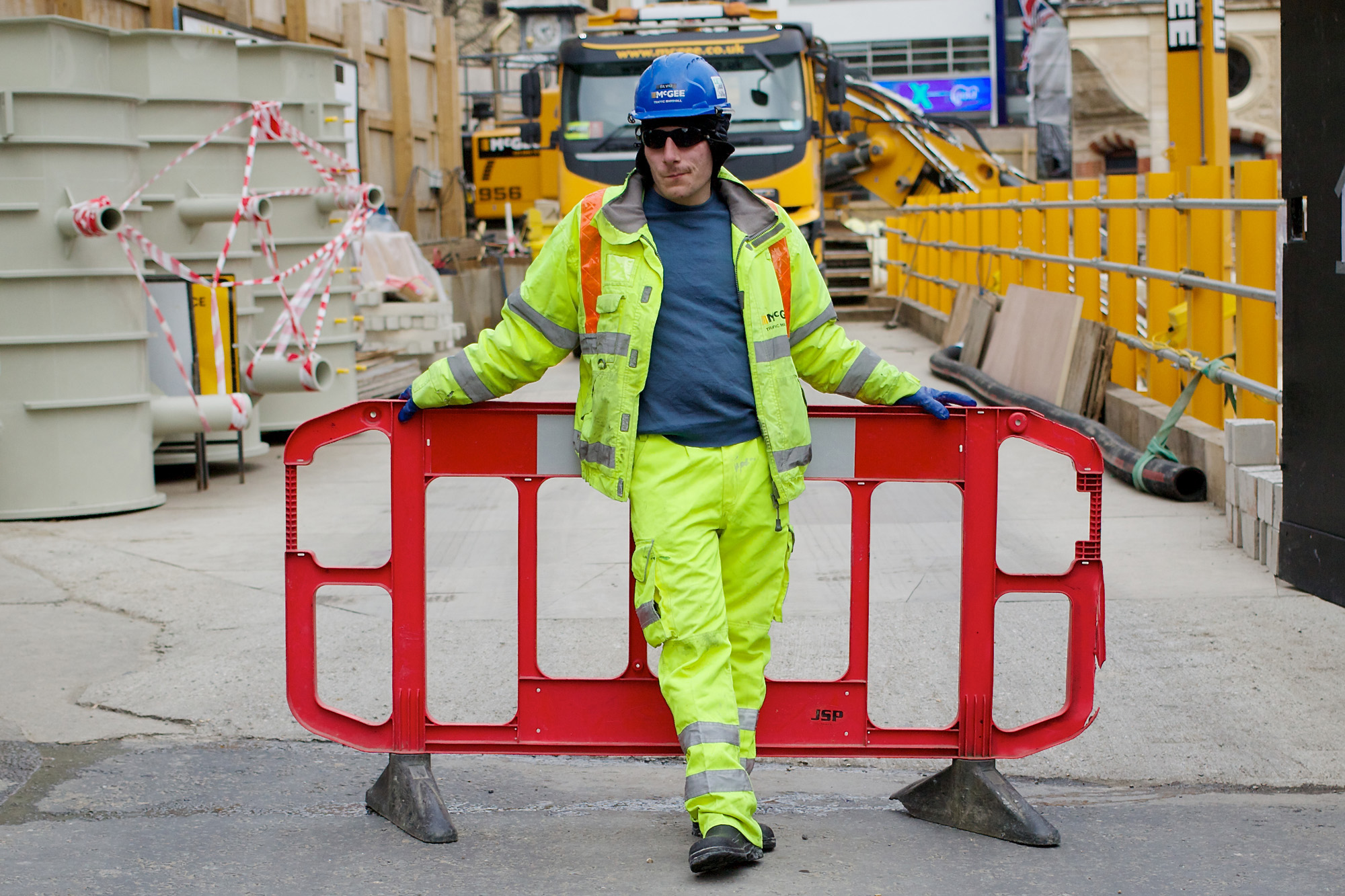
My favourite shot from my walk around Leicester Square’s big hole is this one (below) of the man on the gate. His job is to supervise the constant flow of trucks entering and leaving the site, bringing liquid concrete for the foundations of the new hotel complex.

The man was taking a break and looking in my direction, probably wondering if I’d cause any trouble. He later asked me, politely, to keep to my side of the barrier. After all, I belong to the other, non-construction world of pedestrians, onlookers and passers-by. I plan to keep it that way.

Footnote

In this blog I occasionally refer to my favourite Japanese writers, but I usually keep to the conventional western habit of reversing the Japanese word order so that the family name comes last instead of first, as it does in Japan.

I’ve not done that with Mori Ogai (1862-1922) because not many people have read him in the west, despite his sublime story “Takasebune” (“The Boat on the River Takase,” 1916) being translated eleven times. (OK, not very many people…)

Lieutenant-General Mori Ogai, who once worked as an army surgeon, was born Mori Rintaro and took various names for his poetry and short stories. With affectionate reverence the Japanese call him “Ogai.”

Waterway “Street” Photography

Can you do street photography on rivers and canals? I don’t see why not. The only difference between the waterway and the street is the obligation to use a boat for transport, rather than your feet.

Yes, I admit that’s a major difference, because the knock-on effect is the lack of pedestrians. Without passers-by, the street photographer no longer has a constant flow of potential subjects. All that remains is a constant flow of water.

However, rather than dismiss out of hand the potential of “waterway photography” I think we should first consider its advantages.

For a start, the light is nearly always excellent. It reflects off the water and illuminates the subject from below as well as from above. You won’t find this effect on the street unless it’s been a very rainy day.

The air is clearer on the river; the traffic more graceful; the people (if you can find people) more relaxed and more open to the idea of being photographed.

Any pictures you get on the river will evoke a slower and possibly more appealing style of life than the one you left behind on dry land. When you embark and set sail you’re entering a parallel world that will inspire you to see people in a fresh light.

It’s fun to join in, but not essential. You don’t have to get on a boat to participate in waterway photography. You can remain on the quayside and photograph other people jumping on and off ferries, motor launches, gondolas. I’m tempted to say “whatever floats your boat.”

The Parallel World
The subject of my featured image (above) is a small boy on a large vessel: the last section of a river “barge train” on Bangkok’s Chao Praya. I took it from a public ferry, but I was lucky to get the shot because ferries rarely pass close enough to these massive barges to enable a decent shot.

The photograph sets me thinking: “What’s life like for a small boy on a barge?” It must be extraordinary. English children dream of being train drivers, but even if Dad drives the 07:15 express from Paddington you don’t get to ride with him by yourself. This little chap does more than ride. He lives on the barge, surrounded by dangers — and I bet he enjoys every minute. You’ll not see anyone remotely similar to him on the street.

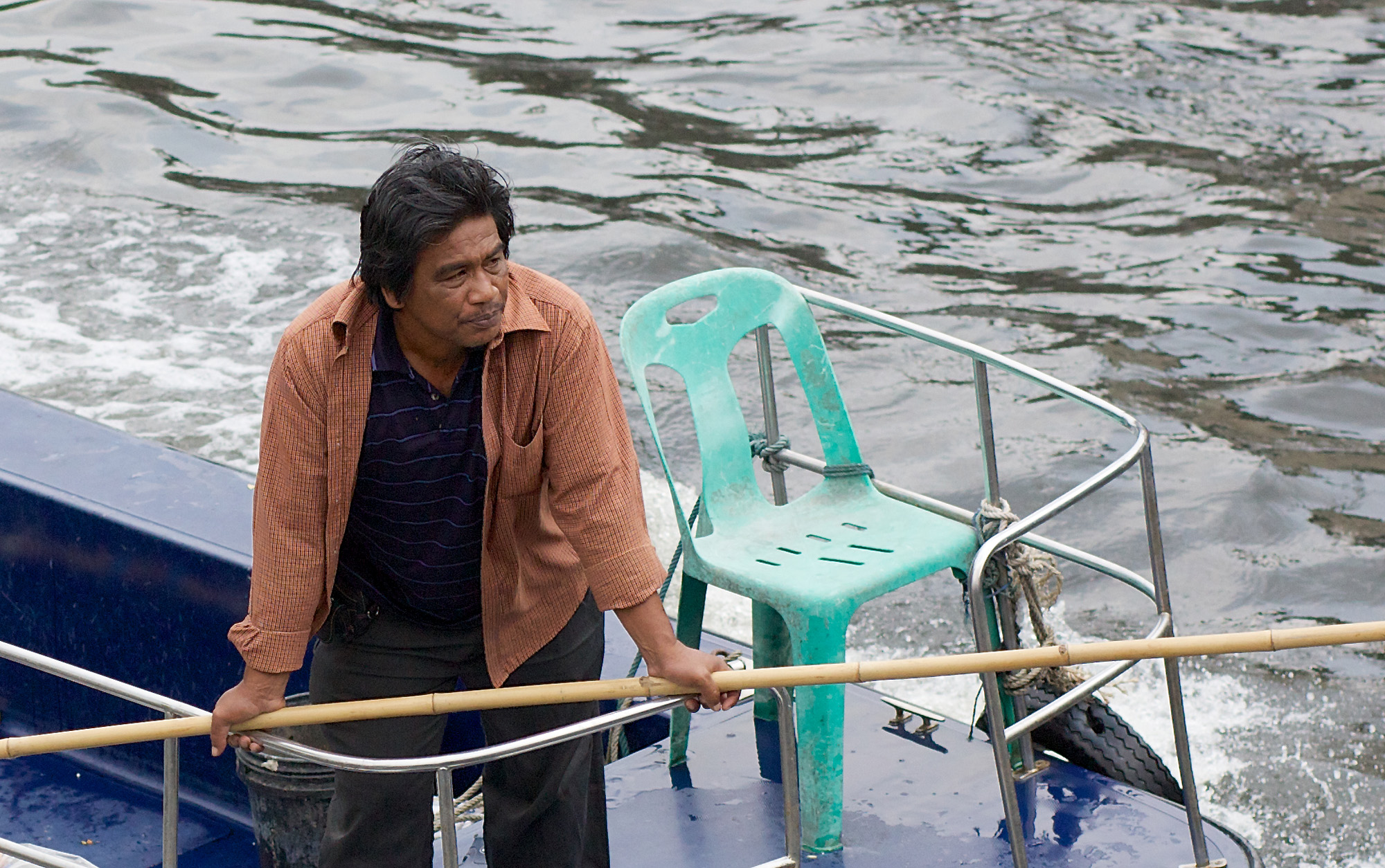
When they get older, river people have a weather-beaten look. It’s a tough life on the water, especially in Thailand where the rivers and canals are crowded with traffic. I took the shot (below) from a bridge. I liked the empty seat, which looks inviting — although the man has to hold a bamboo pole in readiness to steer clear of other vessels rather than relax comfortably on his chair.

Passengers
My next composition (below) is closer to what we think of as “street photography.” The wind helps to make it a “decisive moment” by displacing a man’s hat, blowing hair out of place and waving the stripey shirt of the lady on the right. Every movement speaks of the river, even though you can only glimpse it through the railings of the boat.

Divided into two halves and crowned with a car tyre the image works because all the detail is rigidly organised with straight lines and symmetrical balance. It just avoids becoming over-organised by virtue of the central pillar beneath the tyre, which adds a diagonal to a composition which is otherwise undisturbed, except by the breeze.

The possibilities for waterway photography are endless and I have to say it’s one of my favourite activities. I have a great love for rivers, in particular for their varied reality as well as for their metaphorical significance. It’s impossible to experience a river and not be reminded of how its journey from upland to the ocean resembles the life of an individual human being. You don’t need to read the wonderful novel “The River Ki” by Sawako Ariyoshi to have this thought (but it helps).

Celebrations on the River
It’s not surprising, therefore, that people choose the river for special celebrations and ceremonies which mark our passage through life. In Bangkok, there are engagement parties, weddings and funerals — all held aboard boats on the river.


I’m not sure of the occasion being marked by those on board the vessel in my shot above. The boat had just left when I arrived. The sun was setting; people were dressed in traditional costume. There was an air of formality and seriousness about it which I’d not experienced on the river during the day. I took the shot quickly before the vessel moved out of range, all the while hoping it was a happy event and not a sombre one.

To my original question: “Can you do street photography on rivers and canals?” my answer can now be more definite.

Waterway photography offers subject matter which has all the extremes of youth and maturity, work and recreation, wealth and poverty, life and death — plus good light. So, yes, it’s a great environment for taking candid shots. Just don’t fall in the water.


Feasting, Eating, and Snacking on the Street

The civic authorities in Bangkok are beginning to outlaw the sale of fastfood on certain streets, especially those in trendy, up-and-coming areas like Thonglor. Not everyone is happy about it. After all, street food is trendy too.

Bangkok is unique in having the world’s most elaborate street food culture. A lot of vendors specialise in a single dish — and they get rather good at making it. Although the vast majority of vendors (there are an estimated 380,000) sell relatively low-cost meals, some of them use the finest ingredients and serve an up-market clientele.

For the street photographer, the existence of street vendors in Bangkok offers an excellent opportunity to get some great shots. In the past I’ve tried to keep these shots to a minimum — regarding the subject as too obvious — but now that 15,000 food vendors have already been evicted I’m beginning to change my mind. They represent an entire way of life which could one day disappear.

If only there’d been a few accomplished street photographers operating in Tokyo at the end of the samurai era — or others working in Dickensian London in the early nineteenth century. Think of the treasures they would have preserved! Every city undergoes constant change and we all need to recognise the process before it’s too late.

Food, Work, Sex, Religion, Art
When I look at the photos I take in Bangkok I can see they nearly all relate to food, work, sex, religion or art. Almost every composition you’re likely to find has one or other of these elements within it. Only if you focus on a giant lizard in Lumpini Park will you escape them, but, even then, the lizard is probably thinking about food, or sex, or both.

In recent years I’ve learned quite a lot about Thai food — and Thai attitudes towards it. I’ve helped my partner, food writer Oi Cheepchaiissara, to produce five books and sixteen e-books, taking all the pictures for the e-books and for the most recent of her printed books.

There’s no doubt about it: for the Thais, food is both fun and serious at the same time. It’s long in preparation (that’s the serious part) but quick to cook and fun to eat.

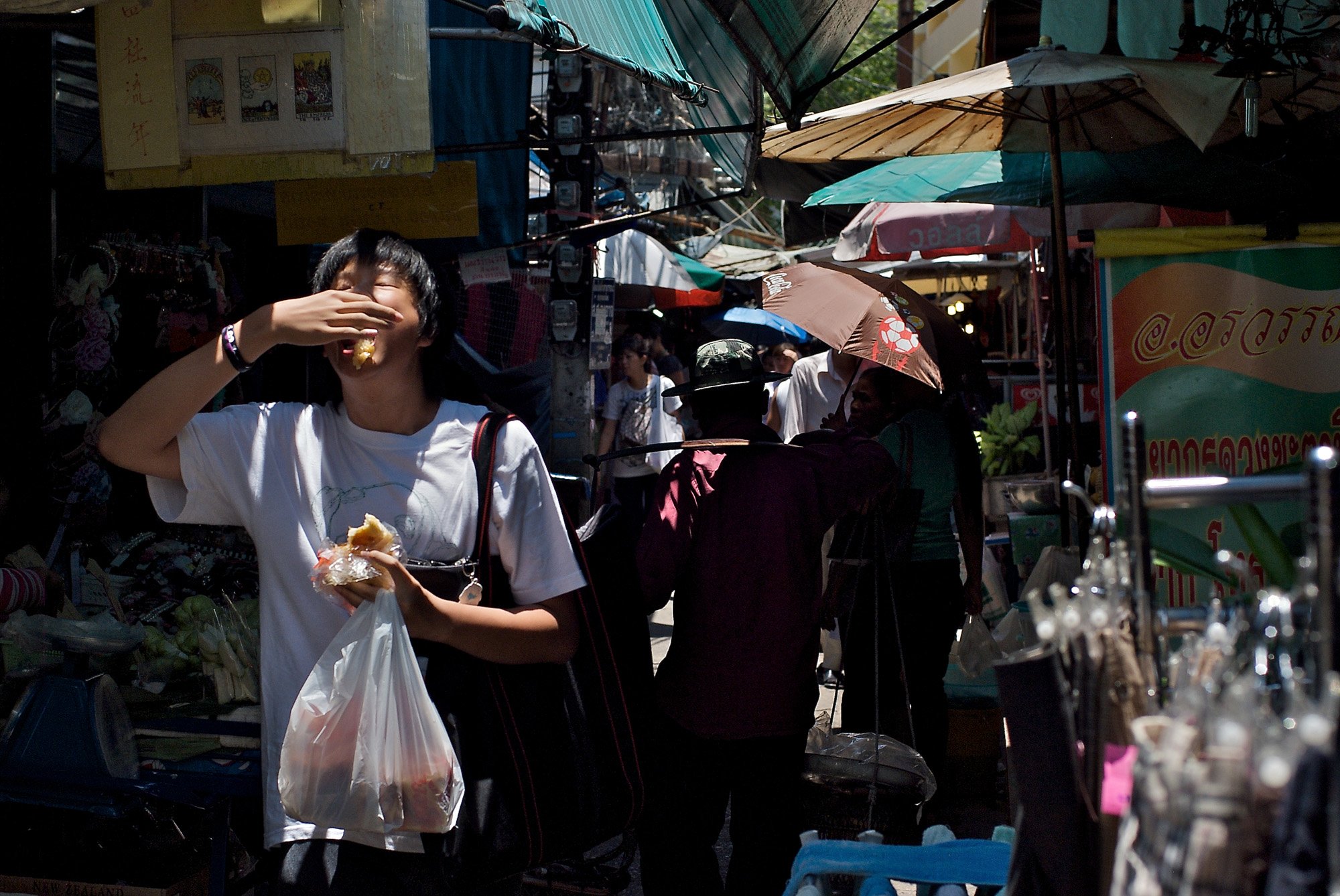
You can tell Thai food is fun to eat by the way people eat it. My featured image (above) shows someone snacking on-the-hoof in a street market on the west (Temple of Dawn) side of the river. Thais enjoy food when they’re alone, when they’re in company, during the morning, afternoon, evening, before bedtime — at any time — and the majority of them remain relatively slim. It’s one of life’s mysteries.

The Western Influence
Among “young upwardly-mobile professionals,” western fast food is popular in Bangkok, as long as it’s fun to eat. Unlike traditional Thai food it always comes in clever packaging and is served from outlets that look reasonably hygienic (above). When you’re dressed in designer clothes it seems to make sense to eat something clean and neat.

Contrast the relaxed, western-style ice cream stand (above) with the frenetic chaos of the street food vendor (below). I’ve called this image “Cleaning Up” although I took it early in the day when you’d normally expect a vendor to be fully prepared for business. However, once he gets that oven with the crooked stovepipe fired up, he’ll be in full swing and there’ll be a queue of customers waiting for him. I’m not sure if that’s his car in the background. Probably not.

Moving Indoors
One option for the displaced street vendor is to move to an organised market space, perhaps even to an indoor market. Every mall has a busy food hall, patronised by crowds of hungry customers.

One of my personal favourites is a market (below) that’s almost unknown to western tourists: the Old Siam Plaza on Burapha Road. It’s a great place for desserts and occupies a very old building, the first of its kind in Bangkok. The guide books invariably describe it as a “hidden treasure” or a “living museum.” These days it’s very much alive, despite having closed and reopened several times in the past.

Divided into two large open areas and three floors, Old Siam Plaza is a place where you can buy anything from a sniper rifle to a wedding dress. Foodwise it offers every dessert from Woon Grob (crispy jelly) and Kanom Sai Sai (sweet coconut steamed in banana leaf) to Sa Koo Sai Moo (steamed tapioca balls) and Khanom Buang (crispy pancakes).

The growing popularity of sweet foods may have something to do with the spread of air conditioning in Bangkok. Maybe that’s why so many activities are moving indoors.

Non-Food Addendum
The famous wholesale flower market, Pak Khlong Talat (“market at the mouth of the canal”) moved indoors in 2016. I suppose it makes sense. Cut flowers last longer in a cool environment. Yet it no longer has the same atmosphere — one which is likely to inspire the street photographer.

The unique atmosphere of Pak Khlong Talat has gone the way of the Covent Garden fruit and vegetable market in London. The place is still there. But the life, activity and everything that made it unique have all disappeared into the past. It’s an inevitable — and entirely natural — process, recorded by street photography so that we don’t forget it completely.

Deliberate Obscurity

When William Eggleston said “I am at war with the obvious” I don’t think he was recommending the deliberate embrace of obscurity. Yet it’s a measure of how far we’ve come that today a photographer can offer complex images with hidden meanings and unusual compositions — a long way from the “rectangle with an object in the middle of it” which Eggleston decried.

The change in how we look at photographic images is similar to that which ushered in the age of Impressionism (and Post-Impressionism, Cubism, Fauvism…yada-yada) while sweeping aside the stultifying influence of the academies. Artists led the way; critics and intelligent onlookers followed.

Playing Catch-Up
Unfortunately, the vast majority of people can be slow to catch up. Perhaps this is because, on the surface, the world looks too familiar to most people. They look at it with an unquestioning eye, whereas the perceptive street photographer sees a completely different reality.

Once you start to look at the world with a questioning eye — wondering why this man is carrying a mysterious object, or why this woman is shielding her face — only then can you begin to see beneath the world’s everyday appearance of normality.

The more adventurous we become in our street compositions, the more closely our photos begin — at least on a superficial level — to resemble “snapshots” rather than perfectly composed photographs.

Eggleston again: “The blindness [of most people] is apparent when someone lets slip the word ‘snapshot’. Ignorance can always be covered by ‘snapshot’. The word has never had any meaning. I am at war with the obvious.”

Man Made
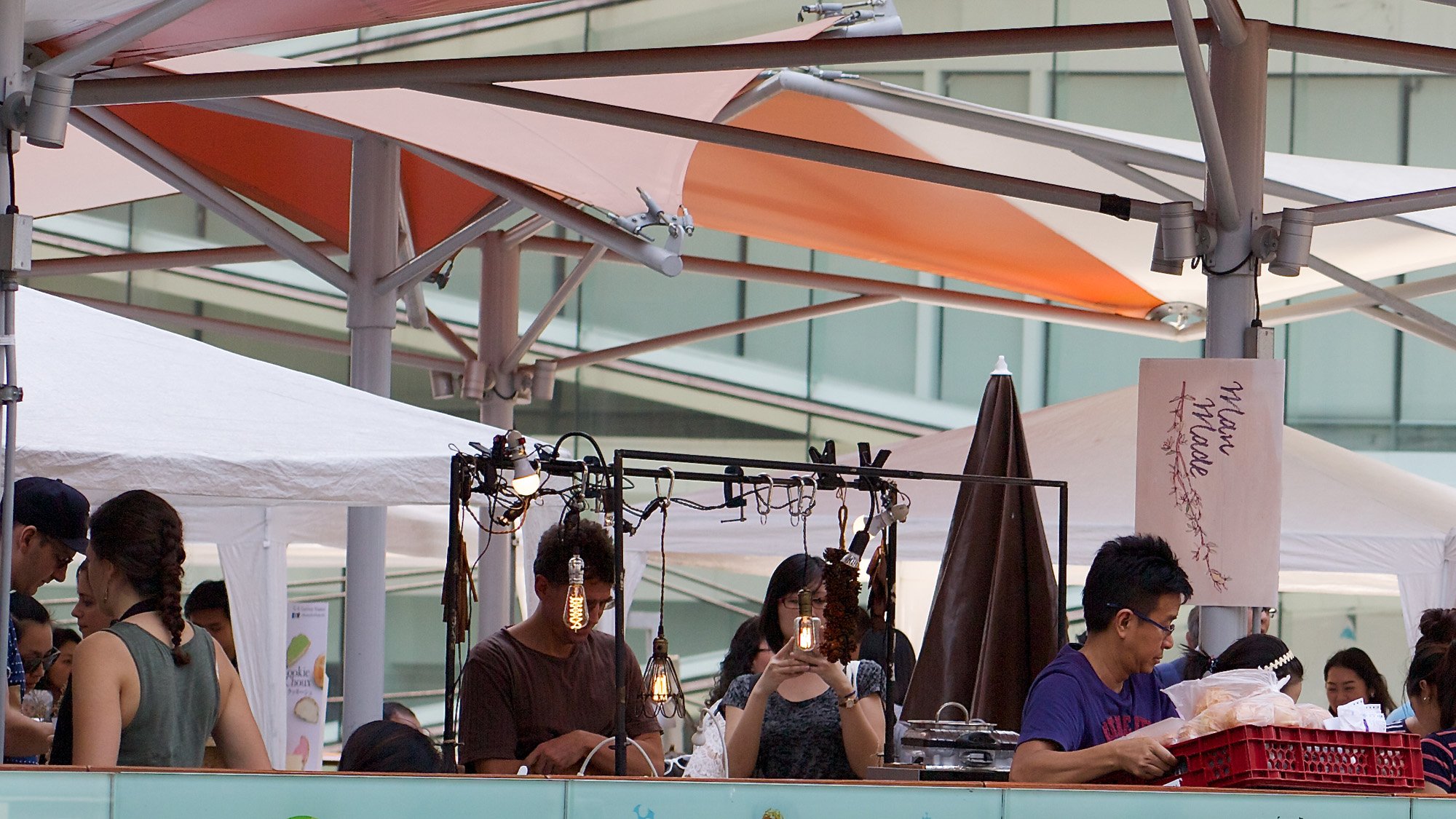
My featured image (above) is far from being obvious. To many people it may look like a hastily taken snapshot! In fact, I composed it very carefully when I took it, so I’m not guilty of just “snapping” a random image.

I was intrigued by the dull light emanating from the ugly light bulbs which appear to be hanging from a tangle of wires on a clothes rack. The bulbs are directly in front of the faces of the two main subjects, making it impossible for us to see the subjects properly. Nonetheless, the “clothes rack” with the lights (and another one without) together make a natural rectangle, cutting out the subjects from the rest of the image.

No fewer than seven people in the photo are wearing glasses — and everyone is looking intently at different objects (which we can’t see). Maybe it’s a Saturday morning sale! I remember taking it on a Saturday (the EXIF confirms it) and if you’re familiar with markets I think you’ll agree the image has a Saturday morning atmosphere.

Apart from the people, the most noticeable elements in the photo are the orange and white canopies and awnings, some of which look a lot more permanent than the others. Beyond them all is the solid structure of the building. Attached to a pillar is a scrawled notice which says: “Man Made.” The words are hard to read because the English language is tricky to decipher when you rotate it ninety degrees.

My picture suggests the idea that many layers of organisation are apparent in the modern world. You can see four of them here: the permanent building, the less permanent orange and white awnings, the temporary stall canopies, and the ongoing, somewhat disorganised, ephemeral muddle of the Saturday vendors. But don’t worry. It’s all “man made” — including my photo.

When Subjects Hide
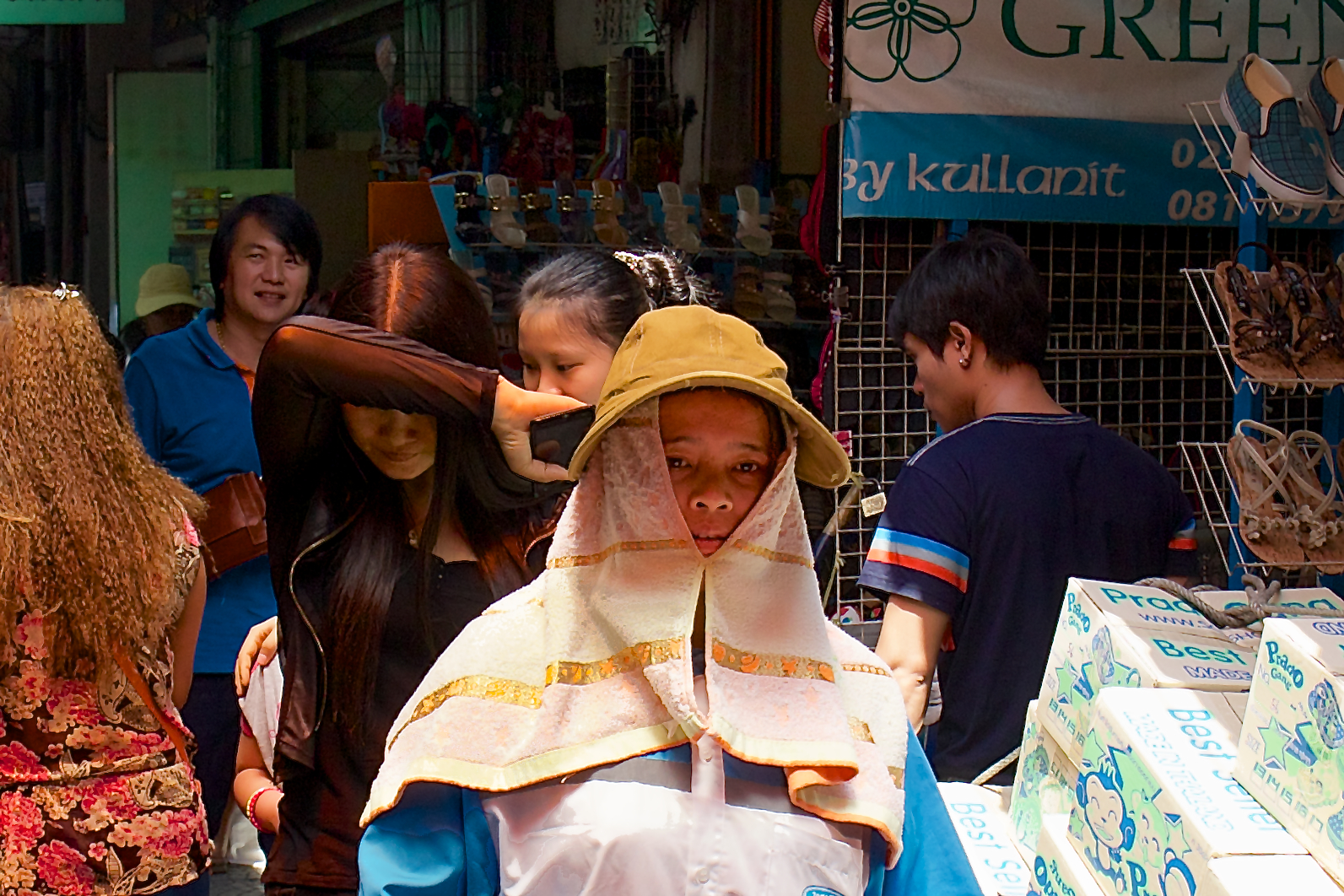
My next picture (below) is not nearly as “obscure.” In fact, the main figure is placed centrally, thus satisfying the demands of (in Eggleston’s words) “more people than I can imagine.”

Yet as you can see, there are really three women near the centre of the frame. It’s just that we tend to notice the main figure first because of her gold-coloured head-gear. The woman with the raised arm is no less interesting photographically because her bronze jacket and hair are an exact match in the afternoon sun. Behind them both is another woman whose hair gleams silver with specular light.

Gold, silver and bronze are the three colours at the centre of the image — and all else is incidental. The onlooker may not be conscious of this combination, but can sense it subconsciously. Partly because of it, the image has a mysterious quality which is hard to pin down (although I’ve done my best).

There’s a smiling man in the background; another man with a prominent ear-ring looks far from happy; a protective hand rests on the shoulder of a child. Surrounding them all — including the gold, silver and bronze women — are endless pairs of sandals. How mundane is that?

I have to admit, I’m at war with the obvious, too.

Street Photographer Goes Birding

If you’ve just built a hide in the woods and bought a 600mm lens, please stop reading now. This morning I looked out of my bedroom window and snapped a baby goldcrest with my Canon 5DIII and 40mm lens, using settings unchanged from the night before.

The fact is: I didn’t have time to change the settings. My street photography instinct is to shoot first and ask questions later, so that’s what I did.

I’ve often caught a glimpse of these tiny birds — Britain’s smallest, at around three inches from beak to tail when fully grown. The babies, like the one in my featured image (above) are between one and two inches long. They flit rapidly from twig to twig among the branches of the Scots Pine in front of my house, looking for spiders and small insects.

A skilled bird photographer could get a much better shot, but I’m quite pleased with my opportunistic effort. The settings, as you can see from the EXIF, were 1/2500th second at f/2.8 with ISO 2000. When the bird sat on the exterior door handle I just grabbed the camera and took the shot quickly, hoping for the best. There was no time to lower the ISO, which I’d been using previously for night-time shots outside.

In fact, the high ISO and shutter speed may have delivered a better picture than I could have expected with more sensible settings. They froze the bird’s movements very well. The biggest problem was getting focus through the double-glazed door, but I aimed for the bird’s eye and that, at least, is sharp. Depth of field is pretty much non-existent, but I like the out-of-focus railings of the balcony and the bright light from the river beyond.

So, does the street photographer’s image of a bird differ from one taken by a professional birder? I think it does, and the difference comes from my motivation for taking the shot. I was not out to document the bird’s appearance or to get the perfect shot of what is, after all, a fairly common bird.

I was struck by the bird’s fragility and innocence — not to mention it’s bravery in venturing close enough for me to photograph it with a 40mm lens. Even an adult goldcrest weighs only six grams. It clings to life at the best of times, and perishes easily in a cold winter. I think my photo shows the poignancy of such a life.

Not the First Time
If I see birds in the street (other than pigeons) I’m sometimes tempted to photograph them. Walking along the sea-front at Phuket in Thailand I came across these two Common Mynah birds (Acridotheres tristis) standing side by side, apparently surveying the beach.

Again, I was struck by (for want of a better word) their “personality.” I’m not sure what else to call it. Presence? Aura? Attitude? They’re obviously not “persons” — as no doubt a fully trained mynah bird would be able to tell you — but they seem to be intelligent and clearly in cahoots with each other.

I was tempted to draw speech bubbles (“Look out, it’s the paparrazi. Let’s pretend we’re just good friends”) but I didn’t want to spoil the atmosphere. With the sun going down and the two birds looking out to sea — just like people do — I thought the image would remind us of our commonality with them. Their evolutionary journey has been no less improbable than our own.

At least this time I was armed with a more powerful lens, a 24-70mm zoom, and I had time to adjust the settings: 1/200th second, f/9, ISO800. The smaller aperture has allowed me to get both birds into focus, despite shooting at 70mm. I focused on the closer of the two, then edged slightly forward.

Much as I love seeing them in their natural habitat, I don’t wish to take up bird photography full-time. Other people do it so well. But if I see an opportunity to take a shot which says something about birds and our relationship with them, I’ll take it.

It’s another form of street photography. With feathers.