Shooting From the Hip, Part I

Is shooting from the hip a good way to take street photos? Such an innocent question! The answer is yes. And no.

In thinking about it very carefully and weighing up the arguments for and against I find myself questioning the very purpose, essence and philosophy of street photography: its ethics, its aesthetics, its whatever.

Let’s look at three arguments in its favour.

1. Shooting from the hip certainly gets you great shots, if only occasionally.
2. It enables you to take shots that would otherwise be impossible. For example, when you know the subject may glance in your direction and ruin the shot if you raise the camera to your eye.
3. It’s often good to get a lower angle of view, looking up at your subject and cutting out extraneous detail from the background.

The featured image (above) shows some of the virtues of shooting from the hip. I like the shot because it identifies a particular moment that cannot be repeated. The light is on outside the Gay Hussar restaurant (which has now closed permanently). Yet the whole scene remains typical of a chilly day in London. I couldn’t have taken the shot in any other way and achieved the same result.
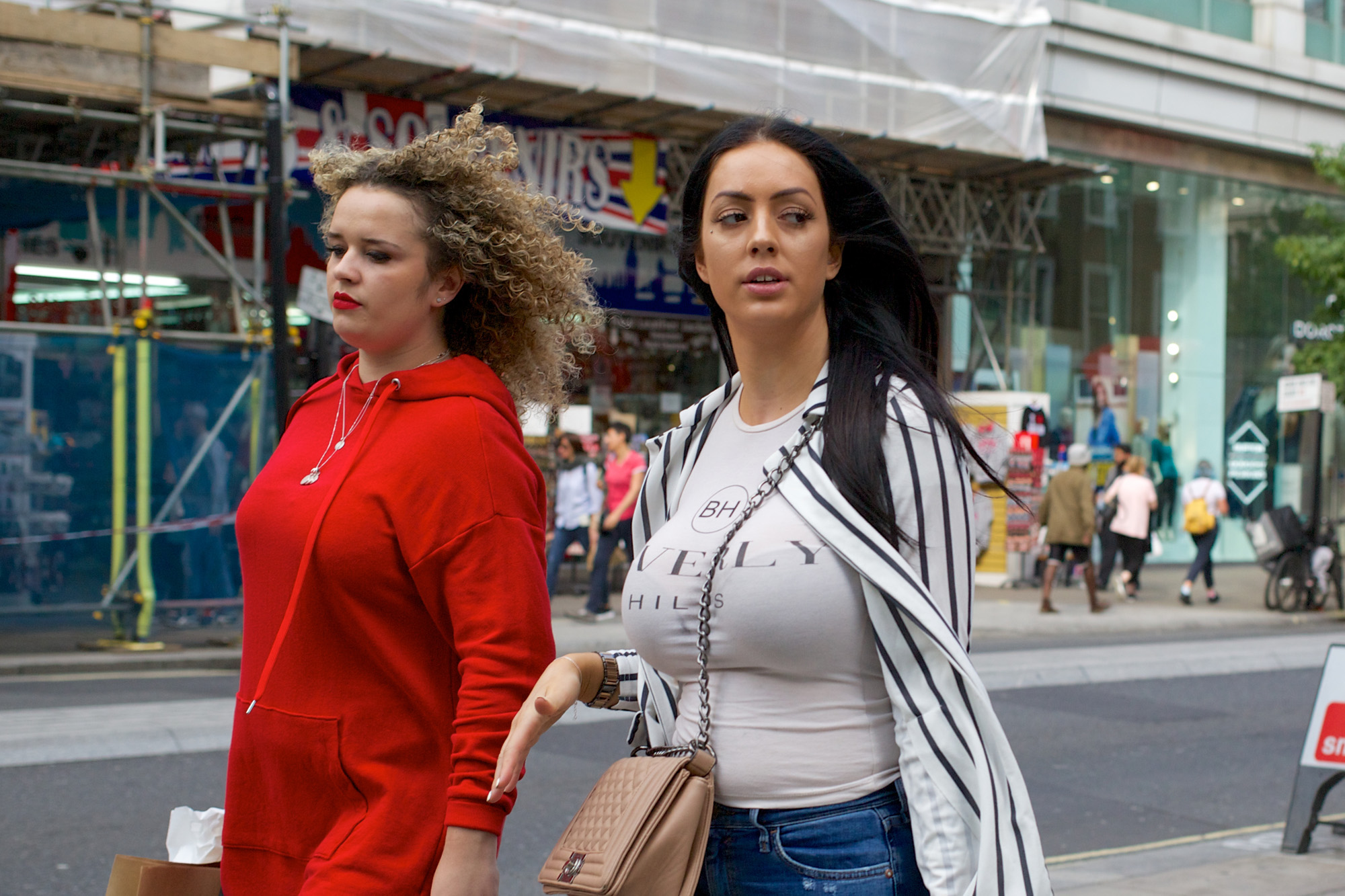
Two women, one gesturing with her hand

The Easy Option?
One argument against shooting from the hip is that it’s too easy: like shooting ducks in a barrel. (Ducks have to be easier than fish). I would counter this by insisting: once you’ve mastered how to get the subject in sharp focus, which isn’t as easy at you might think, the technique does at least allow you to get close without being noticed (image above).

Other Arguments
Now let’s look at three, more effective arguments against it.

1. It can be very “hit and miss,” with a depressingly high percentage of failures.
2. It removes your main control over the composition of each photo taken in this way.
3. With loss of control comes loss of intentionality. In other words, you’re inviting Lady Luck to play her part, rather than deliberately taking the shots you want.

Should we imagine a pair of scales and place these two sets of arguments on either side? Which scale would have the weightier argument overall?

Frankly, I can’t offer a definitive answer. You’ll have to decide for yourself, after giving it a try. Personally, I quite enjoy shooting from the hip and I don’t see any harm in it unless it becomes habitual.

Other photographers are not of the same opinion.

The Winogrand View
For example, American street photographer Garry Winogrand, as reported by Mason Resnick in the June 1988 issue of Modern Photography, was surprisingly adamant that shooting from the hip was a really bad idea.

Wrote Resnick: “I tried to mimic Winogrand’s shooting technique. I went up to people, took their pictures, smiled, nodded, just like the master. Nobody complained; a few smiled back! I tried shooting without looking through the viewfinder, but when Winogrand saw this, he sternly told me never to shoot without looking. ‘You’ll lose control over your framing,’ he warned.”

On looking at Winogrand’s images one could reasonably reply: “What framing?” — and personally I have other objections to his technique, including all that smiling and nodding which tends to make subjects smile back! Would he not have achieved better results — more authentic results — by shooting from the hip?

I’ll leave that rhetorical question hanging in the air.

Parting Shot
Here’s my parting shot: an example of shooting from the hip that was not “hit and miss” and didn’t sacrifice control or composition. In fact, it had been my explicit intention to photograph a tourist couple marching past London’s Coco-de-Mer shop (“Fashionable purveyor of designer sex toys, lingerie and other clothing, erotic books and gifts.”)

I was quickly rewarded with this photo, in which the man succeeds admirably in keeping his eyes in the direction of his companion’s gesture, despite the delights on offer elsewhere.

Neither of them looked in my direction, either. Thank heavens!
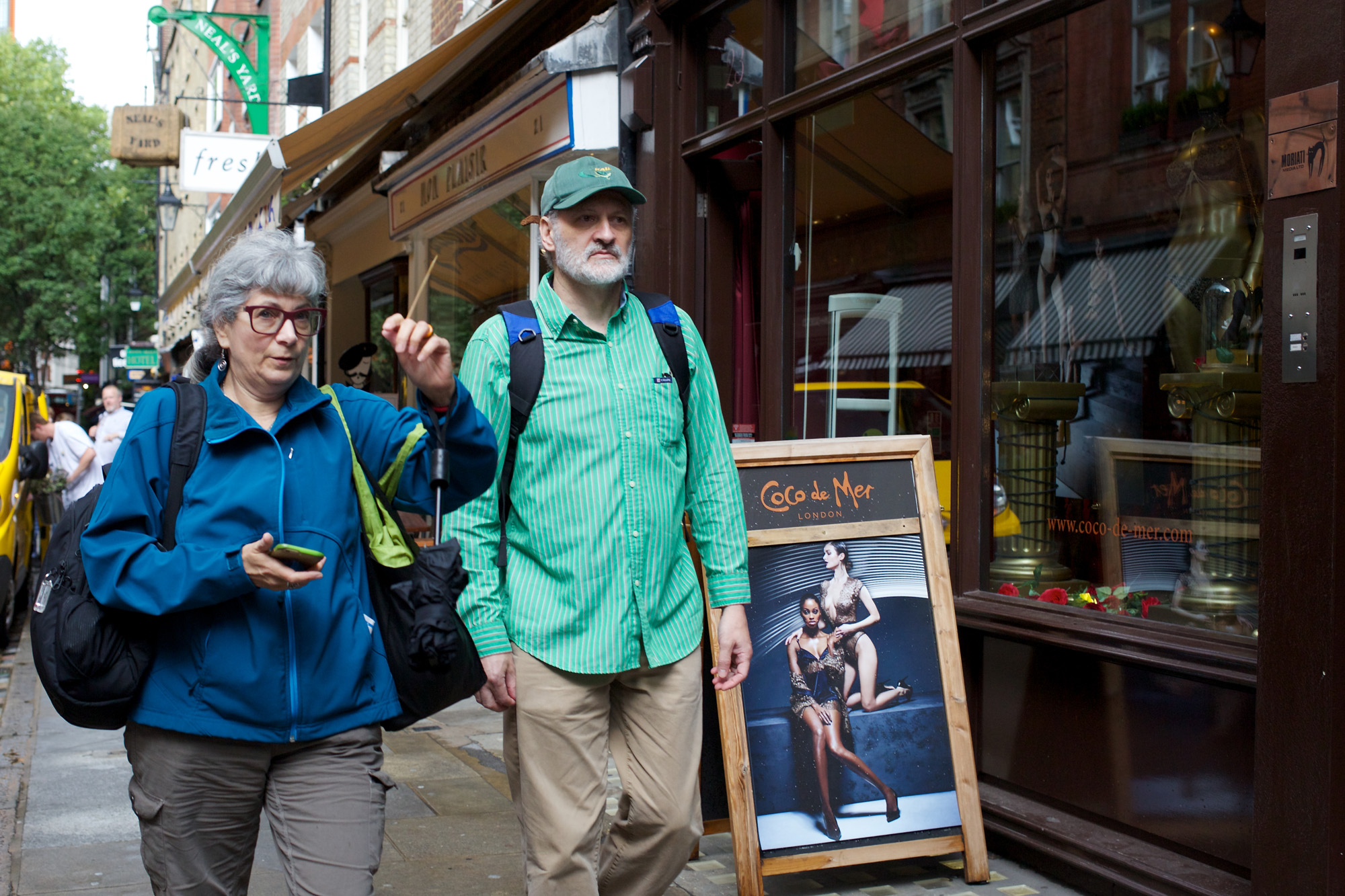
tourists walking past sex shop

Why It’s Best to Have Low Expectations in Street Photography

On the day after Twelfth Night the weather was dull, the light fading, and the Christmas lights had just been switched off. People seemed not to have recovered from their New Year’s hangovers. The chances of getting a good street photo in these circumstances were low, to say the least.

I was quite right. People were scurrying home when I walked into town. The High Street was forlorn without much illumination and getting a shot seemed all but impossible. Then I spotted someone loading a large chair into a vehicle, with two girls sipping drinks nearby, staring wistfully into the distance.

I crossed the road for a better angle, waited for passers-by to catch up — and took the shot you see above. It’s not perfect, but I like it. Somehow it seems to fit the mood and the moment.

Try “No Expectations”
So is it better to have low expectations rather than high ambitions when you go out to take some shots on the street?

Never mind “low expectations,” it’s best to have NO expectations in street photography. It’s the only way to avoid disappointment when you return home without the perfect shot.

Frankly, I never have any expectations of getting a decent shot on a quiet day in my home town, but one time I chanced upon five men in motorcycle outfits walking side-by-side. I’ve always valued this shot because I didn’t expect it.

Five men in motorcycling gear

I’m not suggesting street photography is a hit-and-miss activity. It isn’t. With flair, skill and lots of experience you can go out and give a wonderful performance. It’s the rest of the cast — the world at large — who may be having an “off day.”

It’s possible you’ll find yourself asking, somewhat ungrammatically: is it me or is it them? (‘Tis I? Nay, ’tis they!) In other words, have you failed to get the perfect shot because:

1. You didn’t try hard enough.
2. You weren’t looking properly.
3. You missed golden opportunities.
4. You didn’t use the right camera settings.

Or did you fail because:

1. The weather was too gloomy.
2. There were too few people around.
3. Those who were around were too gloomy.
4. No opportunity presented itself.

These two sets of possible reasons tend to play off each other. You start mixing them together. For example, you may think that no opportunity presented itself because you weren’t in the right place (very likely!) and therefore you weren’t trying hard enough.

However, you’d be wrong to beat yourself up. You were trying hard to be in the right place, but it didn’t work out. At that exact time, somewhere else in the world, another photographer was getting (and perhaps fluffing) a better opportunity. You just didn’t know where to go.

Empty Hand Syndrome
I’ve spoken with other street photographers about the “empty hand” syndrome — of returning home with nothing worth sharing — and I think it may affect the experienced photographer more than the beginner. It happens when nothing you see fits perfectly with your style. Beginners have not yet developed a style, so they can feel reasonably satisfied when returning with just a few visually interesting shots.

When you develop a style — when you start to notice certain configurations of people in the street and photograph them in your own particular way — you begin to have expectations which are not fulfilled every time. That’s why you should be prepared to have a post mortem analysis when you return home.

Was it I? Or was it the world? Just possibly it could have been both.

When the Composition Isn’t Obvious in Street Photography

There’s a school of thought which says the best compositions are the tried and tested ones, but another which insists on the need to be creative and avoid the obvious. Who’s right? And why?

No art form can advance if all the people who practice it merely adhere to a set of rules, however sensible these rules may appear to be. After all, fashion changes. Nature evolves. Dinosaurs become “so last year.”

I’m conservative by nature and I strongly disapprove when someone builds an ugly extension to a house I once occupied, or when the government imposes new regulations affecting tax or business. But in matters of art I assume the role of agitator, provocateur, and would-be revolutionary.

Invention v. Tradition
Art requires both stability and instability: the steady hand of tradition and the killer instinct of revolution. Most artists combine characteristics from both categories. Their creative talents compel them to be inventive, but taste, tradition, and a desire to communicate in a language people understand — all act as restraints, keeping them firmly grounded.

I’m guessing that many street photographers find themselves caught in this dilemma when they have to make basic decisions about where and when to point the camera, how to frame the composition, and what camera settings to use.

When you’re faced with thousands of different options you need to have an overriding purpose to govern your actions. Honing this purpose (yes, you can hone a purpose!) consists of balancing the stable and unstable elements in your work. You need to cling to certain things — such as your guiding moral sense, or a desire to represent objects faithfully, or even something simple like retaining at least one true vertical in the image — while still leaving room to experiment and play.

Composition, For Example
I think this process can best be demonstrated in composition, which is clearly one of the most fundamental aspects of street photography.

Being guided by easy rules of thumb like the “rule of thirds” is not sufficient in matters of composition. You need a much larger repertoire of compositions that you know will work. For me, composition is a key element in my photography, so if I had only one overriding option — such as compose in thirds — I’d soon get very bored with the results.

Here are a few options among the dozens you can use. You can divide the image into two halves, separated by a natural dividing line, providing there is a vital relationship between each side of the image. Alternatively, you can base the composition on a pyramid shape, anchored by deep shade at the bottom and tapering to a point higher up the frame. Or you can make one object the central focus of the image, with all the other figures and objects seeming to dance around it.

I chose the last of these three options when I took the featured image (above). My overriding purpose (honed beforehand) was to keep the composition stable while moving in close to achieve some kind of intimacy with the subject. In other words, I was reasonably certain about the effect of the stable composition, less so regarding the “dance” of the others elements around it.

In the Centre
The central object is the voluminous bra and panty set hanging from a plastic chain on the stall. The bra says “I love you, I love you” over and over again, while the other item says “Shine like a star, shine like a star.”

The young women take no interest in the large brassiere, being more concerned with feeling the quality of various inserts that will make breasts look big enough to fill it. It’s as though the large bra has been deliberately displayed as the standard size, to which all women must adjust themselves artificially — regardless of their enviable figures.

By moving in close I was able to capture several elements that express the feeling and message of the content. One woman scratches the back of her head in a gesture of indecision, the other two feel the sponginess of the inserts. Are they serious? Or is this the female equivalent of “kicking the tyres,” as when men prowl around the forecourt of a car dealership?

Frankly, I have no idea — and I didn’t really like to ask. In fact, I don’t think they were aware that I was taking pictures. I would have told them they could save their money by not believing the message on the box: “Become attractive lady with perfect breast.” To my mind, any lady with “perfect leg” is, by definition, attractive.

Avoiding the Obvious
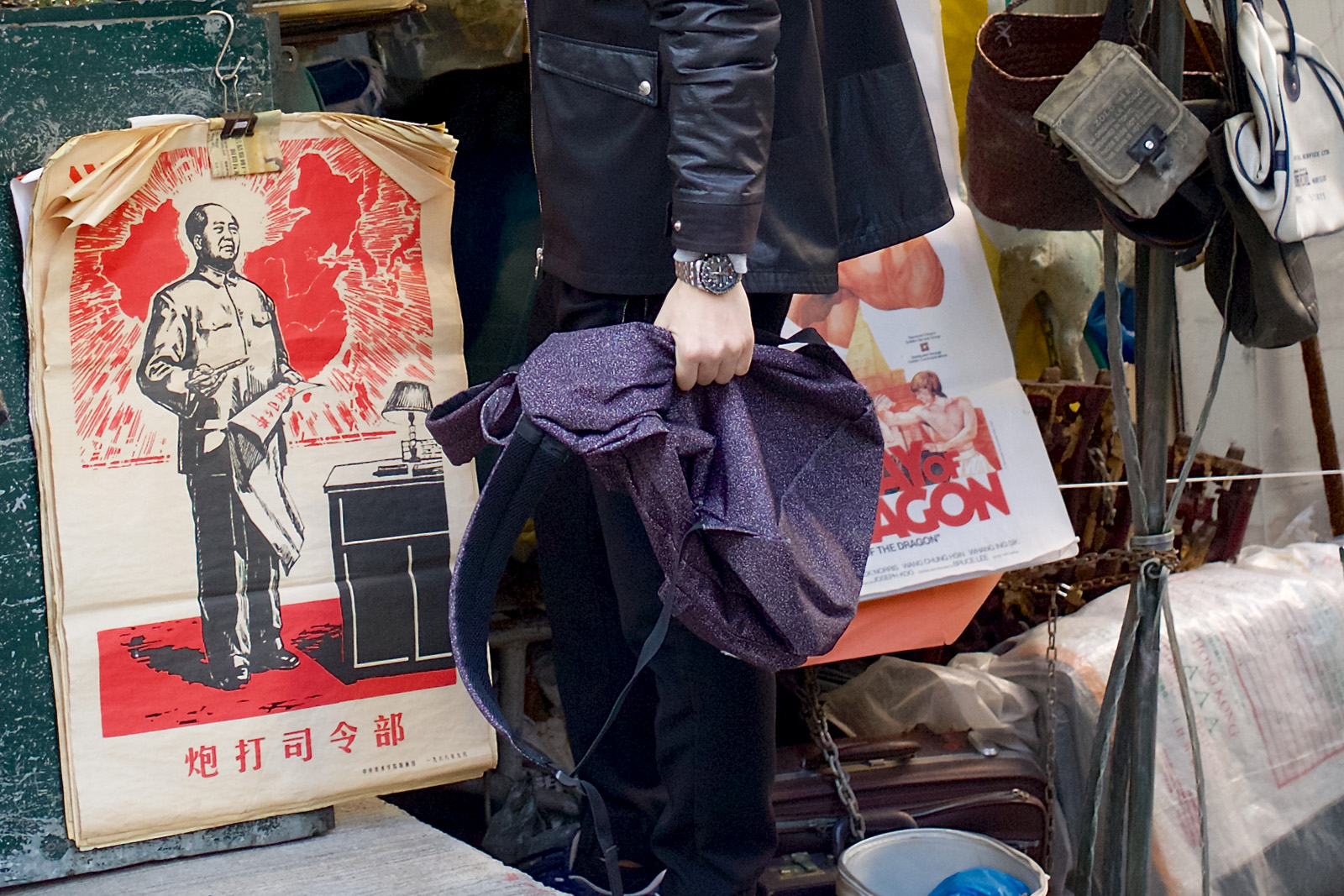
Here’s another, perhaps less exciting subject, to which I’ve applied the same principle. I’ve placed the purple backpack in the centre of the frame, partly because it’s such a striking colour but also because it’s being gripped firmly by a young man’s hand. Behind him are a stack of posters: Chairman Mao posters on the left, and kung fu movie posters on the right.

hand clasping bag in front of posters

Because it’s a stall selling antiques and memorabilia, everything on it is old, or, being in Hong Kong, old-ish. Only the man’s hand is young and alive. Even his bag has seen better days!

My method, as before, was first to find the content for a photograph, then to chose a composition, and finally to figure out the best way — and the best moment — to get the shot. As always in street photography, timing was crucial. It was important to get a clear image of Chairman Mao on one side and Bruce Lee in “The Way of the Dragon” on the other. The impression I wanted to give was of a young man holding on to the present in the midst of the past, brought to a standstill by the undesirability of all the objects offered for sale.

In neither of the examples I’ve given were the compositions obvious on first looking at the scene in front of me. When faced with a market stall a photographer naturally sees the stallholder as a potential target, perhaps in conversation with a customer. You have to look more closely to see what’s less obvious, to find the details that allow you to tell a different story.

By moving in close, by shifting your attention up, down or to the side, and by ignoring the siren call of the obvious — you can uncover stories where you least expect them. That’s the joy of street photography. When it works.

Same Place, Different Time

“What are the chances?” That’s what I say to myself when I revisit a spot where I’ve taken a street photo that worked out well. Will it happen again? Will someone be there — in more or less the same place — enabling me to take another image, just as good as the first?

I’m constantly exploring new scenes and walking along streets I’ve never followed previously. I find that my confidence level changes according to the “lie of the land.” Let me explain what I mean.

In certain places I get the feeling I’m more likely to find reality arranging itself into a street photo than in other, less photo-friendly places. Sometimes it’s because there’s a confluence of streets: several streets meeting at a single junction. Or it could be because there’s a good vantage point, with perhaps an incline — up or down — opening a vista to another place beyond.

I particularly like places where people are obliged to jostle against each other or take exceptional steps to avoid collisions. Markets are great for finding busy spots where people are brought into close proximity. Not only do the inevitable interactions provide excellent photo opportunities, they also keep people sufficiently occupied to stop them noticing the camera.

Favoured Places
One of my favourite locations is in Central London outside a café where I frequently grab lunch. I always take a few shots before going in, then a few more when I emerge, refreshed and raring to go. However, you’d never guess it was the same spot, so I have to find alternative examples for this article. After all, my main purpose in pursuing “Same Place, Different Time” is to show an identifiable background, transformed by variations in the foreground subject.

I took the featured image (above) with the aim of illustrating places “Where Bad Things Have Happened.” It was close to this corner on Gerrard Street where, some years ago, one of the London Triad gangs clashed with a rival Snakehead gang, newly arrived from mainland China. Machetes were used to chop up customers in a downstairs dining area and one person died.

In the end, I wrote the article without using pictures from Chinatown, so this image became surplus to requirements. It’s still one of my favourites — and probably better than the illustrations I used. It carries it’s own alternative message of hope and despair.

A woman pauses in front of a casino, carrying a bag which says: “Friends are more important than money.” A man sits behind her, smoking a cigarette — despite, it must be said, the nasty-looking spikes which seem to be positioned to deter squatting punters who’ve lost their money. “Breathe deeply,” says the bag. Really, there’s a whole unspoken conversation happening here.

Returning to the Scene
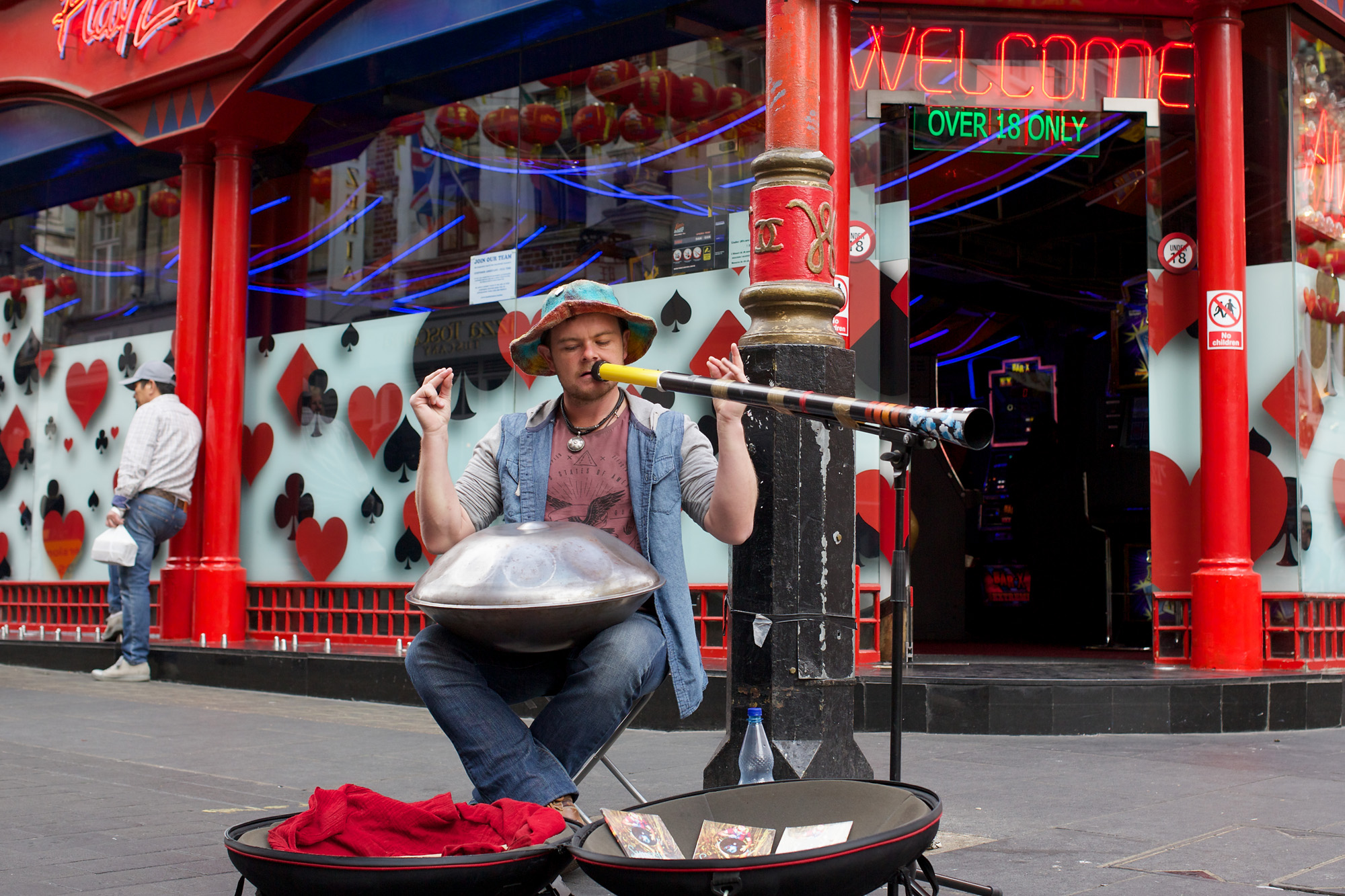
A few weeks later I found myself in the same place, wondering if I could get another shot using the same colourful background. This time there was a street musician outside the casino, playing a steel bongo drum and occasionally blowing on what appeared to be a miniature didgeridoo. I don’t normally photograph street musicians, but I could scarcely avoid him if I wanted to use this particular background.

Busker outside casino
The two pictures make an interesting pair. In the second one (just above) there’s another man leaning against the pillars on the left, not unlike the seated figure in the featured image at the top. He, too, is turning his back on the open door of the casino with its big “Welcome” sign. Are both men gambling addicts who’re trying to shake the habit?

Meanwhile, the musician appears to be warning other gamblers by blowing on the didgeridoo — happily positioned in the middle of doorway. Yes, it’s a fanciful interpretation, but I don’t think it’s too farfetched.

Luring the Punters
The casino itself is covered in warning signs: “No Children,” “Over 18 Only” and so on. In a sense, these self-imposed warnings are actually adverts — “come on” signals for people who want to feel grown up and in charge of their own lives.

The messages are, of course, very misleading — as many punters discover to their cost. Fixed-odds betting terminals, such as those found in High Street casinos, can relieve punters of their entire year’s wages in a single session, as the charity GambleAware recently reported.

The idea that a gambler is ever “in charge” is a complete illusion because the casino always wins in the end. By contrast, a street musician is completely independent and this one seems to be in charge of his own destiny, at least for the time being.

So yes, as a street photographer you can return to the same location and get a second shot. It’s a gamble. But there’s no big money involved — and you can never lose your original stake.

Up Close and Personal

One of those silly “rules of thumb” in street photography is: “You can never get too close.” I think you can, but I’m not going to show any examples of it here.

There’s close and there’s too close. We need to define which is which. My personal view is that “too close” is when the lens begins to distort faces, as when you shove a 28mm lens a couple of feet away from somebody’s nose. I mean: what do you expect? The result is always the uglification of the subject — and frankly, I don’t think that’s fair.

Shooting strangers close enough to distort their faces is like shooting polar bears with a machine gun from a helicopter. The latter has nothing to do with “sport” and the former nothing to do with street photography.

After all, where’s the street? Without a little bit of context, the photo is not a street photo but simply a candid portrait, taken at too close a range.

Close, But Not Too Close
The pictures I’m showing here represent the maximum closeness I’m willing to tolerate. My featured image (above) shows a smartly dressed (and presumably married) couple checking their phones. I was tempted to use it for a blog post called “Everyone’s On the Phone,” but I had so many others from the same session it became surplus to requirements.

There was something so “Titianesque” about the woman’s beautiful scarf I couldn’t resist taking a shot as I walked past. I wasn’t looking through the viewfinder so I could only guess the framing and focus. Fortunately, this gets easier with practice, and I was confident the shot would work.

Apart from the subjects’ smart dress, their absorption in their task (probably checking a map), and the low camera position, what makes the image is the quality of the light. This was no accident. Before scheduling a day’s street photography I study the weather forecasts closely to make sure conditions will be favourable.

It’s possible to shoot in all weathers, but I prefer the day to be cloudy but bright, illuminating people and their surroundings with soft, even light. Only on those days can you move in close and take candid street portraits which are not unflattering to the subject.

The Virtue of Light and Colour
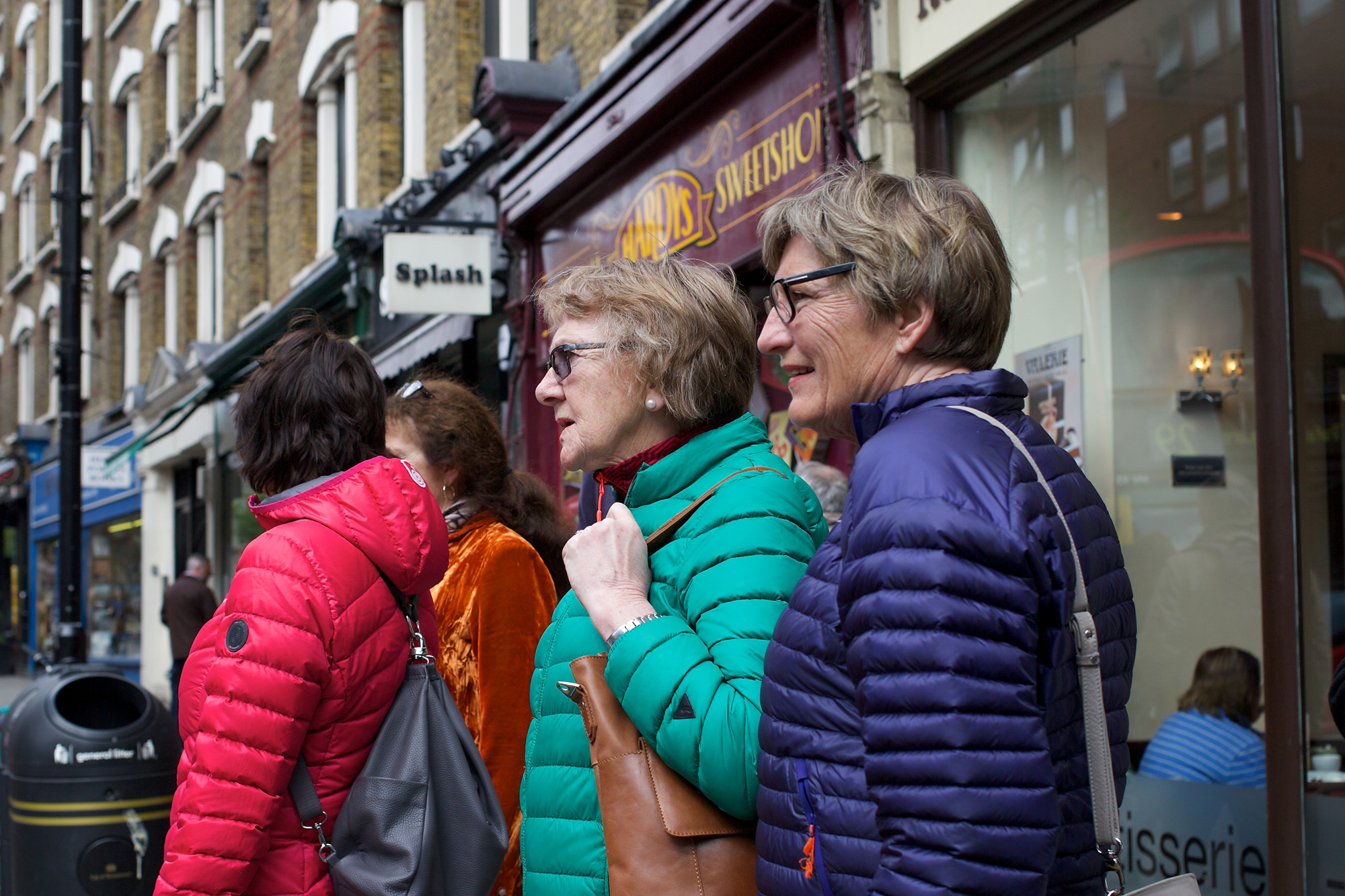
Here’s another example (below), taken two hours later. It’s now around lunchtime — and on a sunny day this would have been a terrible shot. As it is, the colourful jackets of these ladies are shown to best advantage (did they buy them together?) even though the lady at the back is curiously out of step with the others. Fortunately, the word “Splash” appears just above her head, accentuating the discrepancy and making it seem deliberate.

You can see why I like to photograph in colour. Once you’ve decided to use colour you have to start thinking about the light — and, of course, the colours in the subject. That’s why I concentrate on light and colour, which I regard as being at least the equal of “form” in the triumvirate of key elements in the art of street photography.

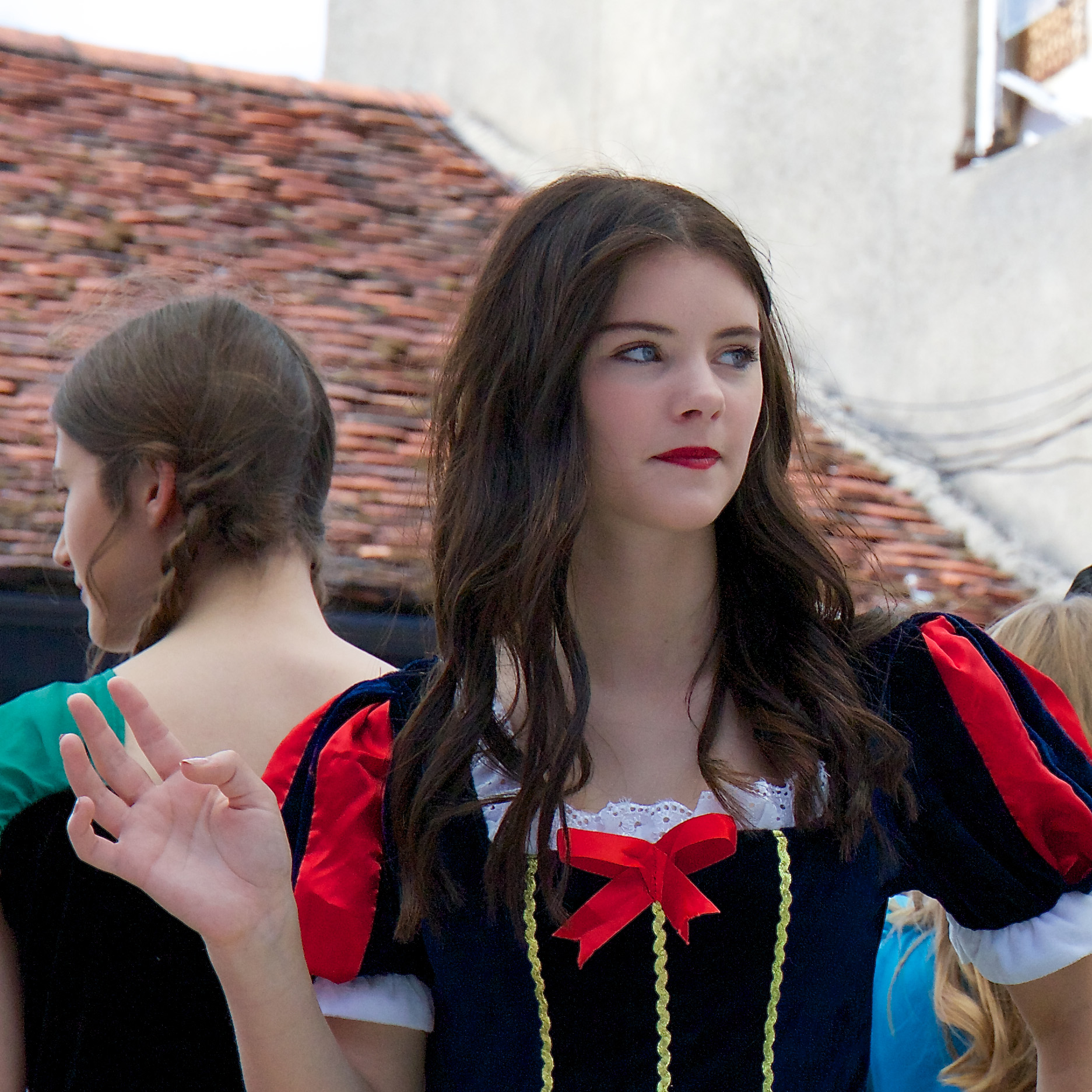
My next shot (below) was also taken in good light. On carnival days in my hometown you’re pretty much guaranteed to see some colour, but you just have to hope for the right conditions. This time, I was lucky. The light was ideal for candid portraits, bringing out the beauty of everyone who’d chosen to present themselves attractively.

Girl in carnival

The girls in the photo are wearing dresses that are somewhat in the Renaissance style, with flared shoulders not unlike Michelangelo’s design for the Swiss Guard at the Vatican. Sorry Michelangelo, I much prefer this shortsleeved, feminine version, without the deep yellow. The Swiss Guard always seem to be “out of gamut” in colour photography, making yellow look orange in most digital pictures.

When the Sun Comes Out
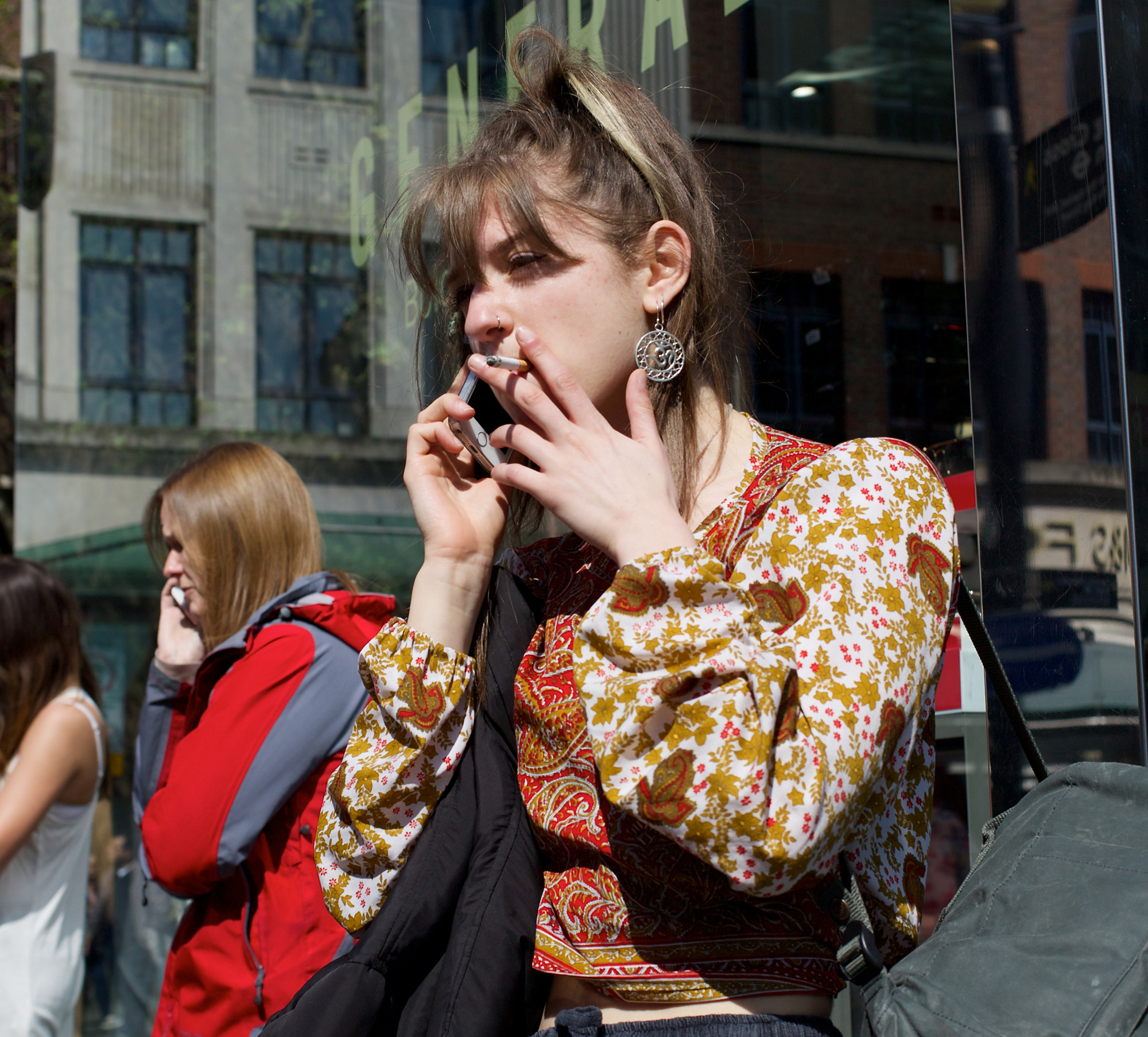
Here’s a final shot which I’m including to show the difference when the sun comes out. It’s not bad — I like its informality and the way in which the subject is clutching her jacket under one arm. The April sun is not especially intense, but it’s not as flattering as the gentle light of an overcast day.

Woman smoking cigarette, chatting on phone

You can tell a lot about the uncertainty of the weather by looking at the photo. Whereas the main subject has removed her jacket, the girl with the red and grey coat is keeping hers on, while another person at the edge of the frame appears to have ventured out in a flimsy, sleeveless dress.

It makes me wonder. Are they all calling up to get the latest weather forecast? Or are they checking if their lunch dates are on their way?

That’s the trouble when “Everyone’s On the Phone.” You can never tell what they’re doing, no matter how “Up Close and Personal” you get.

Home or Away? Travel and the Street Photographer

Were you born and brought up in a city? Let us assume you were. You know every neighbourhood, every shortcut, every bridge and underpass. So who could be better than you to take street photos in this wonderful metropolis?

You have one or two big advantages. You’re there. That’s a good start. You know your way around. You know the look and feel of various districts, which ones are safe and where you need to take extra care. You also know what these places look like in different weather conditions: Washington Square under snow; Place de la République in the rain. All these advantages give you a head start.

Breezing In
But what happens? A street photographer breezes in from abroad and sees your city with fresh eyes. He finds artistic possibilities in places you’ve overlooked because of their familiarity, their ordinariness.

To the foreigner, everything in your city is exotic. A commonplace object or an activity that’s taken for granted may, to the foreigner, assume a symbolic meaning that’s completely lost on you. Let me give you an example.

No Offence Meant
I was travelling across the island of Phuket with a well-known Thai artist. I think one of my comments may have offended him.

We were overtaking lots of people on scooters: one, two, or three people on each one, and occasionally a family of five! I said: “I think the scooter symbolises something about Thailand. I wonder if I could get a classic shot to express that idea?”

I was expecting the artist to make some sort of comment in reply, or at least ask: “What does it symbolise?” But he acted as though I’d said nothing at all. Maybe he was thinking of all the more elevated concepts one could use to symbolise his country: the monarchy, the palaces, the native flora and fauna.

But as I tried to explain (still without any response), to my foreign eye the scooter symbolises the plucky determination of the Thai people, their almost contradictory ability to accept limitations while finding a way to circumvent them. No one in Europe or America transports a family of five on a Lambretta, do they? Yet in a vibrant, developing country where everyone’s an entrepreneur, the scooter is a symbol of progress and energy. It’s optimistic! You have to be optimistic when you’re five-up on a bike without crash helmets.

family transport

Thinking back on this episode I can understand it from the artist’s point of view. He probably felt I was belittling his country when in fact the opposite was true. You can’t belittle a country by drawing attention to some of its most admirable qualities. I was looking at something which he overlooks because it’s so commonplace. Ubiquitous subjects like scooters in Thailand or salarymen in Tokyo can tell us much about a society, if only we can see them with fresh eyes.

A Reason to Travel
My example gives you an excellent reason for travelling. Go to foreign places. Look at them objectively and try to figure out what’s going on. You don’t need a deep understanding of a country to take great street photos, but I think you do need a feel for the place and its people. Every city has different moods, depending on where you go. In Bangkok I can always get happy pictures in Asiatique, sad ones on Charoen Krung, gritty ones just about everywhere. The impression you give to those who look at your images will be governed by what catches your eye and the thought you put behind it.

Please don’t ask me: “Where should I go?” Any country, any city is a potential source of great subjects. I’m aware that some countries are much more favourable than others towards street photographers. If you’re in Vienna and you want to take a photo that has one or more Austrians in it you’re supposed, by law, to get their permission. Yes, that’s an absurd law, as is any law which is totally unenforceable — and it may have an inhibiting effect on street photography.

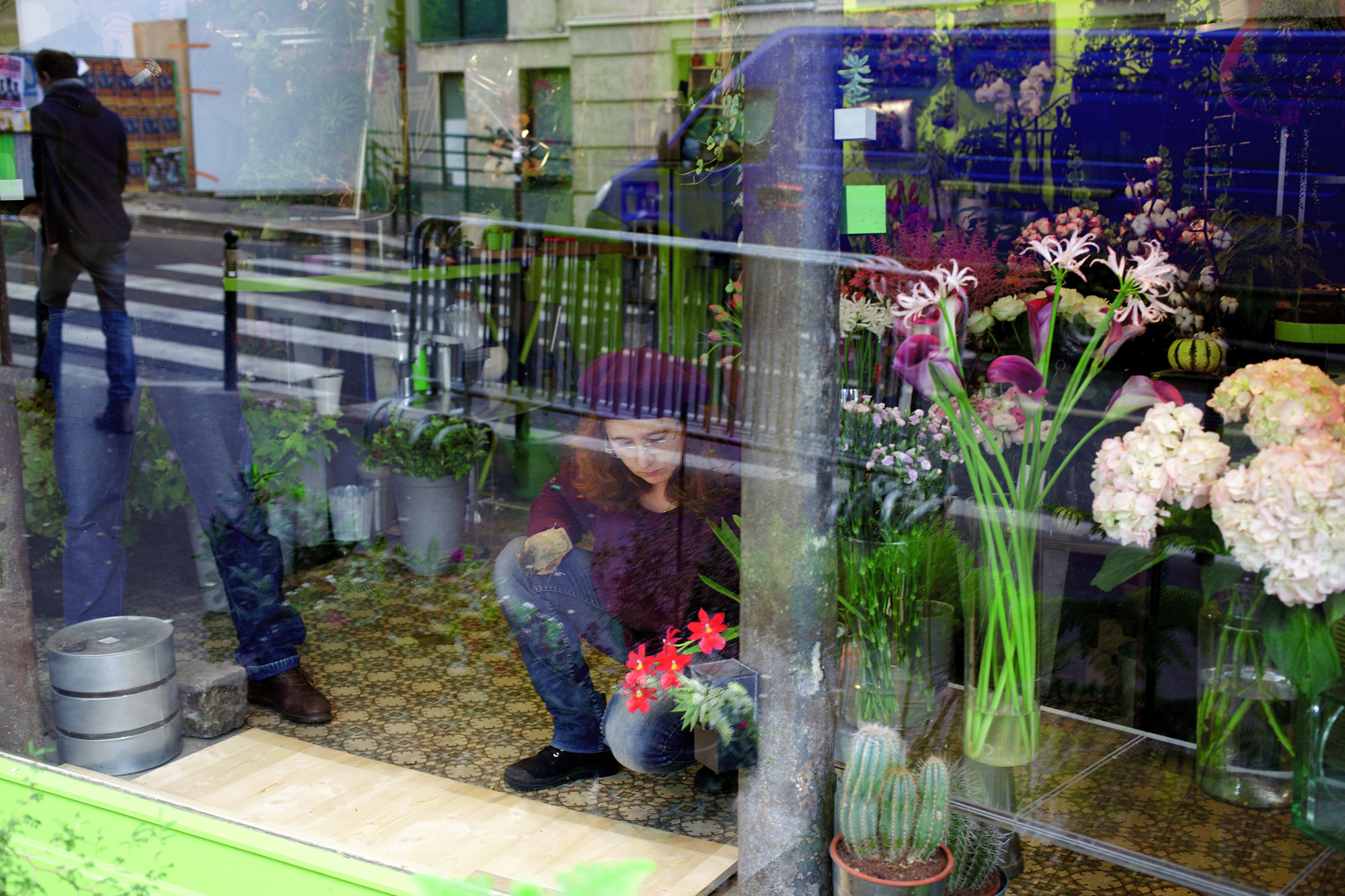
The French have passed a similar law, making Paris — once the home of street photography — another place where photographing strangers in public is deemed to be an invasion of their privacy. Frankly, I just ignore it. I doubt if this lady in the florist shop (below) would object to my candid picture of her, tending the flowers.

florist

Different Mindsets
My one word of warning is not about the law, or even about the dangers of venturing naively into tough areas, it’s this: Don’t confuse travel photography with street photography.

These two activities demand different mindsets. In a sense, the travel photographer never really leaves home: he or she simply brings back memories of foreign places. But the street photographer is really there: up close and personal, getting under the skin of a place and inside the minds of its people.

To practice street photography successfully in foreign cities you really need to extend your stay until you’re no longer a traveller. Settle down for a month or two, if time permits. Get to know the city. When your eyes become jaded, go home.

You’ll bring back more than memories.

Sharing Someone Else’s Quiet Moment

The more street photography I do — as well as thinking and writing about it — the more I become convinced that it’s an exercise in finding contrasts.

Even when the content is minimal, when the image is largely abstract, there’s visual contrast in shapes and tones. Among styles that are more, shall we say “literary” — where people and places are represented realistically — there’s contrast within the content.

This blog post is about one example of contrast: when you find an individual who is having a quiet moment amid the noise and activity of the city.

Why It Works
I like this subject because it plays on the pre-existing tension that always exists between subject and setting in street photography. Although the modern urban environment caters to the needs of the individual by providing food and shelter, its primary master is commerce. There’s no free lunch. Sometimes you have to fight for lunch — and you’re lucky if it doesn’t poison you (as it did me earlier this week in a London café).

With all the hassle of living or working in an urban setting, even the most active individual needs a break. I try not to intrude on anyone’s relaxing moment, but I can’t resist taking a picture, unobserved, if I think the subject and setting have the necessary contrast.

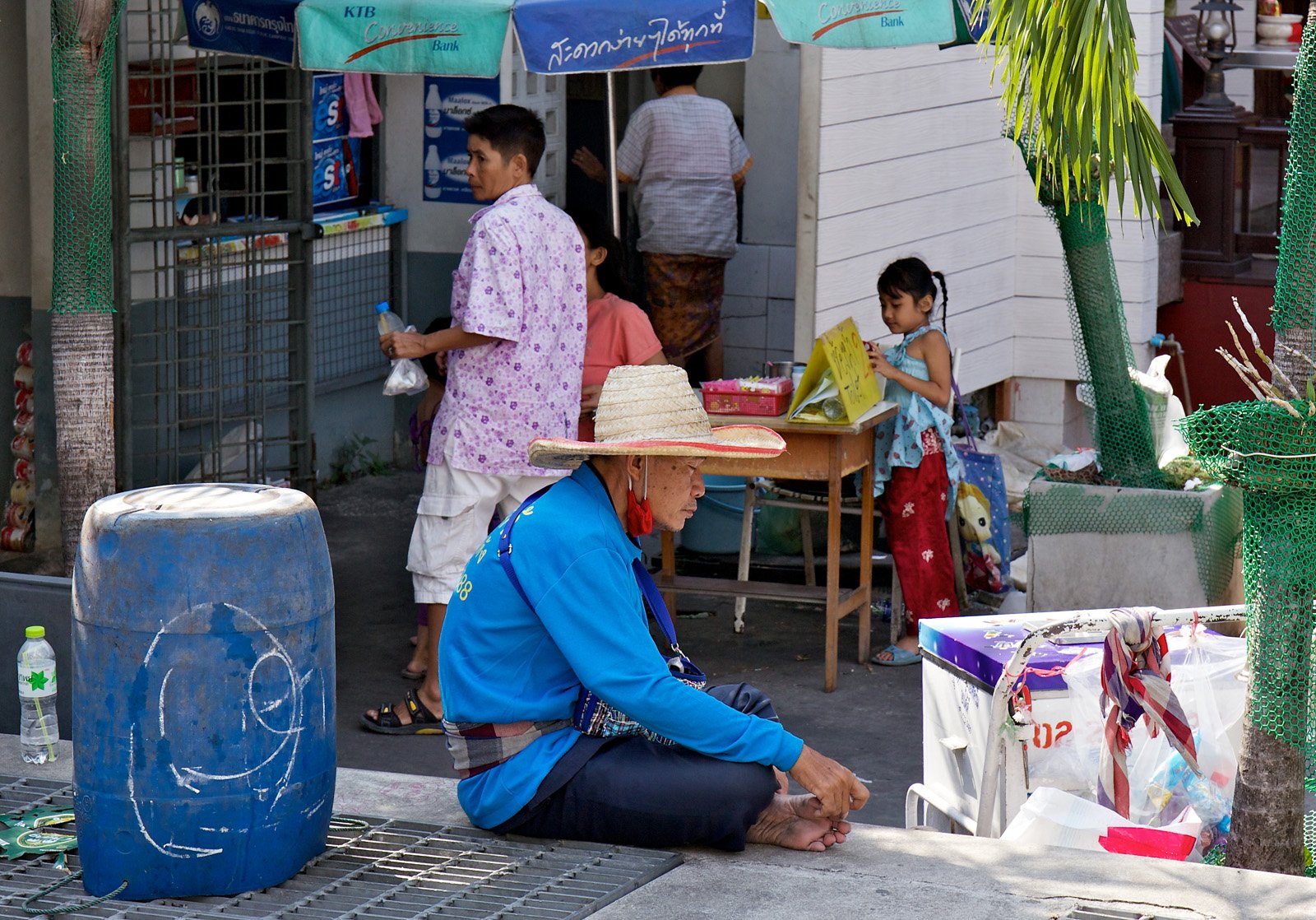
My featured image (above) demonstrates what I have in mind. There are few places on Earth more frenetic than the busiest parts of Bangkok. Here, a street seller takes time out to sit down, close his eyes, rub his feet, and enter a private world of meditation. All around him, people come and go, children play, and life goes on at its natural pace.

I took the picture because the subject seemed blissfully isolated in a world of his own, yet he’s clearly an integral part of the city when he’s at work.

I often like to give the impression that more is happening outside the frame than what we see within it. Here, a man in a patterned shirt stands up and looks at something off-camera, reinforcing the idea of activity continuing beyond the frame. No one looks at the man in blue. He no longer counts as a potential subject of interest for the others because he’s doing nothing. He’s no longer part of the city.

Perhaps I can best express it like this. People opt out. My photos reinstate them. That’s really all there is to it.

They’ll Step Over You
Some years ago when I moved to New York, the American director of the company I worked for (a man from the mid-West) warned me that NYC could be a really tough gig. He said: “If you lie down in the middle of the sidewalk they’ll just step over you. They won’t walk around you or stop to find out what’s wrong.”

I think he was just trying to tell me to get with the pace and stay on my feet. New Yorkers are among the warmest people once you get to know them. Their hard exterior is just another defence mechanism against the perils of big city life.

Girl sitting by roadside

Even a small town in England can become oppressive. The girl in my image (above) has opted out temporarily and chosen to park herself on the kerbside, inches from the traffic. I’d never seen anyone do this before, so I took the picture and managed to include the legs of passing pedestrians. Again, the world moves on, but the individual — in sharp contrast — opts out for reasons that are entirely personal and unknown to the onlooker.

There’s Always Something Odd
Most of us find a park or a café where we can get away from traffic and pedestrians and enjoy a quiet moment. There’s usually something odd — or at least, something out of the ordinary — about those who take their breaks by the roadside.

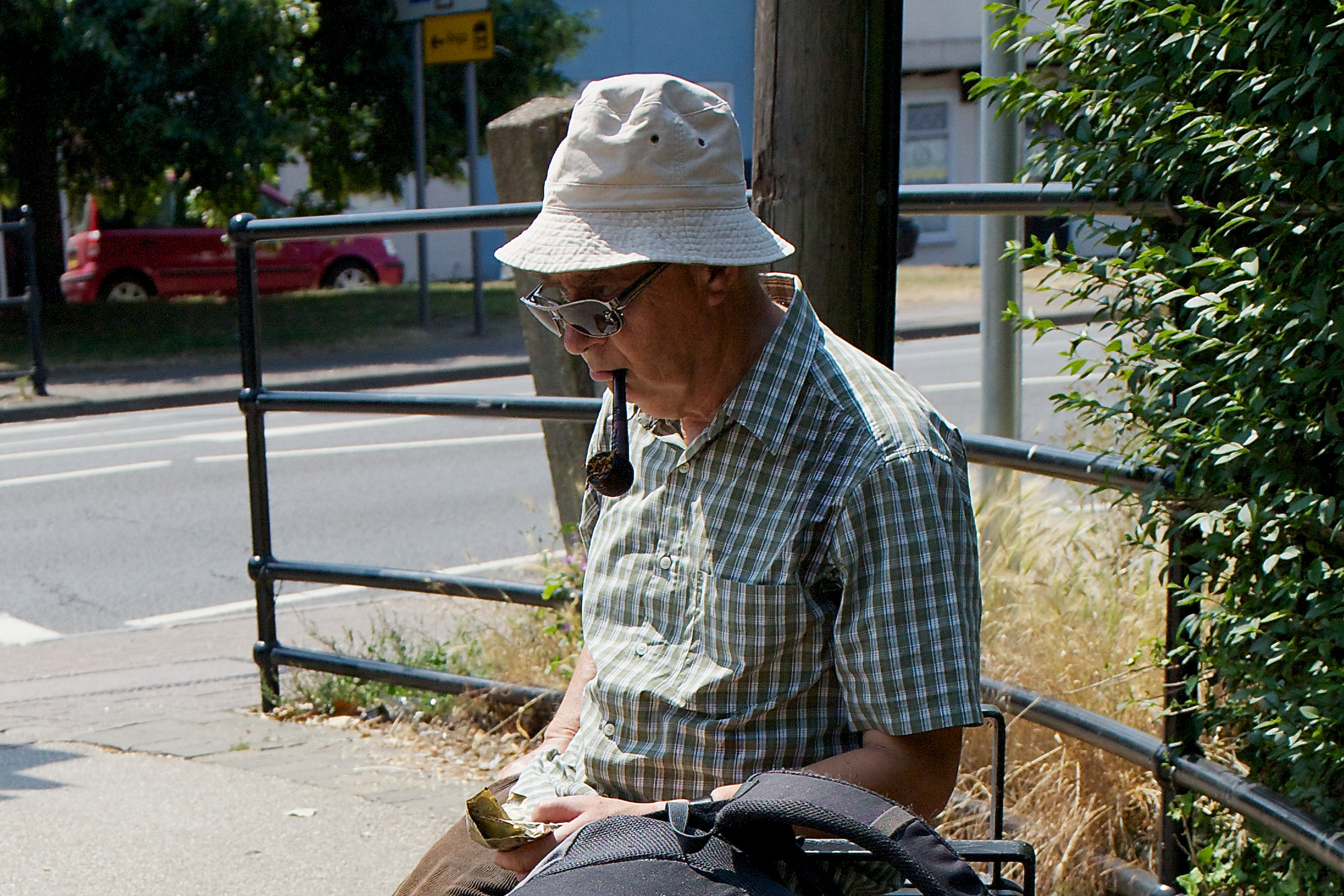
However, at first glance, there’s nothing at all odd about the gentleman (below), sitting by what appears to be a quiet roadside, about to light his pipe on a hot summer’s day. But even in a street photo, appearances can be deceptive.

Man smoking pipe

As the photographer who lives nearby, I know this road is always very busy. At the moment I took the picture there just happened to be a brief break in the traffic. You, the onlooker, were not aware of this until now — but no matter! If you scrutinise the picture carefully you will see its oddity. The man appears to be casting his eyes down, but in fact he’s looking up at the oncoming traffic. And he’s wearing two pairs of glasses.

You see: he hasn’t opted out at all. He’s probably on his way to — or, at this time of day, returning from — a cricket match. Or maybe he’s simply enjoying a holiday, or an early retirement. Like every street photo, this one abounds with unknowns — but its misleading content gives it a dimension it would otherwise lack.

It just goes to show: you mustn’t accept every subject at face value. Street photos are fleeting images of people about whom we know nothing, except what their appearance, actions and expression can tell us.

If you want to know the whole story — how they came to be in this position at this point in time — you’d need a lifetime’s acquaintance with them. Yet, even then…even then…


Two for the Price of One

I love to photograph people in pairs. There’s something poignant about a pair, not only of two people, but also of two animals, two birds — even two objects. When these pairs display certain similarities they indicate the possibility of sharing, of mutual support, of banishing loneliness in a large and often hostile world.

As I say, there has to be some resemblance between the individuals who make up the pair, whether they’re directly related or not. Maybe they just work for the same company and share an identical uniform. Or perhaps they are man and wife who have become so accustomed to each other they dress in a similar style and finish each other’s sentences.

Family resemblance, as between brothers and sisters, is photogenic — especially when taken out of context in the street, away from the family group. It’s great to stumble across twins, although, to tell you the truth, I prefer the two people to have physical differences as well as similarities. Variations in their appearance add visual interest to the photograph.

Musical Harmony
My featured image (above) is of two musicians going to work at the Royal Opera House, Covent Garden. What I like most about the picture is the contrast between their similarities and differences. You see: once again it’s “contrast” that lies at the heart of the image — and sometimes we notice it only when it’s pointed out to us.

The two musicians are probably not related, just friends or colleagues. But they dress in a similar style: dark clothes, narrow jeans, comfortable black trainers with white trim. They both carry a black bag, with a prominent zipper.

Yet their similarities are limited to their clothes, accessories and physical characteristics. Once we address their higher, cerebral capabilities, the differences become obvious: signified by the fact that one wears a hat on her head while the other doesn’t; and by the stark difference in the instruments they carry.

Here’s the point: the instruments may differ, but they’re both stringed instruments and the musicians play them in the same orchestra. It’s possible for people to celebrate their unique individuality while coming together in harmony, not despite but because of these differences.

Incidentally, I’m grateful to the cellist for having a “fragile” sticker on her carry case. A glass of red wine is ideal for celebrating the idea I’m trying to express.

The Same But Different
Continuing the musical theme — and still on the topic of “same but different” — here’s a shot I took an hour after photographing the musicians.

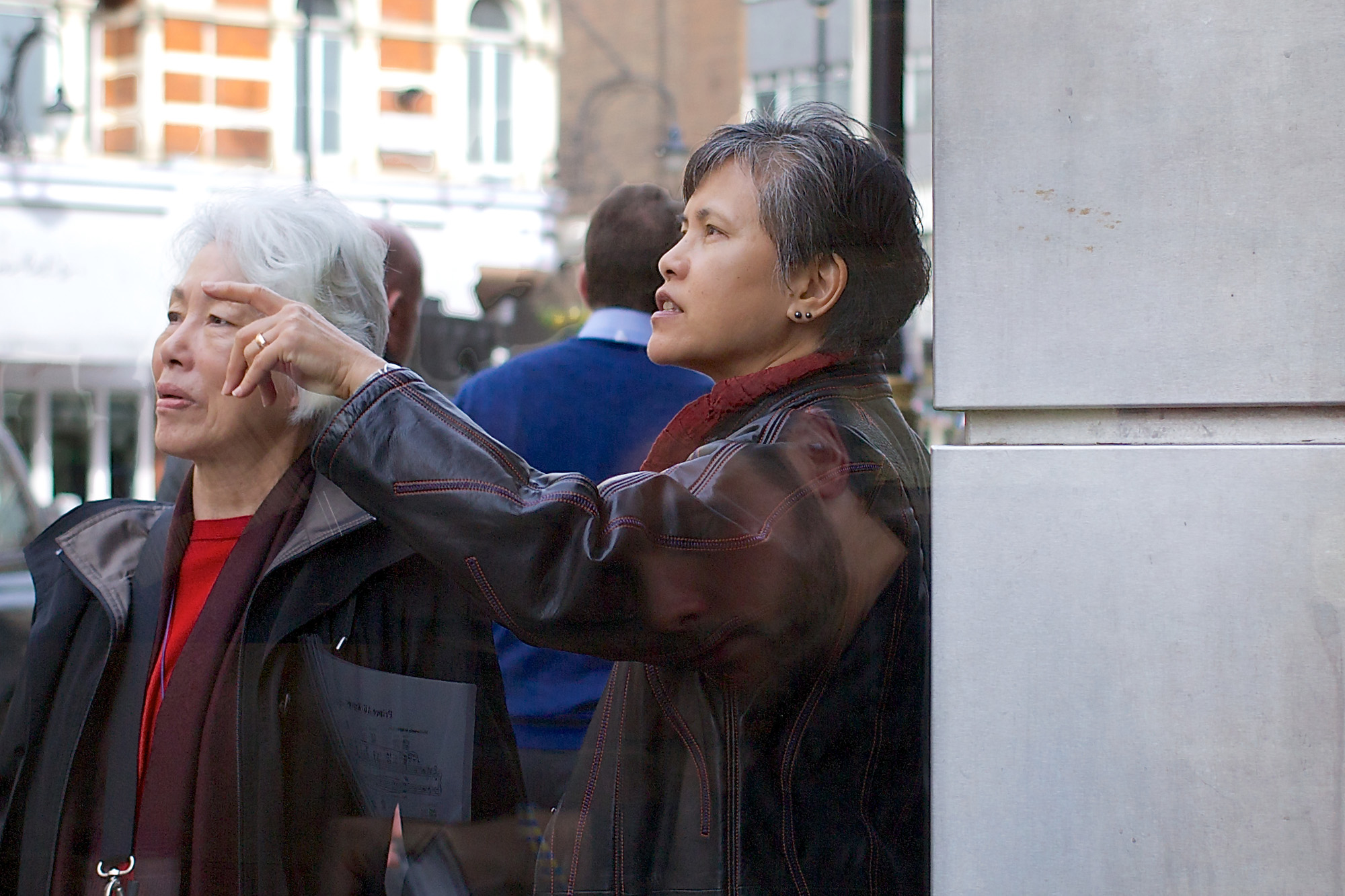
Woman outside cafe, pointing out something to her companion

The two subjects are on the other side of a plate glass window. Superimposed on their dark leather coats you can see the reflection of a musician reading a score. The two people outside are clearly related and share a very similar taste in clothes. Their scarves are identical and their jackets the same deep shade of maroon. By contrast, the people in the background are dressed very differently.

What you see in this image is essentially three or four layers of London life: the musician, the visitor, the passers-by, and the typically English architecture across the street. Yet it’s the pair who dominate the picture space. Are they trying to figure out the right way to get to Leicester Square? I think they look too confident to be lost. Maybe they’re evaluating the building opposite before putting in an offer for it.

The Joy of Pairs in Candid Photography
I hope you can see why I like candid photography from the two examples I’ve given. I can imagine that the people I’ve depicted have their own collections of posed photos, but I suspect they have few which show them going about their normal lives. With luck, an enterprising street photographer will take my own photo when I’m working. I won’t mind at all.

I guess I was “on a roll” that day — or else I was noticing every pair I came across. Certainly the light was particularly good and I was anxious to take full advantage of it.

My final image, therefore, is of the ultimate pair: the married couple (below).

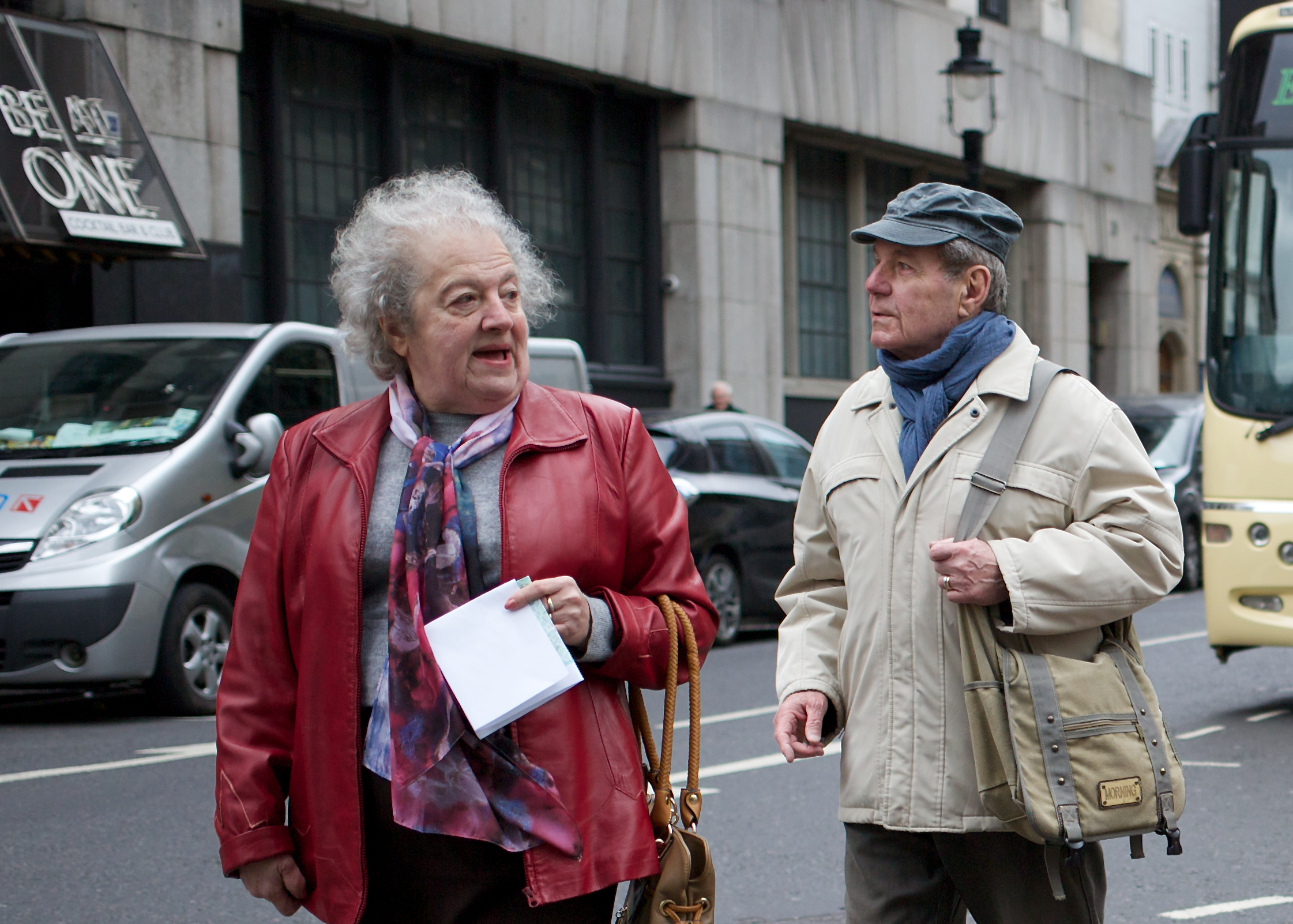
Couple in London's theatre district

I’m not sure what story I can spin for this image, but my guess is that the lady in red — a visitor from abroad — has just scored a couple of West End tickets to a musical production. (This is all sheer conjecture!) Her husband would rather be doing something else, but patiently he goes along with her wishes.

The woman turns to speak; the man makes a tentative gesture with his right hand. You can identify them as a pair from their body language. These people are aware both consciously and subconsciously of each other’s thoughts and movements. Every emanation demands — and gets — a response.

After all, being part of a successful pair is all about give and take. Isn’t it?

Most Photographers Don’t Take Photos, They Rearrange Reality

It’s taken me a while to make up my mind about this topic, but I think we need to be realistic about reality. We have to acknowledge an important fact about it. It’s there.

Most professional photography consists in rearranging really to suit the purposes of the photographer. Whether its portraiture, fashion, wedding, friends-and-family, advertising or corporate — the subject in front of the camera is primped, prettified, fussed over, and generally rearranged to look good in the eyes of the world.

Only landscape, travel, and truly candid photographs are (mostly) free of such deliberate distortion. Not incidentally, they are also more likely than the others to be free from the demands of commerce, taken by people for love rather than money.

No Objections
I have no objections in principle to rearranging reality for the purposes of art, but I don’t think it has any place in street photography. Any interference with the scene — such as attracting the attention of a person within it, or moving an object to suit the composition — destroys the illusion of the invisible camera. Without this illusion street photography has no magic and no identity. It is nothing at all.

Oddly enough, the artist who inspires me the most was one who acquired a reputation for obsessively altering the reality in front of the camera.

In the Movies
I have always admired the films of Michelangelo Antonioni, especially his later ones which were made in full colour with cinematography by Carlo Di Palma. It was Antonioni’s film “Il Deserto Rosso” (The Red Desert) which, several years ago, set me on a path to accepting the reality of the modern world.

In the movie, Giuliana (played by Monica Vitti) is the beautiful protagonist whose neurosis is brought about by having to cope with the hostile world of industrial Italy. She seems to be alone in responding negatively to the factories and shipyards where her husband’s work has taken her. She is a stranger in a strange land.

Only towards the end of the film is there a kind of resolution for her, when she reassures her young son, Valerio, that the birds in the area survive by learning to avoid the poisonous yellow smoke emitted from the chimneys.

Antonioni Speaks
The message of acceptance was underlined later by Antonioni when he said: “The line and curves of factories and their chimneys can be more beautiful than the outline of trees, which we are already too accustomed to seeing.” To get this feeling across, he used every possible photographic technique, including the use of telephoto lenses to foreshorten the distance between the central character and her environment.

The technique of melding subject and environment lies at the heart of street photography. That’s right. The film director who most exemplifies the aesthetic (as opposed to the candid spirit) of street photography was also one who liked to manipulate reality for photographic effect.

For this, his first colour film, Antonioni wanted to compose the colour relationships, so he gave us white steam, red pipes, blue railings, and painted the trees and grass white and grey to suppress any lingering colours of nature in this largely man-made world.

Undramatising, Rearranging
Antonioni’s films positively invite us to see reality in photographic terms. He embraces photography at the expense of theatre by undramatising his scenes, making them appear to be slices of life, although, of course, everything is meticulously orchestrated.

If you’re wondering how Antonioni himself saw reality, here’s another quote: “Every time I enter a strange office, public place or private home, I get the urge to rearrange the scene. I go out to meet someone and the conversation puts me ill at ease. Because I feel that neither of us is properly placed in the room.”

He adds: “Is this professional distortion or the instinctive urge to feel myself in physical harmony with my surroundings? I believe more in the second hypothesis. In fact, I cannot shoot a scene without first being alone in the room, or the set, in order to understand it and sense the various possible camera angles.” (Esquire, August 1970).

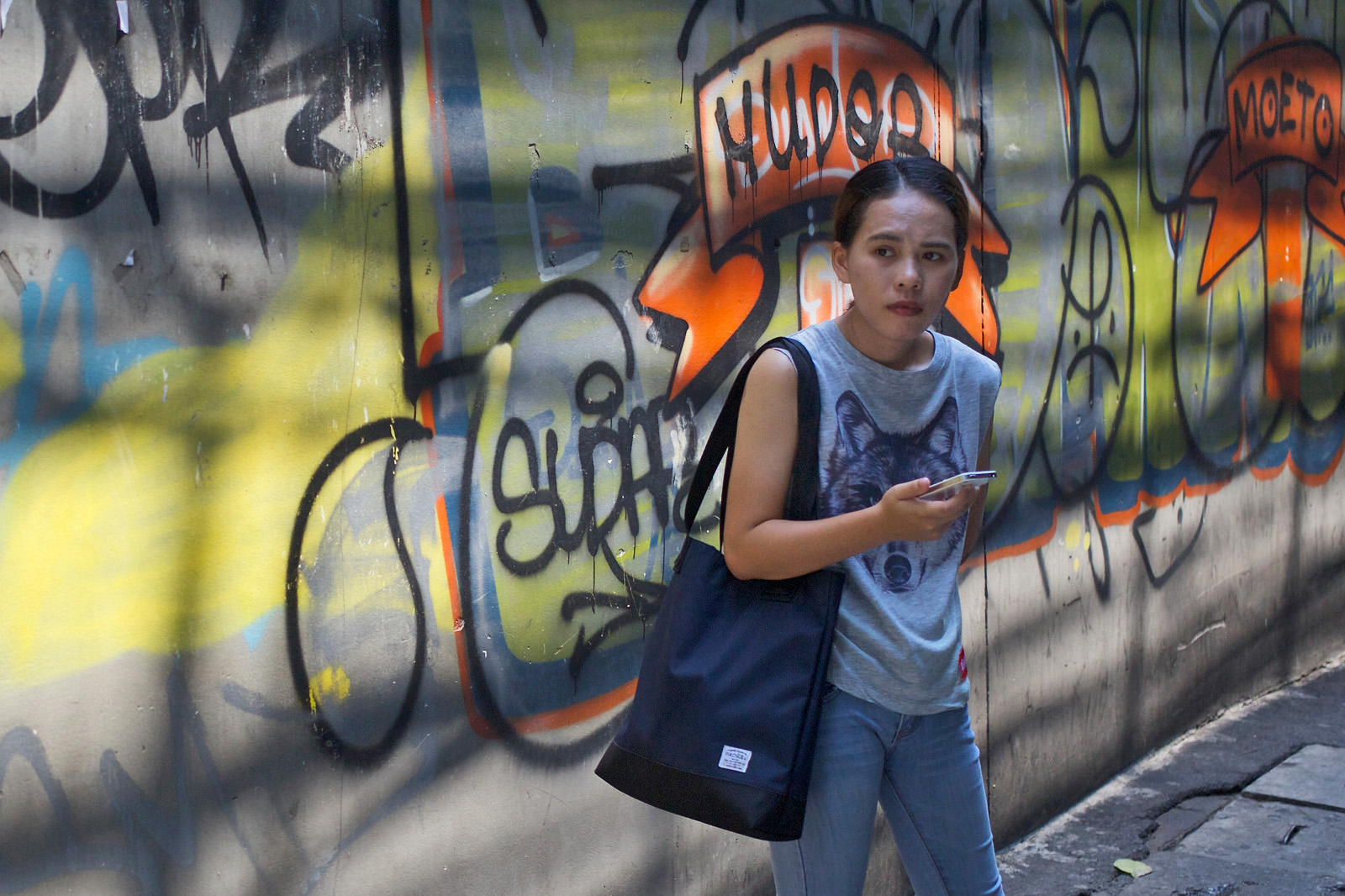
Woman looking anxious in front of graffiti scrawls

A Shared Neurosis
I must say, I’ve always shared the same neurosis: of wanting to feel in physical harmony with my surroundings and being uncomfortable with the “wrong” position.

Watching “Il Deserto Rosso” made me give up art history and go to film school, but I’ve since found that I don’t want to change the reality in front of the camera — I just want to change my viewpoint. In fact, working in environments where I feel out of place is of real benefit in compelling me to look for accidental or hard-to-find arrangements of forms, colours, and contrasts that make me feel better.

Street photography depends on our personal feelings about our relationship to reality. Do we love it? Hate it? Admire it? Do we feel dwarfed by it? Or do we feel superior to it? In awe of it? Amused by it? Puzzled by it?

There are endless questions we can ask, but we probably shouldn’t verbalise them. The extent to which we humanise the camera by controlling where and how we point it is a measure of how well we answer those questions without ever posing them overtly.

Moments of Puzzlement

If you’re building collections of street photographs based on themes, you can group them by emotion — joy, sadness, anger, and so on — or by reaction, such as surprise or puzzlement.

Moments of puzzlement are inherently ambiguous and mysterious if you can’t see what has prompted them. And as I’ve mentioned before in these articles, ambiguity and mystery are two of the most useful ingredients in street photography. I’d be lost without them.

If a subject looks puzzled, the onlooker viewing the image will also be puzzled. What’s going on? Why is this person questioning reality? Isn’t everything obvious once you’ve taken a photograph of it?

A False Assumption
The idea that photography reveals everything is one of the myths of the modern age. We look at scenes that are confusing in reality and we photograph them for later inspection. People do the same in art galleries. A great painting is far too elaborate and potentially meaningful to be absorbed in a few moments, so people photograph it “for later.”

It’s a comforting thought, isn’t it? It’s rather like having some kind of convenience snack-food, like a chocolate bar. “I can eat it later.” You’ll never suffer mental starvation if you have a camera. You can take a picture and tell yourself “I’ll understand it later.”

Outward Signs
To show puzzlement in a photograph you really need the subjects to display some evidence of it. After all, it’s possible to be quietly puzzled and give no external indication of it apart from a Roger Moore-stye raised eyebrow that would go completely unnoticed in a street photo.

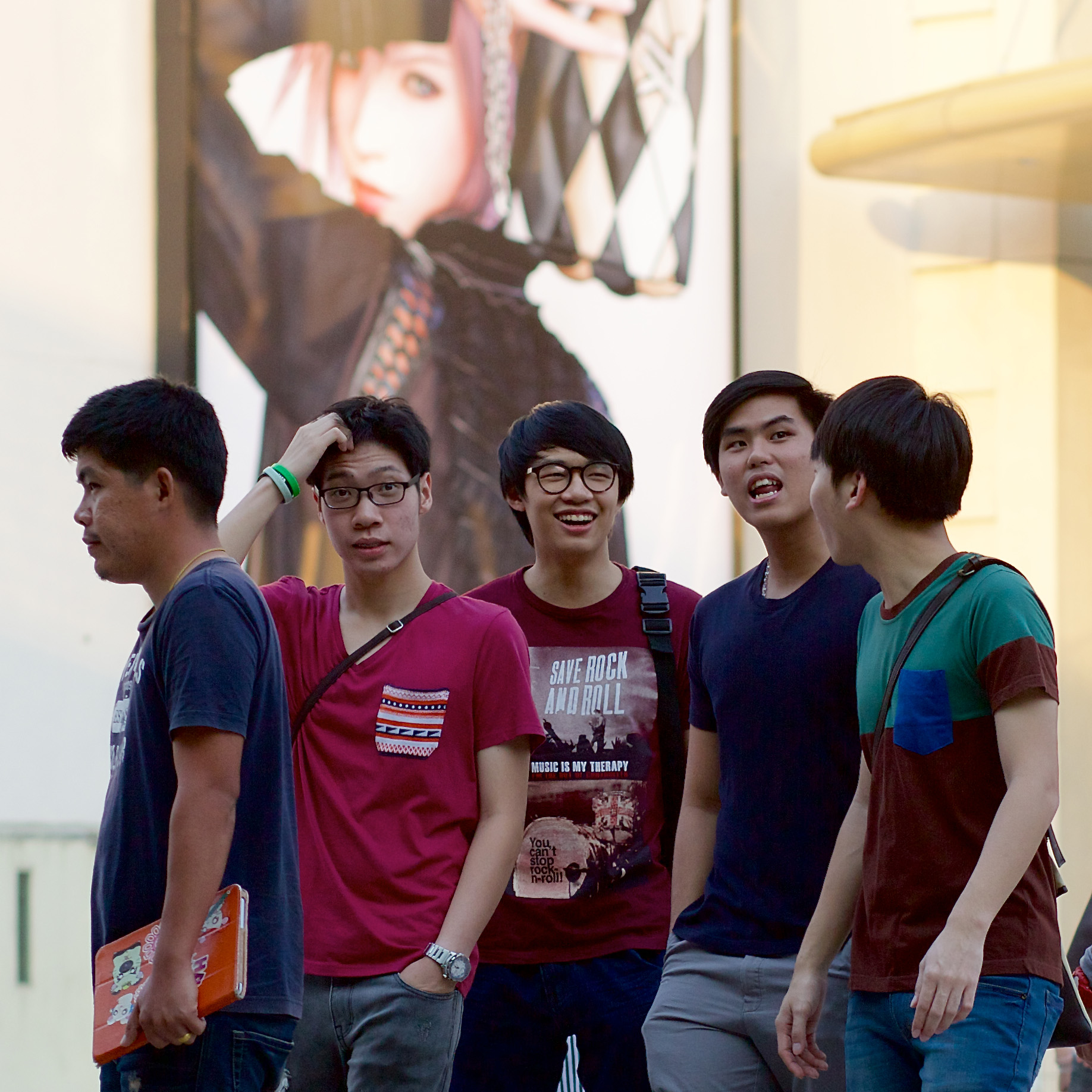
The most noticeable outward sign of puzzlement is a combination of frowning and head-scratching. When you see this, take a picture! You won’t be disappointed. The subject can be looking to one side, as in my featured image (above), or looking directly at the camera, as in the image below. It doesn’t matter. Something has puzzled the subject and the image prompts us to wonder what it is.

save rock and roll tee-shirt

More Ambiguity, More Mystery
Such images as those I’ve described (and offered) have further layers of ambiguity and mystery. For a start, they may be completely misleading.

For example, perhaps the subject only appears to be puzzled and is simply scratching his or her head because it itches — and the frown is nothing more than an expression of annoyance at the itch.

You must admit, that’s a possibility. Does it matter? Not really, because photographs are documents of appearances. They can’t contain full explanations of everything that seems to be happening in them. In fact, their charm is actually based on their inscrutability, on their steadfast refusal to disentangle ambiguity or shine a light on every mystery.

The featured image at the top is a good illustration of the point I’ve just made. The woman who is scratching her head also displays a bandaged wrist. We’ll never know how she injured it. The wrist is just “there” — an appearance without an explanation. Maybe she’s only pretending to have a bad wrist. I know that’s unlikely, but it’s within the realm of many possibilities.

So as you can see, the subject’s puzzlement is also our puzzlement — and we have our own reasons to be puzzled quite apart from worrying about whatever’s bugging the subject.

My second image (above), which I’ve called “Save Rock and Roll,” is not so mysterious as the first. It’s just a group of young men who are probably returning from a class (to judge by the notebook) and thinking about the evening ahead. Will they go out drinking — or share a meal? Certainly they all seem to share a similar taste in clothes.

Very obligingly, one of them touches his head in a gesture that seems to echo the pose of the model in the poster. At the time of taking the shot, I wondered whether he was doing it deliberately. Perhaps he’d seen the poster and had decided to give me one of those “correspondences” which always look interesting in a street photo.

Ah, now you see I’ve started digging up mysteries and ambiguities where probably none exist. I’m looking at these photos, scratching my head and frowning.

It’s all very puzzling.