Placing the Subject Off-Centre

If your first instinct is always to place the subject in the middle of the photo, think again. It’s often better in street photography to tuck the subject off to the left or the right, allowing the rest of the picture to counterbalance the composition.

I’m not talking about those impromptu street portraits which may very well have the subject somewhere near the middle of the frame. Rather, I’m talking about photos in which “the subject” is not just a single person or even a small group of people. It’s when the real subject is the whole scene: people in the context of their environment.

The Fortune Teller
For my featured image (above) I placed the three women in one quarter of the frame, letting the unusual background occupy most of the available space. I’m very glad I did. The small group is sufficiently engaging to hold our attention, yet the rest of the scene has its own charms which make us explore the image to see what’s there.

We can read the stickers, most of which are in English: “Whistle While You Work,” etc. We can check out the garden, which appears to be very well tended, complete with bird-feeders and neat pathways. Yet the eye constantly comes back to the group of three people, because each of them is caught mid-action while performing a particular activity.

Despite all the English stickers, unless you read Thai it’s hard to figure out exactly what’s happening in the photo. The two girls are deep in thought while enjoying their drinks because they’re having their fortune told for the very reasonable price of 39 baht. The sign on the left says they’ll learn all about what’s happening to them as regards work, money, luck, love, everyday life, enemies, partners, and the future. No wonder they look serious!

The image is another of those in which the real subject is “time.” This time it’s all about the future and what will happen in the future. By preserving the present moment, photography itself always has the concept of time embedded into it. Here, the present moment is full of life and movement, yet everyone is concerned about the future. Meanwhile, the past lingers in the stickers and in the can of discarded Nescafé in front of the fire hydrant.

Fifty Percent Off
The next image (below) has no messages about the passing of time, unless you count the limited time offer of a fifty percent discount.

Shoes Fifty Percent

Again, the subject is off to one side, leaving the large advert to dominate the image. Normally this would be an odd composition, but I think it works because of the unusual elevation of the camera. No, I wasn’t lying flat on the pavement to take the shot. Between me and the subject there was a steep flight of steps, enabling the style of shot you see.

Looking up at the subjects made the verticals converge, as you can see on the right. However, I’ve made the verticals truly upright on the left, so that the two figures can approach the entrance while seeming to be propelled towards it by the leaning verticals on the right. Meanwhile a mysterious, shadowy figure appears be reflected in the window at bottom right, helping to stop the image from tipping over completely.

Inside the Store
Having created such a lot of anticipation about entering the store, I guess we should go inside. You can tell this is Robinson’s Department Store from the above image, as the name appears in the large advert — and the reflected road sign says: “Charoen Krung Road.”

Star Product

This store always makes me think of green and turquoise blue because these always seem to be the dominant colours whenever I visit. In the pharmaceutical area especially, there’s a clinical feel of newly squeezed toothpaste, with very few warm shades to enliven the scene.

I was fortunate to find contrast in the figures on the right: flesh and blood human beings in the midst of an otherwise sterile environment. They can be at the side of the image because what matters is the contrast between them and the rest of the shop.

Placing the subject off-centre is a way of avoiding what’s obvious in favour of creating a more complete image. You still have to balance the composition, but there’s often something you can use. In the picture above I’ve chosen the glaring white of the displayed products to counterbalance the figures standing in shade. The distant figure in the background links the two halves of the picture.

Tea Lounge or Coffee Shop?

One of the supposed clichés of candid photography is the coffee shop interior, usually somewhere in Paris, with a woman sitting beneath a mirror, looking wistfully at the street outside.

I try to avoid cliché, so my solution is to add tea lounges to the repertoire. You could scarcely have a subject that’s more different.

Greater formality surrounds the drinking of tea, probably because it was the preferred drink of the English upper classes at the end of the eighteenth century when formality was at its height. However, let’s not forget the traditions of tea drinking in Japan where the ritual of making and drinking tea became a rarified art form.

Invitation to a Ritual
Why does tea invite ritual? I have no idea. It must be something to do with the subtlety of its flavour. To obtain the correct flavour you have to follow a certain ritual: warming the pot, letting it stand, and so on. One thing leads to another — and eventually an entire pattern of behaviour emerges, not only in the preparation of tea but also in the drinking of it.

Today, typical up-market tea lounges don’t specify how customers should behave. They simply impose control through the formality of their design. For example, there’s no question of chairs and tables being scattered, higgledy-piggledy (a word I’ve never written before!) around the room. They’re laid out in regular fashion, where customers can sit comfortably but not slumped.

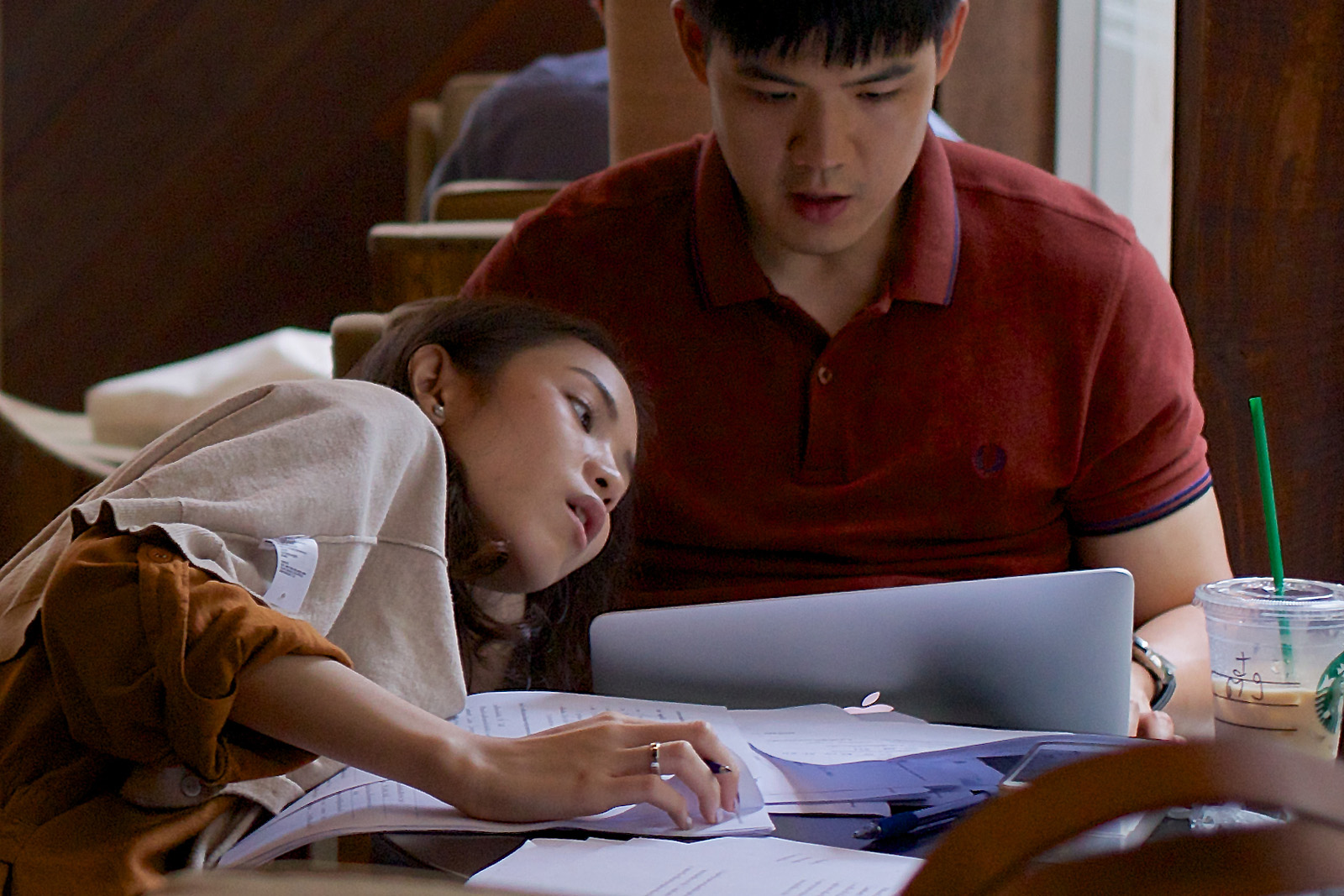
Coffee shops are quite the opposite. They’re relaxed places where casual behaviour is positively encouraged. If you want to do homework or office work in a branch of Starbucks, like the young people in my photo below — that’s fine. You don’t even have to drink coffee: a milk shake will do.

Collaboration

Traditional
It’s hard to find a really traditional tea lounge, especially one where you can take photographs without people objecting. I took my featured image (at the top) in the Foreign Correspondents Club in Hong Kong. It’s not a tea lounge, as such, but a combined tea/bar/café where journalists sit, talk and write. I think photography was forbidden, but I couldn’t resist. I told myself I was working undercover.

The image is entirely candid. I was taking it to remind myself of the English club-like atmosphere when a waitress showed up with a tray. It’s the nearest I could get to recreating the past at five o’clock in the afternoon.

We are now, of course, a world away from the dirt and dust of the street — because clubs and tea lounges keep themselves apart. They rarely have outdoor tables like the coffee shop. To drink tea and enjoy hushed conversation you need the peace and quiet of being enclosed, preferably on all four sides.

Modern
Genuinely old interiors in the Far East are rapidly disappearing, but there are plenty of new, purpose-built tea lounges in malls and hotels. They tend to be “design-intensive,” using a plethora of decorative items to signal their function.

The photo below shows an “1823 Tea Lounge” belonging to the Ronnefeldt group, a company that has adopted the epithet: “Serving the world’s finest tea since 1823.” As you can deduce, even a modern tea lounge needs traditional credentials to attract customers, despite having over fifty teapots arranged in rows along the walls and counter.

Tea Lounge

I took the above shot from public space — the mall equivalent of “the street” — without entering the lounge itself. You can see right through the room to further public space beyond.

The image demonstrates all kinds of contradictions, as confirmed by the deceptive reflection of the woman in the centre. It almost looks as though she’s sitting alone, like the man behind her, but she’s actually photographing her partner’s tea. They didn’t do that in…1823.

I’ve Got Your Back

Please don’t believe street photography gurus who tell you not to take photos of people from behind. You must be the judge. Will the subject make a good photo? Take it. Are you “copping out” because you don’t want to be noticed? Then leave it. It’s that simple.

I’ve always liked paintings and drawings of people’s backs. As a student I purchased some Michelangelo reproductions from Fratelli Alinari (the world’s oldest photographic firm) in Florence. They included “Study for the Libyan Sibyl” (1511), a preparatory drawing for one of the sibyls (female oracles) in the Sistine Chapel. The figure has her head turned to one side so that we can see her features, but it’s her stance — with her back to the viewer — which delights us the most.

Michelangelo knew the human form could look as good from behind as it does from the front. I think his attitude stemmed from being a sculptor who necessarily had to see figures in the round. By contrast, a painter can show only one aspect of a person — and there’s usually more to be gained from the front rather than the back.

The Obvious Choice
The photographer, too, chooses a single viewpoint and meets onlookers’ expectations by shooting the image from the front. If a portrait photographer were to place his sitters with their backs to the camera they’d be very surprised and I doubt if they’d pay the bill.

Even at the most rarified levels of photographic theory we can find a bias towards the frontal pose. For example, theorist Roland Barthes had a distinct preference for portraits which looked him “straight in the eye.” He hated to be ignored.

In “Why Photography Matters As Art As Never Before” critic Michael Fried tries to accommodate Barthes’ theory by referring to what he calls “facingness.” Describing it as “a major strain…in modernist painting since Manet,” Fried is clearly uncomfortable with the idea. After all, he is the champion of the artist’s fight against theatricality: a fight which painters win by depicting people absorbed in various tasks.

I’m with Fried on this. I love to show people who are totally absorbed in what they’re doing. Not only does it make for a great image, the people in it don’t notice they’re being photographed. This is the only true way in street photography.

I’m not suggesting that “facingness” is impossible to achieve without the subject breaking the barrier between scene and onlooker. However, I do think it’s unusual. In his determination to recruit Barthes as a supporter of anti-theatricality (and without naming it as such) Fried resorts to a kind of “sightless facingness,” as when a person gazes at you absentmindedly. The photographs of industrial buildings by Bernd and Hilla Becher fulfil this sightless mode as far as Fried is concerned.

Further Complication
There’s an additional complication for the street photographer because it’s hard to get close-up shots of people from the front without them seeing the camera. As a result, many would-be street photographers tend to “chicken out” and take pictures from the side or back. Clearly, you’ll never climb far up the ladder of artistic ambition if you’re chicken.

I have no idea whether Justin Roberts and Bryn Fenech are brave or timid, but I quite like their Instagram account “New York from Behind.”  It’s a new take on the typical street fashion blog, made popular by The Sartorialist and StyleClicker.

Roberts and Fenech may not match the photographic quality of the others, but their images are revealing, quirky, and — when background plays a supporting role — street photography in a stricter sense.

Their figures do nothing significant. They just walk away from the camera as if it’s a movie camera. Of all possible subjects, these are the least likely to make eye-contact, the absence of which in movies Barthes so lamented: “in film, no one ever looks at me; it is forbidden — by the Fiction” (“Camera Lucida,” 1980).

At Last: The Pictures
In my own photography I’m not greatly interested in recording street fashions, but I sometimes see a potential shot when a person’s back is facing me. (I hope you like my idea of being “faced” by a back!)

I took the featured image (at the top) in a street market in Bangkok. If I’d taken a front view the photo would have been grossly inferior. The man’s face would have become the main subject. He would probably have grinned at me and I’d have yet another travel shot with “local colour.” As it is, the footstool-tray of confectionery is the main subject, with the added bonus of “Superstar c’est moi” on the tee-shirt, both in good light.

The second image (immediately above) is one of my favourites. I like the intense colours you can find in Bangkok’s Chinatown, entirely different from the equally appealing, softer shades of the other shot. The back viewpoint is right for this image, which shows a man struggling to tie a heavy load to a motorbike (in case you haven’t worked it out).

Parting Shot
I’ll conclude with a more complex composition, one which I hope viewers will come to like as much as I do. This, too, is from the dusty street markets of Bangkok.

A woman with an old and presumably fake YSL shoulder bag labours to shift crates of bottled water. More crates support the mini-mountain of fabrics in the background. There’s a subtle correspondence between the angle of the woman’s leg and the bare leg of the passer-by. A real bottle of water stands upright on the left, but it’s a different brand to the one advertised on the side of the cooler.

shoulder bag

To see this image properly you have to overcome any aversion to shabbiness. It’s not a fashion shot! Roland Barthes would have hated it — as will many street photographers who see only in black and white. Neither of the subjects takes any notice of the onlooker; they’re absorbed in their own activity. The image is cinematic, but the composition has an accuracy that you won’t find in many frames of film.

Yes, I know. I had to squarify it. No one’s perfect.

Off the Street and Into the Park

When I wander off the street and into the park I find the act of taking street photos goes up by a couple of levels of difficulty. People are relaxing and watchful. They notice you more easily and don’t like their downtime interrupted. What’s more: everything’s green.

Nothing looks good against a green background, except tiny patches of intense red and a different shade of green. I guess black’s OK, too, but people rarely dress in black when they go to the park. They put on their “glad rags” and — in my locality at least — go fully armed with the pram, the kids, and the balloons.

The Park Event
If everyday shooting in the park is difficult you have to wait for an event, such as a fair, or “fun run,” before you can feel free enough to take candid snaps. However, the trouble with organised events is the way in which they present you with ready-made subjects that may not be to your liking.

Here in Colchester we have food fairs, “town and country fairs,” medieval fairs (“fayres”), music fairs, Scottish marching band competitions, fireworks displays and 21-gun salutes to celebrate H.M. the Queen’s birthday. Honestly, there are so many events in the park I sometimes wonder how the grass stays as green as it does.

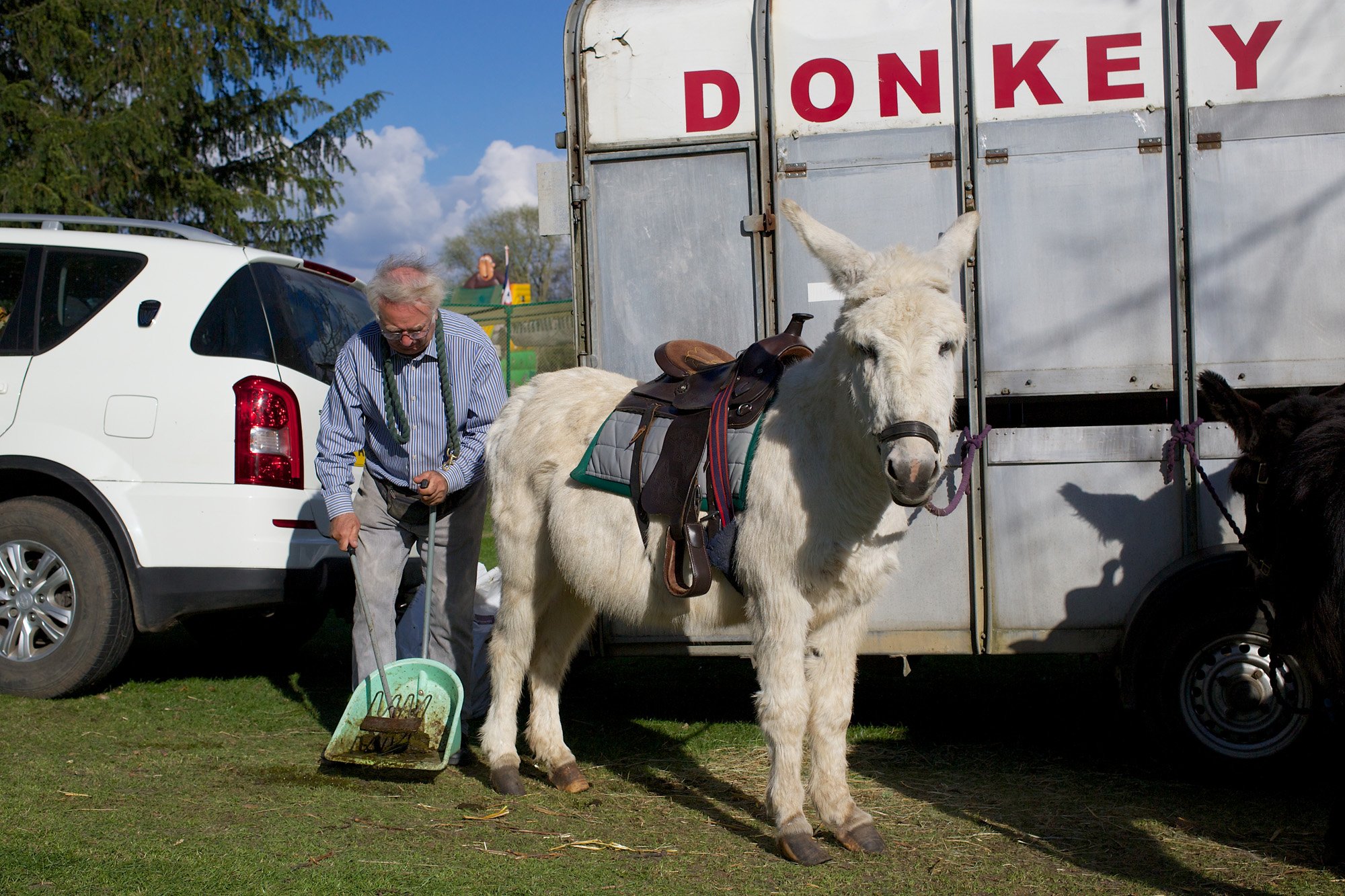
I made a flying visit to the Town and Country Fair, just before closing time when they let you in for free. It’s by far the best time to get decent pictures. The sun is low in the sky, the participants are letting down their hair, and the donkeys are having a well deserved sh*t (featured image, above).

I was surprised to get a nice series of pictures, particularly since I’ve often paid full price on previous occasions and spent the entire afternoon getting nothing. Yes, there was a cute shot of a dog looking out from under a tent — and another of a horse, which I’ll append to the foot of this blog post. But those were exceptions. Organised events, especially when they’re in full swing, don’t seem to yield the kind of subject I like to take.

The Park Non-Event
I really like to photograph people when they’re doing lots of different things, not when they’re spectators of organised sports and entertainments. Left to their own devices, people reveal more about themselves than when a staged event dictates their reactions.

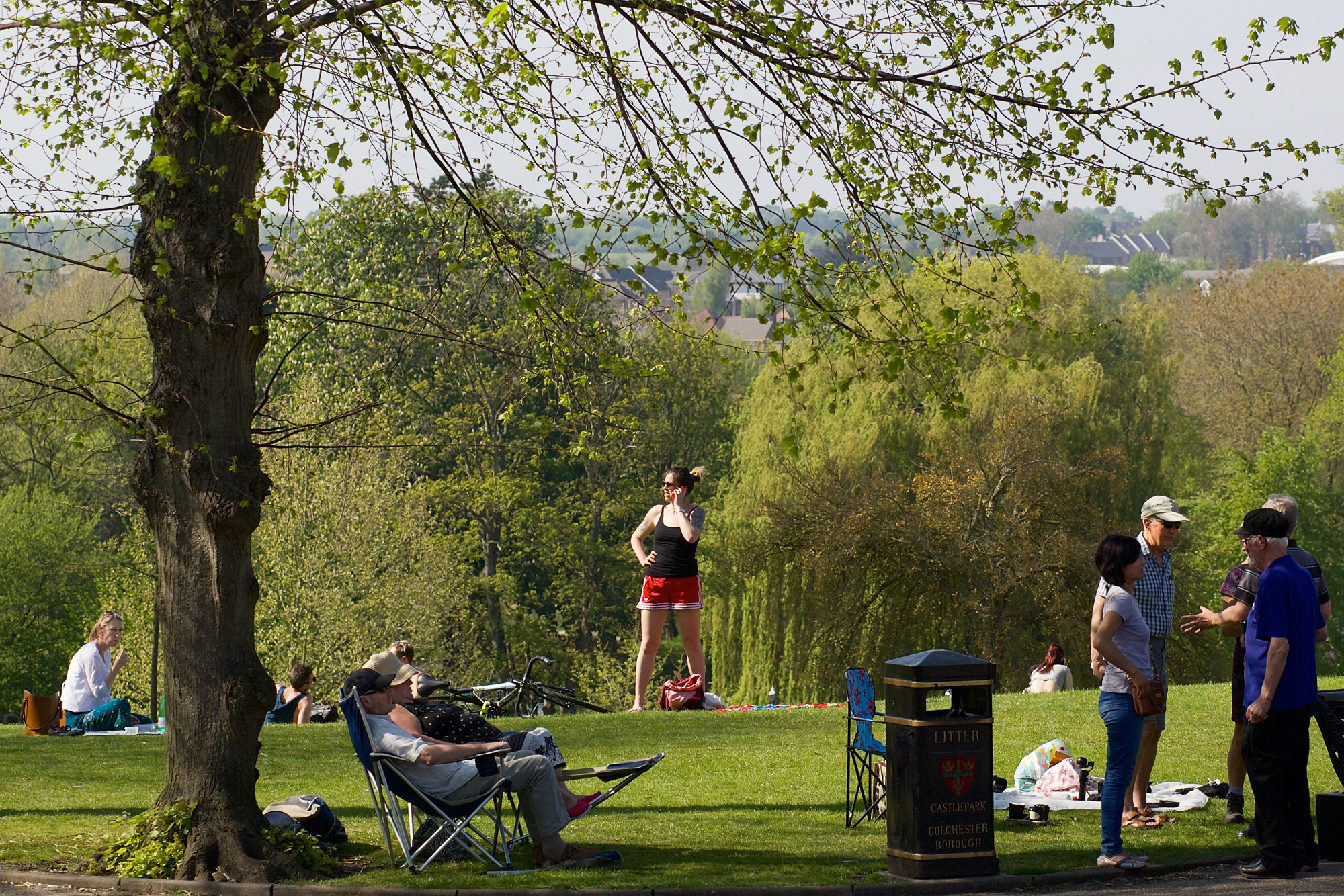
Here (below), for example, is a picture of a typical Sunday afternoon in Castle Park, Colchester. People are sitting, eating, and chatting. Some have gathered together in groups, debating the issues of the day. They’ve brought bicycles, folding chairs, footstools, table cloths — everything for “Le Déjeuner sur l’herbe” (Luncheon on the Grass), if not quite in the style of Edouard Manet.

Sunday in the Park

You see what I mean about the small patch of red? The woman making a phone call was fortunately wearing bright red shorts which form a natural focal point at the centre of the picture. Seen against the subtle greenery of Spring (it was early May) the red is particularly striking. Later in the year the green will become more intense and far less photogenic.

The Same Strategies Apply
When you’re taking pictures in the park you can use the same strategies you normally use on the street. You can “work the scene” when you find something that demands it — such as some people engaged in breakdancing or playing “boules.” Or you can try to remain invisible and get candid pictures, like the one above.

As a backdrop, Colchester’s Castle Park offers amazing props for the off-road street photographer. It has the remains of a Roman villa, a medieval castle built on the ruins of a Roman temple, a wall (Roman, of course), and an extraordinary collection of rare trees — including an oak that looks like a poplar.

Inevitably, any pictures you take in a park — particularly one as beautiful as Castle Park — will be “picturesque.” You can’t keep avoiding the trees, walls, and winding pathways which tend to make the image look more suitable for a calendar than for a portfolio of street photography. Yet the park is a public place, full of pedestrians, and it’s undeniably photogenic.

Winter in the Park
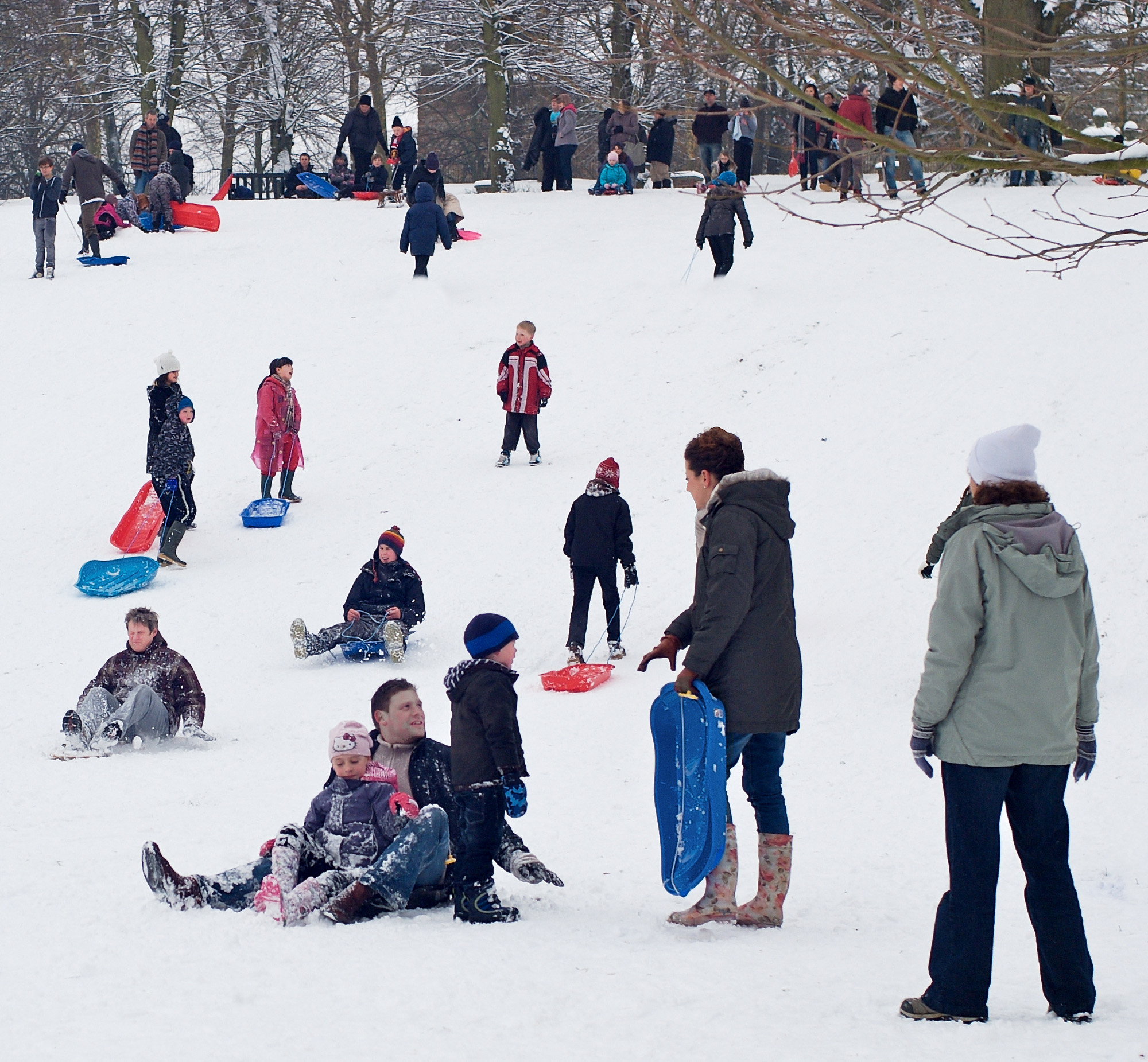
Every year the shops stock up with sledges and shovels, but snow falls about once every two or three years. When it does, everyone goes mad with excitement (especially the shopkeepers). The park really comes to life after a snowfall.

As you could see from the previous image, Castle Park has a very steep hill (as does the whole town), making it ideal for messing around on sledges. By ambulance, the local hospital is only a few minutes away, so there’s no need to slow down before you hit the Roman wall at the bottom of the hill.

It's his turn with the sledge

And Back to Summer
Looking at my final shot you’ll probably think I’ve wandered as far away from the city streets as it’s possible to go. But in fact we’re still in Castle Park, surrounded by thousands of buildings, streets, shops, schools, colleges and a university.

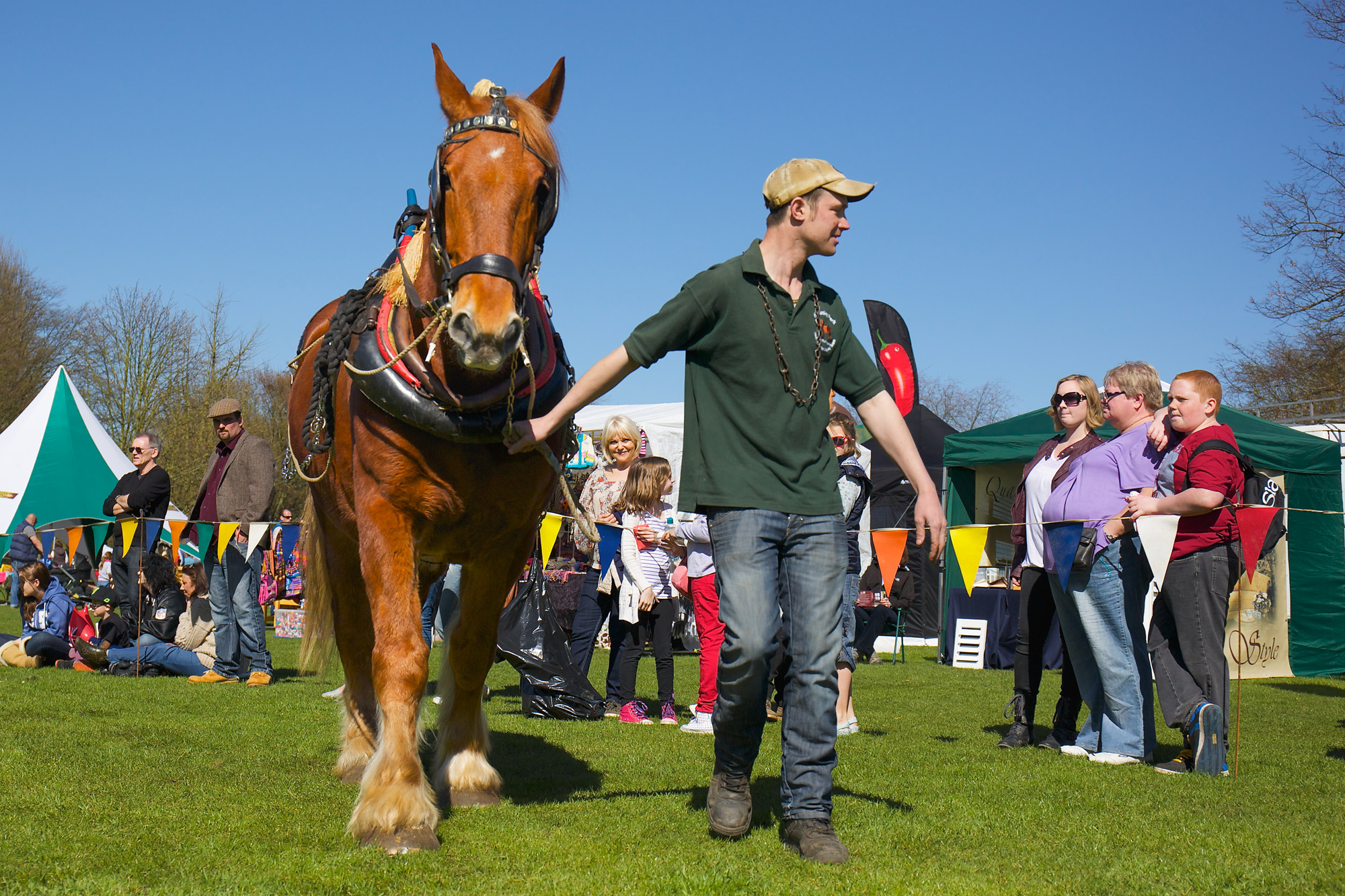
Horses and donkeys are always kind enough to look directly at me, while diverting the glances of spectators away from the camera. That works in my favour. I think this shot captures the moment: both horse and minder are putting their best foot forward. I like the word “style” on the right hand edge of the picture.

Man leading horse

My own style of taking pictures in the park seems to revert to classical compositions, quite unlike those I usually take on the street. They sometimes strike me as quaintly old-fashioned, but I don’t really care.

It’s good to have a change. Even a street photographer needs the occasional day off. Our occupation is not always a walk in the park.

Passing Moments

They’re one grade down from those “decisive moments” — the hypercritical instances captured by Henri Cartier-Bresson. Certain actions are so commonplace, so casual and unremarkable in themselves, that it’s pointless to call them “decisive,” even though they may be critical to the image. What are they?

I call them “passing moments.”

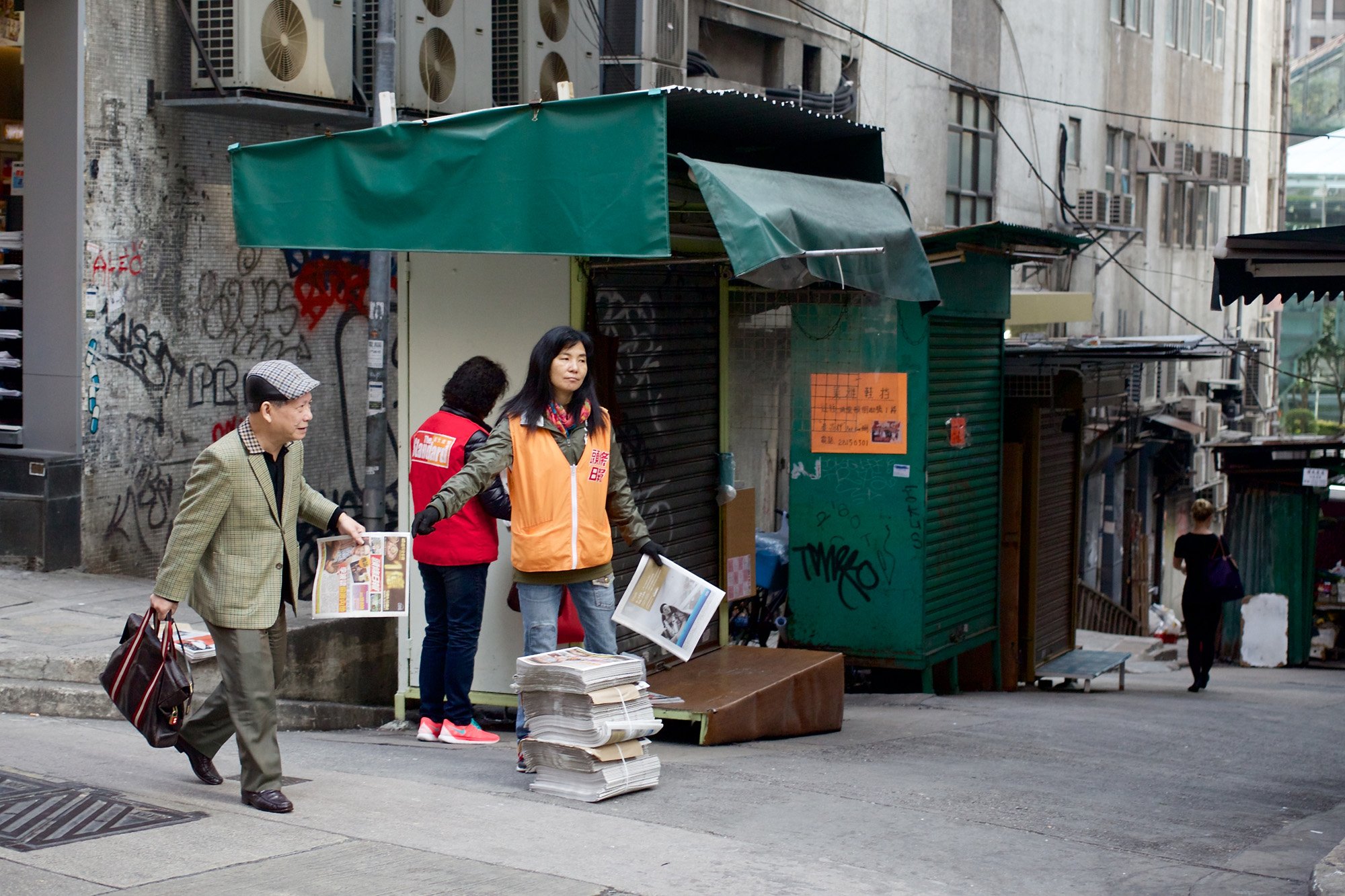
My featured image is a good example of a passing moment. The woman in the orange jacket is standing on a street corner in Hong Kong, handing out free newspapers to commuters on their way to work. She repeats her action time and again with each person who passes.

There’s nothing “decisive” about the moment of delivery. In fact, it seems to happen over a period of one or two seconds rather than in an instant. The man approaches; the woman readies the paper. The man gets closer; the woman offers the paper. The man never breaks stride; the woman doesn’t even look at him. The long moment has passed.

I like these passing moments. They give a sense of “life continuing,” rather than “life frozen.” I actually prefer them to Cartier-Bresson’s decisive moments, which are surely an attempt to identify a phenomenon that doesn’t exist beyond the confines of photography.

You can find actual “decisive moments” only in the realm of science fiction. I remember watching a BBC TV serial called “Quatermass and the Pit” in which scientists dig up an alien space craft which has crashed near a Tube station. When they eventually break through the super-hard metal exterior of the craft they discover what appear to be dead, but perfectly preserved (and very frightening) insects, almost as tall as men. Then Dr Quatermass offers a key insight. These space-voyaging insects are actually alive. They’re simply existing in a different dimension, caught between two micro-seconds of time.

Life Continues
You see, we human beings don’t exist in decisive moments. For us, one moment blends imperceptibly into another. Even if we pause mid-air for a micro-second — like the gentlemen (below) who’s checking his recent purchase of some fresh cakes — we’re not really stuck there for eternity. We delight in swimming through the flux of time — and I really think the happiest people are those who “go with the flow” and enjoy it.

Looking at cakes

I grant you one thing: photography fixes our appearance for eternity, or at least for as long as the image can survive on disk, paper or computer memory. But there’s a huge gap between the reality of the image and the reality of the material world. It’s a gap that doesn’t exist in, say, literature, in which the flow of time is recreated by the act of reading the poem or novel.

If you concentrate on a single, isolated incident in street photography, you can certainly reduce the scene to a single instant. Yet I really prefer to see a contrast between this briefest of moments (the man looking at the bag) and the wider context of the image (people walking past in the background). When you put the single instant into its context you get…the passing moment.

In the photo below, a shopper examines a dress on a shop dummy. The woman is undemonstrative, pausing for a moment or two before moving on. The inanimate dummy, on the other hand, appears to be much more lively, holding up one hand in a gesture that would yield a “decisive moment” if made by a real person.

Looking at dummy

My photo therefore contains a fake decisive moment, simulated by the dummy, but sufficiently convincing nonetheless to give the image a sense of “rightness.” I’m not sure if I can even call it a “passing moment,” because the mannequin is poised in such an insistent, transitory position, in imitation of real life.

Yet the formula remains the same. There is a point of focus which appears to be pivotal in the flux of time, around which you can see time still flowing naturally.

That’s a passing moment: not particularly decisive, but a key element of street photography.

Uncomfortable Cafés

London is full of uncomfortable cafés. That’s a pity because if there’s one thing I enjoy more than walking around taking street photos it’s sitting in a café looking through my morning’s work.

Sometimes I like to take revenge by photographing the cafés themselves, just to remind myself why I always go the nearest Caffé Nero with its assortment of sofas and easy chairs. I wonder, are comfortable seats so expensive as to be beyond the budgets of independent coffee houses?

Take my featured image (above), for example. If you’re out on a date with your girlfriend would you really consider taking the middle table? “This one will be fine, darling. Let’s have lunch here.”

Shabby Chic
Or how about the one below? I think this is taking “shabby chic” a bit too far. “Bloomin’ shabby cheek, if you ask me, mister.”

Comfort cafe

As you can see, my personal likes and dislikes do tend to influence my street photography. They direct my attention. I look at the scene for incidents, activities, combinations of forms and colours, interesting people — and so on — but what catches my eye is often something that triggers thoughts of approval or disapproval. In this sense my photography has the characteristic of being a kind of diary, not entirely unlike Sei Shonagon’s “Pillow Book” with its occasional lists of “Annoying Things,” “Very Tiresome Things” and “Pretty Things.”

There’s nothing wrong with finding a personal connection with the scene you’re taking. Any motivation is better than none. Perhaps a person in the street reminds you of someone you once knew. Or you see a name on a building that resonates in your mind because of some personal link to it. Or the subject of your photo can simply be “the sort of thing” you find fascinating, puzzling, attractive, beautiful, surprising, revealing — the adjectives could continue indefinitely. What they indicate is your reaction to the subject and its setting, your underlying motivation for taking the shot.

However, this initial impetus — the provocation which attracts your attention and draws you into the shot — is only a tiny part of the process of taking a street photo. You still have to figure out how to take the photo, how to make the subject and its surrounding context fit the frame in a way that will be most pleasing to you when you check your pictures back home.

A Clear Example
I hope you can grasp this difficult concept. Let me give you an example.

Man with ferret

London is full of people walking their dogs on a lead. However, it’s a bit unusual to see a man with a ferret on a lead. Who is he? Why does he have a ferret in the West End? I had to take a shot, but he was sitting on a window-ledge by himself and would see me if I approached.

Circling round the block I approached him from another angle, by which time he’d fallen into conversation with a passer-by. Now here’s the point. My shot makes the passer-by the centre of the image because his profile stands out sharply against the stone building. A bollard and some tourists balance the image on the right. The keeper of the ferret is tucked away on the left, and the ferret itself…well, that’s been relegated to a very minor role at the bottom of the image.

This is exactly how it should be. Ferrets are only a very small part of London’s cornucopia of photographic subjects. They can’t have a starring role, but they can provide the initial impetus for taking a picture. I’m just glad this one didn’t meet that lady with the rabbits I once photographed in Bangkok.

Birds of a Feather Flock Together

So many factors work against the best interests of the street photographer! There’s the constantly changing light, the hostile attitude of people who hate to be photographed, and the incessant movement that causes perfect compositions to disintegrate before our eyes before we can press the button.

How delightful it is, therefore, when something works in our favour! One such factor is the tendency of people to dress in similar ways whenever they join a group.

I guess this harks back to our prehistoric past when we all belonged to a particular tribe. Some of us still do. If we join a company that has a corporate uniform, or if we’re in the armed services, or simply working at a job that demands a certain kind of clothing — then we’re behaving tribally once again. It’s all to do with identification, of being part of something greater than ourselves.

Couples
Young couples often dress like each other, not because they don’t have individual taste but because they like to demonstrate what they have in common. Perhaps they go shopping together and express a liking for certain materials, styles and colour combinations.

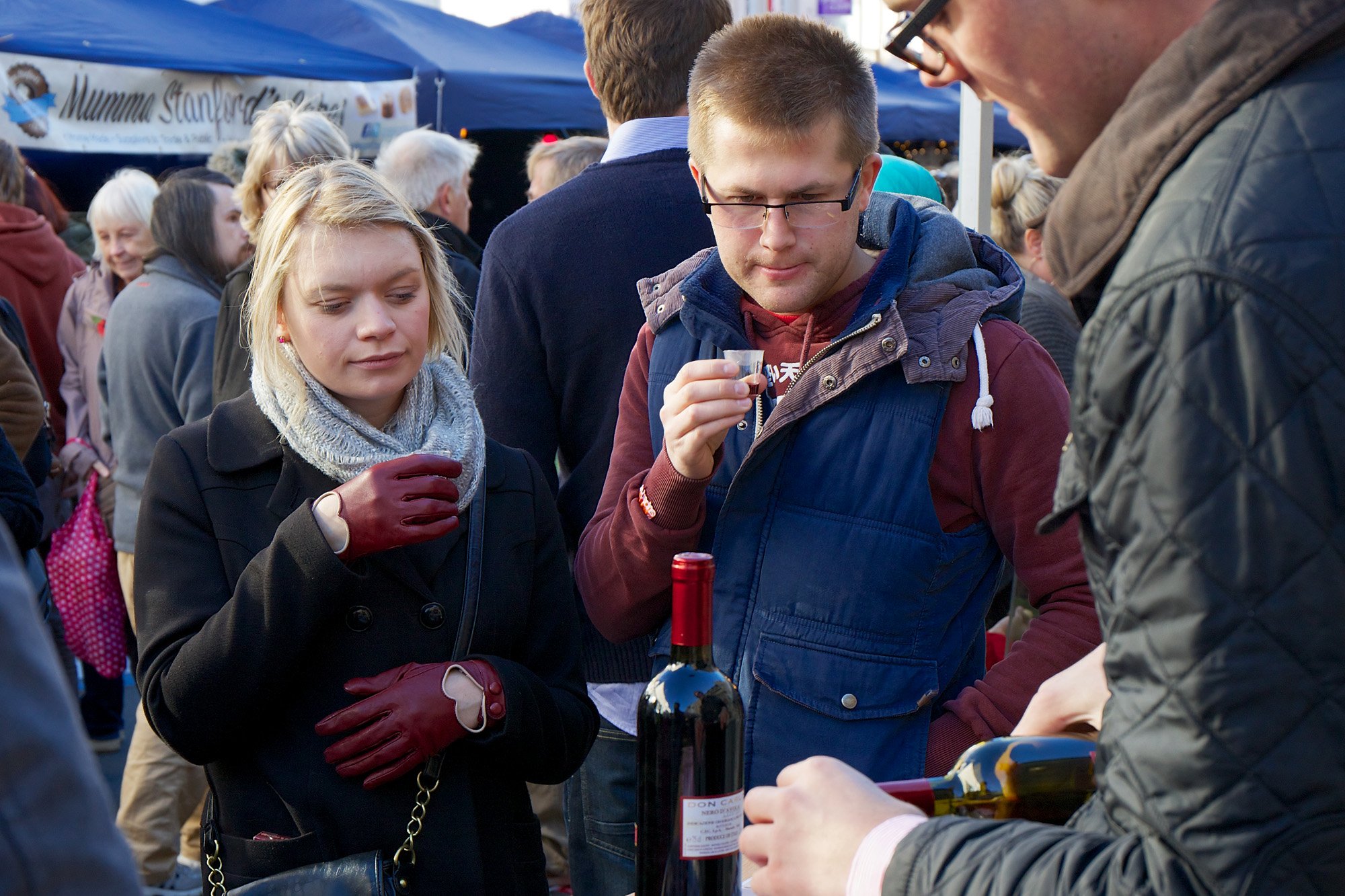
The two people in my featured photo (above) make a harmonious composition with their shared love of burgundy red. I was fortunate to come across them when they were enjoying a wine tasting at a winter street market — and luckier still to see them sampling red wine rather than white. Spanish burgundy?

Larger Groups
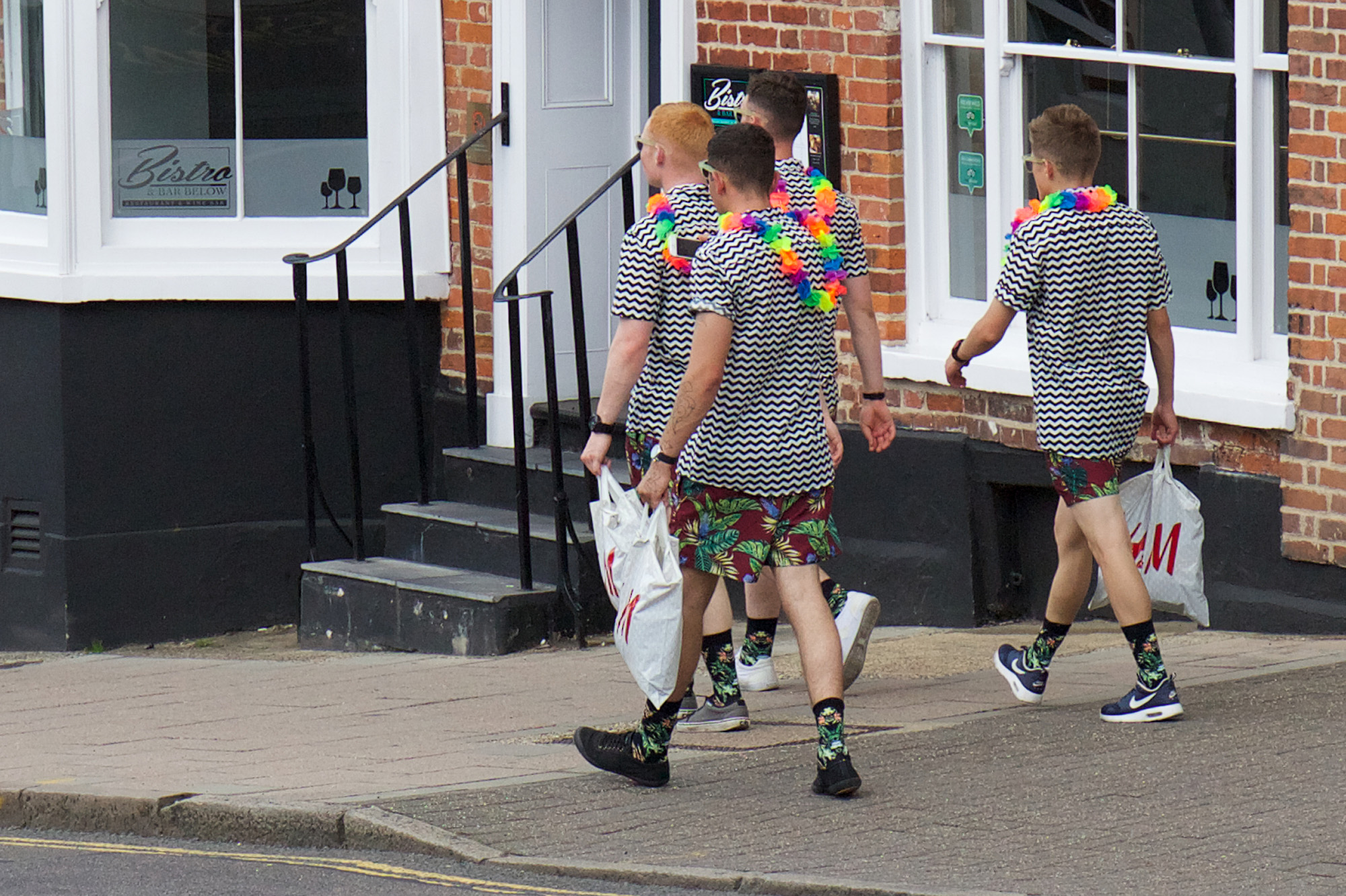
It’s a little more unusual to find larger groups of people wearing similar clothes unless they share the same occupation. I saw these four guys (below) walking away from a street carnival at the end of the day. I have no idea who they are, but for that very reason I find them thoroughly intriguing.

four guys

As you may know if you read this blog regularly, I like pictures that compel the onlooker to make up a story to account for the content of the image. Here’s my own version. It may or may not be true.

Four friends, possibly members of a boy band, came to town dressed in their normal clothes (not the ones you see here) and discovered there was a carnival in the afternoon.

It was a bright day, so they all bought sunglasses in matching styles, then one person had the bright idea of buying matching clothes as well. As a result, they popped into clothing retailer H&M where they picked out identical tee-shirts, shorts and socks.

The town is full of party stores, so it was easy to find some colourful, carnival-style garlands. The only problem — apart from non-matching trainers — was having to carry their regular clothes in the H&M shopping bags. Maybe next time they’ll come fully prepared!

Working Parties
If you’re looking for colour repetition among groups of people you could do worse than photograph men and women at work. When people are obliged to wear a uniform they automatically make a harmonious picture. I hasten to add: it’s up to the photographer to make sure there are also other reasons for taking the shot.

working party

The group shot of people at work seems to be most successful when the individuals clearly show their unique personalities, despite wearing identical dress. Such an effect does not come across when you see, for example, a distant shot of soldiers on parade. They all look very much alike. But in civilian life, people are free to express themselves in different ways while still being able to work together effectively.

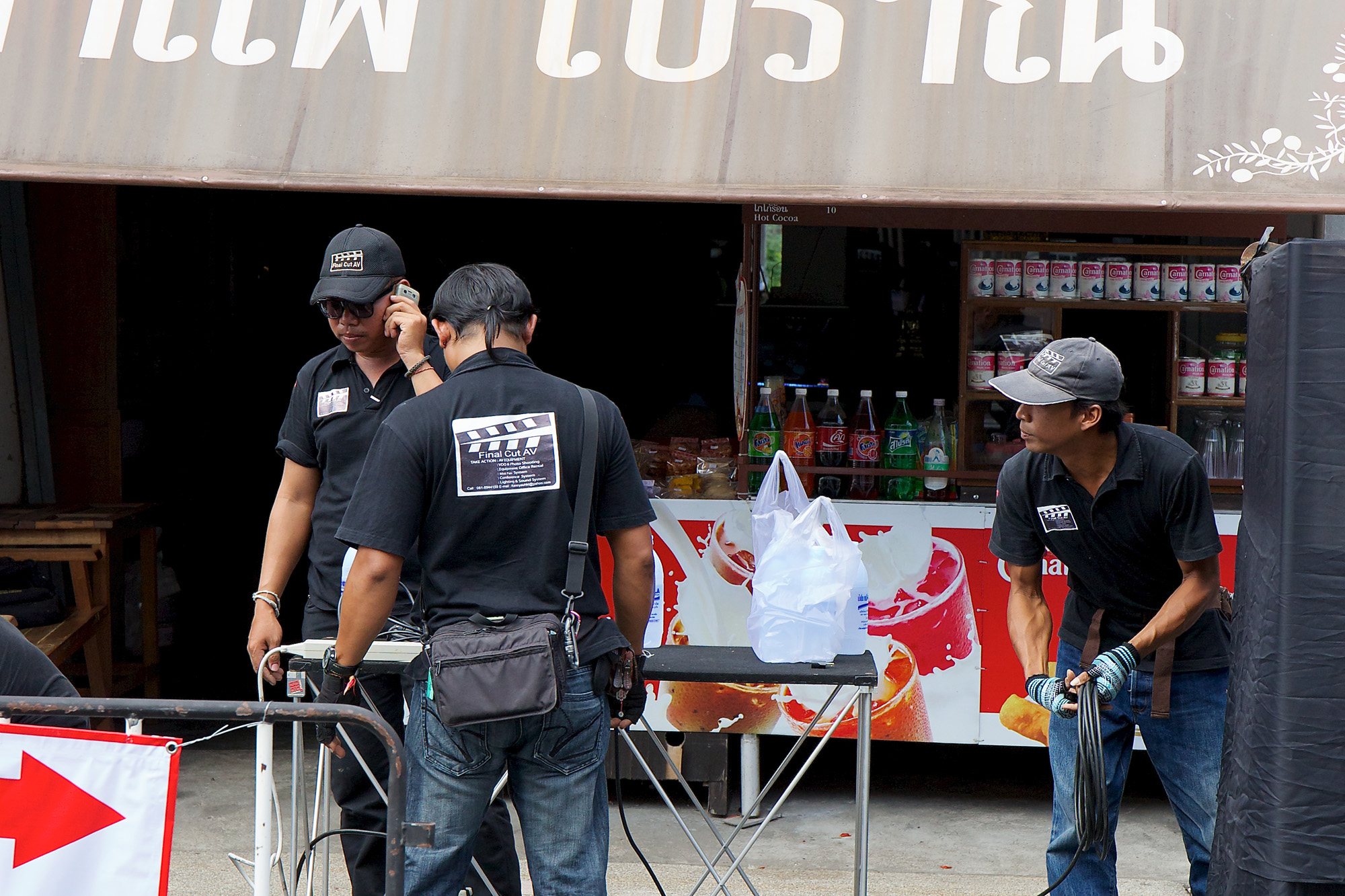
I have a couple of shots to support this theory. The first (immediately above) shows three guys setting up an outdoor sound system. They all look pretty efficient, dressed in the corporate tee-shirt, with two of them wearing the corporate baseball cap as well.

However, each man has a separate task to perform while communicating with colleagues, including someone else at the end of the telephone, presumably back at base. Individual personalities are apparent, making a contrast with the similarity of dress. The red arrow and stark white of the untouched water bottles suggest a sense of urgency, but the man with his back to us — with the jaunty pigtail — provides a calm, stabilising influence.

I took a similar, but more humourous shot on a later date (below). Again, there are three guys making preparations for an event, putting name-tags on seats. A passing TV cameraman is not part of their “tribe” because he wears a different corporate outfit and works without any reference to the others.

panda theatre

The photo would not be as amusing without the family of pandas in the background. They’re all part of their own tribe: Mum, Dad, and the two Cubs.

Yet like each of the men in the photo, the pandas seem to have individual personalities. The young male has a zany hairstyle and is the only one expressing any concern. Likewise, the man in charge — who points with his finger and seems to be saying “that’s where it goes” — is equally self-conscious about his hair. What appears to be a colourful comb juts out from his back pocket. The young panda looks aghast!

What Are the 3 Most Important Factors in Street Photography?

Here’s a Long List of candidates.

Drama, humour, colour, depth, eye-catching interest, facial expressions, sharp focus, balance, frame-filling content, texture, beauty (“Did someone say beauty? What do you think this is? Art? Get the hell outta here!”) clarity, mystery (“Can you have clarity and mystery in the same image?”) mean-streets grittiness, energy, decisive moments…

Oh, sure. Those are all very nice, but I’m afraid the three most important factors in street photography are a little bit…excuse the pun…a little bit more pedestrian.

Light. Background. Figures.

If you pay attention to those three factors (they’re not ranked in order of importance) a lot of the others will take care of themselves. At least, they’ll show up occasionally if you’re patient.

Light
When photographers talk about “good light” and “bad light” they’re making a subjective judgement rather than indicating something that can be identified and measured. “Good light” means light which is best-suited to the style of the individual photographer; while “bad light” makes it more difficult to achieve images in the same or similar style.

For example, if you see the city as being a grim, prison-like environment, populated by inhabitants who are miserable and downtrodden, then you’re unlikely to get the best results by taking photos bathed in the gentle rays of the evening sun.

In street photography there is very little you can do about the light except take advantage of it or wait for it to change. I have friends who like to go out with off-camera flash, an accessory that suits their style of photography. Personally, I find it an encumbrance, so I use natural light most of the time, augmented by light from shop windows, neon signs, street lamps and car headlights.

If you want to put in a full day’s work on the street, your style needs to be sufficiently accommodating to include morning, noon and evening light. Intensely sunny days are the most challenging — as well as being the most frequent in some countries. For my own style I prefer bright days that are just slightly overcast (giving results like those in my featured image, above). Wouldn’t it be good if we could order these at breakfast? “Sunny side up? No, thanks, I’ll have mine with a thin covering of cloud.”

Background
Photographs are often made or ruined by what’s in the background. Nowhere is this more true than in street photography. The background can be every bit as important to the picture as the foreground figures. Sometimes the background plays a greater role; sometimes it’s “just there,” minding its own business while the figures dominate the scene.

The Guvnor

I often think of these two elements — background and figures — as working hand-in-glove with each other, or, to vary the metaphor, behaving like a singer’s voice and its musical accompaniment. In some works of music the accompaniment is mere strumming, while the voice soars above it. But sometimes there can be a dialogue between the two, yielding additional layers of meaning.

A street photograph can show men and women dominating or being dominated by their environment. Equally, it can show them moving within a space that supports and reinforces their presence. All of these three types of street photograph are valid and you may have a preference for one over the other.

For example, if your eye is caught by the abstract lines of buildings illuminated by shafts of light, you may like to have tiny figures in the middle distance and nothing more. Create a set of images like that and you’ll impress the jury. But eventually the dynamics of street photography will command you to move in closer: to focus on the figures whose activities and movements are the true subject of this rewarding but difficult art form.

Figures
Given that figures are so highly significant in street photography, shouldn’t we be identifying the most likely people to fill the frame and start chasing them down the street?

Well, no, that’s not the best tactic, although I admit I use it occasionally. A better tactic is to chose your background, then wait for the right figure to move in front of it (as below). This, I suppose, is the classic ploy known to all experienced street photographers. When you choose the background you can also, in a sense, choose the light — because light can hit the background in many ways: full-on or at an angle.

Facial expressions, from joy to misery, may become a key feature in your work, but unless you’ve allocated most of the frame to people’s heads then much of the image will still be torsos, arms, shoulders, maybe even legs as well. That’s why I refer to “figures” as one of the three most important elements. Your photo can have emotional content, expressed facially, but there’s no escaping the considerations of form. From a formal point of view every part of each figure’s body makes a contribution to the success or failure of the image.

Working with a wide angle lens, you’ll capture figures plus their immediate background in sharp focus. However, there’s usually very little depth-of-field between the point of focus and the camera — far less than between subject and background. It you include figures between the point of focus and the camera you’re likely to make them large and blurred: an effect that spoils many street photos, in my opinion.

There’s a good reason for why the “foreground bokeh” effect looks unsatisfactory. When a figure is shown large it’s more noticeable and deemed by the viewer to be more important, but if it’s blurred it’s clearly intended to be less important. This is a contradiction! It makes me uneasy. By all means use it if you want to instill a sense of unease in the viewer.

So there are the three main factors of street photography: light, background, figures. Think about all three of them at the same time and you’ll be on the right track to taking great photos.

One Person, Centre Frame

One of the most difficult candid shots to get is the classic “one person, centre frame” composition, with the subject facing the camera. In this scenario, the likelihood of the subject looking up and reacting with alarm, delight, or some other emotion (most likely embarrassment or irritation) is probably around ninety percent.

I think it’s easy to underestimate the appeal of this basic style of composition. Although it’s identical to the composition used by millions of people every day when they snap each other with their mobile phones, it still has the power to hold our attention in a photograph taken with artistic intent.

Personally I don’t think there’s any need to “big up” the subject by getting close with a wide angle lens. That’s what street photographers do when they go over to the other side and start collaborating with the subject. My own motto is “Never Ask Permission,” a slogan I once found on a sticker in London (no, I didn’t put it there!)

How To Do It
The only way to get such a shot is to find a subject who is absorbed in some activity — or else sitting dreamily, staring into space and taking no notice of the camera whatsoever.

My featured shot (above) is an example. For obvious reasons I’ve called it “Relax Time.” The woman is sitting in a comfy and partly open-air bar which faces directly on to the street. Hence she is lit entirely by natural light, which is slightly unusual for an interior setting.

In the “one person, centre frame” composition the setting is every bit as important as the subject. Street photos — even those taken a couple of yards off the street like this one — show people in the context of an urban environment. For this particular shot I found a mini-environment, a true haven, adjacent to one of the main thoroughfares in Bangkok. I took the shot just as I was leaving — and the subject was completely unaware that she’d become part of my day’s work.

I doubt if I’d be able to get a similar shot unless I were in the mood for taking pictures. On this occasion I’d been sitting at the open window, observing pedestrians and photographing them in close-up as they passed the bar’s welcome sign. I was pleased with the results. Then, pausing just a yard or two away from the “Relax Time” subject I noticed this entirely new composition at once.

It’s divided into a “busy” half on the right and a “relaxing” half on the left. The jumble of decorations are confined to one corner and below them are the brightly lit table and cushion. On the other side are brown stools, a brown chair, a light brown wall and the edge of a picture frame.

In the late afternoon the bar is at its quietest, my partner and I being the only customers. Once the drinkers start arriving the subject of my photo will soon find that her “relax time” has come to an end. Her working day is divided into busy and relaxing spells — and my photo, similarly divided, encapsulates the story.

Another Example
I’ve been looking through my pictures to find other examples, but they are few and far between. Most of the time I’m not trying to place the subject centre frame and I tend to include several people in each shot.

However, here’s another one (below), taken in a busy street, with the subject in the centre of the frame. Like the other shot this one deliberately places the subject in context. People hurry past; I linger for a moment to take the shot. The man at his makeshift desk doesn’t take any notice, He’s completely absorbed in reading a message on his phone.

Broken Specs

I’m tempted to say: “That’s the best thing about mobile phones!” They distract people sufficiently to enable us to get a full frontal shot without being noticed. The downside is that you end up with a gallery of mobile phone shots — but that’s OK if they have some genuine quality.

I like to think this is the case with the image above. I took it partly because the light was particularly good at this location on the street. The red table was striking and I liked the glimpse of the stool to the right, plus the yellow sign which enlivens the image. I deliberately waited to catch a passer-by in mid-step, which adds a decisive moment to an otherwise static image. There’s also a sense of depth, added by the scene in the background where someone has paused, holding a blue suitcase.

Yet none of these qualities makes the image truly unique. There’s one detail which elevates it to my Chosen Few folder. Can you see what it is?

The subject has quizzical eyebrows which curl up at an angle. As if in sympathy, his spectacles do the same. One side of them is broken and the plastic rim points up at a noticeable angle. It looks as though it’s part of the man’s expression, perhaps one of shock or surprise at what he’s reading on the phone.

I’ve called the image “Broken Glasses” to draw attention to the detail. Many people who enjoy looking at photos don’t actually linger long enough to read them.

That’s really the secret of street photography. Look, linger, and see the image. Afterwards, you can only hope viewers of your image will do the same.

Capturing Raw Emotion in Street Photography

There’s emotion and there’s raw emotion.

It’s not hard to capture emotion of the non-raw type in a street photograph, as long as you’re close enough to the action to see it.

A human subject can express emotions like unease, mortification or contempt, primarily through gesture but also by facial expression.

People are not normally demonstrative on the street. They simply go about their lives and behave with remarkable decorum, quite the opposite of what they do in private. But if you’re especially observant you can find revealing gestures and expressions that can tell you a lot about their state of mind.

The most common emotions captured by street photography are feelings of impatience, boredom, frustration, anxiety, embarrassment and amusement.

You can get great street photos if you include people who are showing any of these emotions. I love these suggestive, low-key images which tell us so much about life in the modern city.

But What About Raw Emotion?
By “raw emotion” I mean feelings that are more overt, more openly expressed and perhaps overstepping the normal rules of civil society which call for everyone to get along with each other in public.

For example there is anger, jealousy, spite, rage, exasperation, despair, and grief: the full gamut of extreme emotions that sometimes spills over from the privacy of the home into the public domain of the street. These feelings are not always suitable subjects for the photographer. No one should intrude on private grief. Yet neither can we ignore expressions of displeasure, annoyance, pique, affront, and fury when they occur openly in front of us.

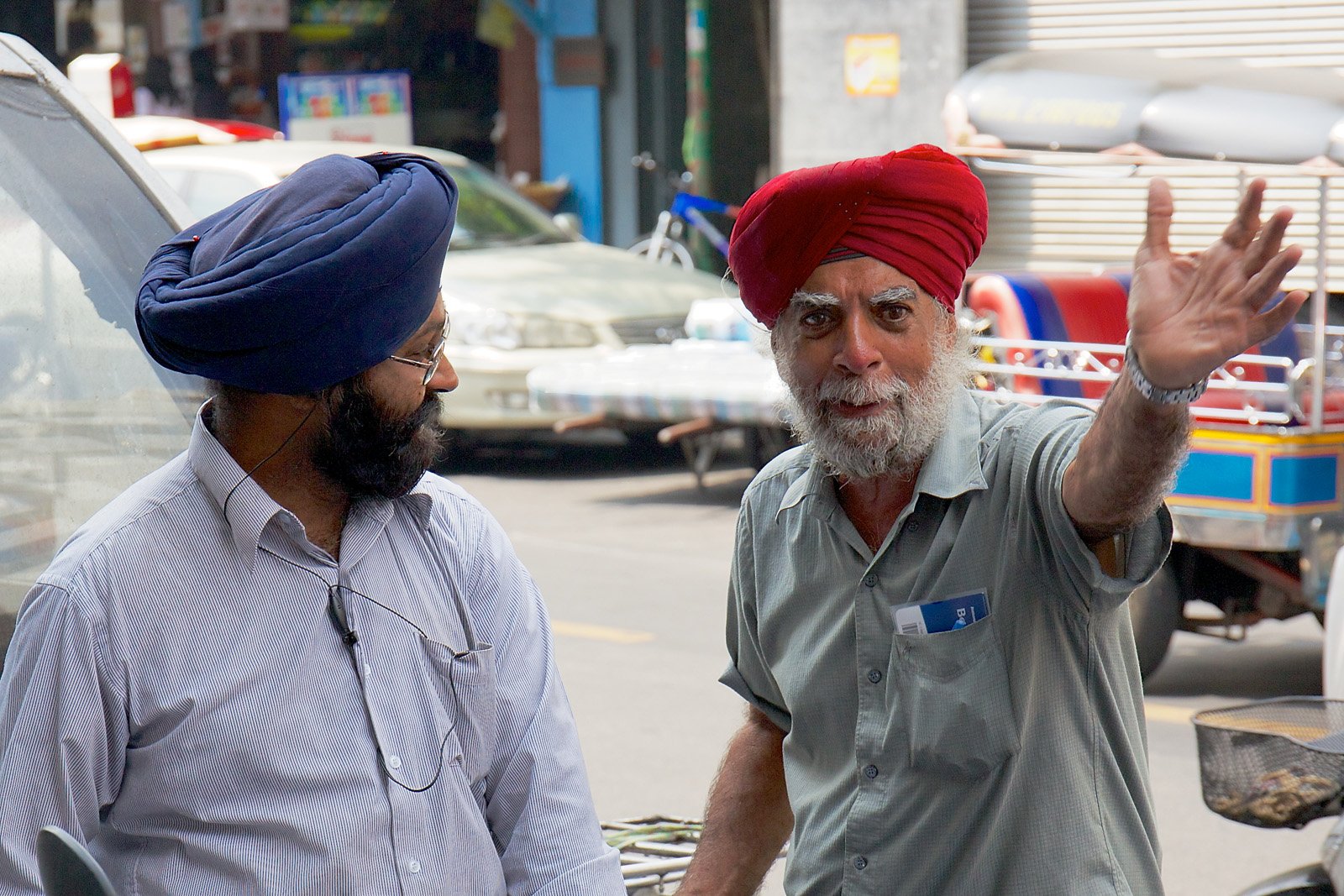
I have no idea what the two men in my featured image (above) were discussing, but their argument was impassioned. They weren’t at odds with each other, but probably expressing exasperation with someone else. I felt I could take a picture quite safely.

Does raw emotion make a good photograph? Not necessarily. You still need all the other components: strong composition, good light, balanced colour within the frame, and high technical quality. Much can be forgiven if you preserve a wonderfully dramatic moment at the expense of these other elements, but for a classic picture you need it all.

The Problem of Intrusion
When you’re a witness to any display of raw emotion on the street there is always the danger of becoming personally involved. It’s not the job of the street photographer to intervene in other people’s arguments, although you could certainly justify intervention when physical abuse occurs in front of you.

A problem can arise if you are seen to be photographing the incident, only to unite the people who are arguing (that’s good!) who then turn their rage against you, the snooping third party (that’s really bad!)

Fortunately, those who rage against each other in the streets are usually very much absorbed in their mutual hostilities and unlikely to pay you any attention. Nonetheless, you need to take care. I had my camera with me in Brooklyn when I (and a friend) came across a gang fight involving broken glass bottles and copious amounts of blood. Discretion (the better part of valour) triumphed over any desire to take photos and we didn’t go any nearer.

Capturing a Mix of Emotions
It’s often possible, especially in crowd scenes, to find one person expressing anger or annoyance while other people are smiling and obviously enjoying themselves. If you’re lucky you may get something similar with a smaller group, where, because of proximity, it has greater impact.

Incident with pigeons

My image above, taken from a boat, shows a woman making a stabbing, accusatory gesture towards a man who looks seriously concerned. Quite unconcerned is the man in the background. He’s laughing his head off! I can see from an earlier shot that the couple (or rather, the group of three) are standing several yards away from the laughing man who is probably quite unaware of their disagreement.

I didn’t know what to call the image, but I wanted the title to be in keeping with the full content, not just the apparent quarrel. In the end I settled on “Incident With 61 Pigeons.” The title helps to diffuse the situation.

Raw emotion can evaporate as quickly as it arises. Catch it while it’s there!