The vast majority of street photos fail to show any real interaction between people. Is this an accurate representation of what actually happens on the street?
Most of the people moving about our big cities on foot are shopping, going to and from appointments, or looking for somewhere to grab a bite to eat. Couples and small groups are different, but their interaction is usually limited to chatting. Any demonstrative action between them occurs only now and again. Blink and you’ll miss it.
Action and Interaction Human action is something that underpins our entire economy and society. Wasn’t it the great thinker of the Austrian School (of economics), Ludwig von Mises, who based his entire theory on it, calling his definitive work “Human Action”? No product gets made, no service provided, until someone takes action.
The actions we make can be either competitive (as in the featured image, above) or collaborative (as in the image below).
In fact, what often happens in a given society is a constant switching between the two modes of behaviour. People compete with each other for money and love, but they collaborate when there’s a major threat to the common welfare.
I think there can be a large amount of self interest in collaboration. The man in the photo, who is rescuing the woman and preventing her from falling into the water, is simply doing his job. Drowing a passenger would have unwelcome repercussions for him personally.
Observing Interaction Because human interaction tends to happen at rare moments on the street, the photographer has to respond quickly in order to capture it.
Yet it really is important to capture these moments if we want to give a rounded and accurate picture of city life.
One way to do this is to attend events that attract groups of friends and sightseers. When people are not burdened with the need to reach appointments or get to their place of work they’re more likely to engage with each other in having fun.
I’m not sure if Ludwig von Mises would approve, but it seems that leisure rather than work — in my photos at least — leads more frequently to human interaction on the street.
Happy are they whose work has a physical component as well as an intellectual one. I’m referring to the surgeon, the sculptor, the builder, the engineer — and yes, the street photographer! Without physical activity, human beings become sad, lopsided creatures, divorced from the reality of the world around them.
I have a huge admiration of people whose work is primarily physical and who take the trouble to do it properly. Without them, street photography would be impossible. There would be no cameras, no buildings, no streets.
As we move into an age of robotics and artificial intelligence, we may be tempted to sit back and let machines take over. This will be a fatal mistake because machines will organise reality to suit themselves, not us.
Ownership The concept of work underpins our concept of ownership. That is to say: it’s our physical work which cultivates the land, creates the built environment, and confers upon working people the right — by common agreement — to claim a measure of ownership of the physical world.
That said, unskilled labour has never been highly rewarded. The concept of “slave” completely undermines the concept of property.
When I take pictures of people engaged upon physical labour I often get the impression they’re resigned to their fate. They’re just going through the motions, aware they’ll never be able to afford to buy one of the high-rise apartments they’re building, or to which they’re delivering goods.
Today, a lifetime’s physical labour will just about feed and clothe you. Unless you’re among the sporting elite you’ll never win a fair share of the tangible world by running, digging, chopping or lifting various parts of it.
Money If there’s one thing that makes slaves of us all it’s money. Fungible currency (you can swap it to buy anything) serves the purpose of separating physical labour from ownership. Once it becomes available, everything assumes a market value governed by supply and demand. Convenient? Yes, but it shortchanges the physical labourer and rewards the trader and the banker.
The downside to trading and banking is the physical effect on individuals who spend all their time in front of computer screens. A complete lack of physical labour leads to obesity, ill health, and, eventually, an early death.
The professional, screen-bound classes believe they have a solution to this problem, namely: pointless labour, or “exercise.”
Pointless Labour Personally, I hate the idea of going to a gym and “working out.” It’s an insult to the noble concept of work and ownership. If you want to stay healthy, the most sensible course of action is to do something useful: dig the garden, paint the house, or create something tangible. Pumping iron is insane. Form follows function, so why would anyone trust a musclebound web designer?
What Does All This Have to do with Street Photography? My argument has nothing — or perhaps everything — to do with taking pictures in the street. The physical activity of street photography is all about walking and looking: about seeing and recording what’s really going on.
Human beings are prepared to work hard, but we also like to seek advantage and acquire more than our fair share of possessions by scheming and calculating, even if it means taking risks. The risk-takers who make the most accurate calculations — so accurate they have predictive power — are the ones who gain greatest advantage.
Can we really see and photograph all this on the street? We can certainly see the stark difference between those who labour physically and those who manipulate figures and give instructions. On the other hand, it’s impossible to tell — from vision alone — whether someone sitting in a café is writing a novel or causing a stockmarket crash.
There are strict limits to what street photography can show us and even stricter limits as to what it can explain. It can’t tell us how the world works, but only show us the outcome: how the world turned out and how people are reacting to it.
The Impossibility of Knowing Oddly enough, the limitations of street photography only add to its magic, not subtract from it. Images taken on the street tell us something about the impossibility of knowing. They make us think without necessarily directing our thoughts in any specific direction. In this sense, the shortage of explanation — street photography’s inability to provide a complete narrative — can be an advantage.
The street photo is a “fait accompli.” It leaves us with no other option than to accept it for what it is: a snapshot, a statement, a solitary frame from the movie of the photographer’s mind.
In London, the sight of couples walking hand-in-hand is commonplace and unremarkable. Yet in Bangkok — the other city where I take most of my pictures — it’s rare to see open displays of affection. The only exceptions are tourists and a few young people who have no expectation of bumping into older (and possibly disapproving) relatives.
The difference between the two cities makes me think: what’s really going on with this public show of togetherness?
Is it simply a private exchange of affection between two people, like a kiss, only somewhat further down the scale of intensity? Or it really a public statement? One which says: “We’re declaring ourselves officially as a couple.”
Looking Closer Taking candid pictures is an activity that raises — and sometimes answers — the kind of questions I’ve just raised.
To the casual eye, there’s only one category of hand-holding, namely, two people walking hand-in-hand. But the street photographer notices that there are many different ways of holding hands, surreptitiously (as on a first date), ostentatiously (committed couples), and elaborately (playful couples who may or may not be committed).
The most elaborate example of hand-holding I’ve seen is pictured in the featured image (above). You have to look carefully to see how their hands are entwined, his in hers and the same again with the opposite hands using the phone.
Incidentally, the above shot is entirely candid although it looks posed. I tried to see if there was another photographer in the vicinity, but there wasn’t. Maybe the couple were about to take a selfie.
Low Key I have no idea whether the couple above, standing outside Wat Arun (Temple of Dawn) in Bangkok, are married or on a date. Their way of holding hands is very low key, not surreptitious but certainly understated.
I think they may be acting this way out of respect for local custom. Alternatively it could be an expression of individual personality. After all, the tee-shirt says: “Easy Does It.”
High Key The couple walking down London’s Oxford Street (below) hold hands in a very different way. They make them into a feature! The man points to something in one of the shops and his partner willingly goes along with the gesture.
In each of these three images the central feature is the recurrent one of interlocked hands. Surely, this is surprising, given the grandeur of the different settings? In the Bangkok scene, in particular, we notice the clasped hands immediately, even though the temple takes up most of the background.
It makes no difference whether hand-holding is a private or public gesture, or a little bit of both. It seems that our gaze is drawn to the image of human touch, in whatever context it occurs.
When people bend down in the street there’s usually a good reason for it. They’re picking up something important, or attending to an urgent task. No one “stoops in the street” (that sounds a bit rude, doesn’t it?) without good reason. In public it’s far more comfortable and dignified to remain vertical.
As a street photographer I love it when people stoop. It means I can catch one of those elusive but “decisive moments,” giving the image a justification for its existence. Every picture needs to justify itself by its inherent qualities.
When Stooping Reveals Sometimes the photograph can benefit, not by showing the purpose of the figure’s bending action, but by revealing something significant in the space where the figure was standing. This is true of my featured image (above).
In this shot the subject is stooping very low and is looking out of the frame at the bottom. Despite his red shirt we therefore have to discount him as the main subject of the picture. Instead, he has been replaced by the dead birds with their yellow feet in the air. These feet seem to be pleading in supplication for second thoughts: “Don’t eat me yet…”
When Stooping Reveals Nothing At other times we may come across an incident where the act of stooping reveals nothing whatsoever. For example, in the second picture (immediately above) we can’t see what the man is picking up. It’s clearly something fairly important because the lady with the scarf is watching intently. She “makes” the photo by displaying concentration on something which appears utterly trivial to the viewer of the image.
Street photography is often “about nothing,” in the classic Seinfeld sense. Larry David and Jerry Seinfeld famously pitched their series to NBC executives as being “about nothing,” (whereas, in fact, it was about everything: about the hassles of real life as experienced by city dwellers).
When Stooping Is Upstaged In a good street photo there’s usually more than a single point of visual interest. But when a woman in shorts decides to bend, revealing a couple of shapely legs, then it’s difficult to provide anything more interesting (certainly to a heterosexual male).
In the shot (below) I’ve solved this delightful “problem” by including a carved figure of a demure woman in a full length costume. I chanced upon the scene in question while walking along a Bangkok street in the early evening. In a sense, it was a readymade image of “the sacred and the profane” with some of my regular motifs: clocks, legs, and faded colours.
Speed Is Essential I’ll end this short post with a tip. If you see someone stooping in the street, be quick if you feel like taking the shot! I had just a split second to get each of these three pictures, meaning that there was no time to make adjustments to the settings. Fortunately, I’d already set them for just this kind of eventuality.
I have to add one proviso: yes, be quick, but also be deliberate. You mustn’t snatch the shot, because there’s not going to be a second opportunity to obtain it.
I’m sorry if the proviso makes the tip more complicated but it would be wrong for me to leave it out. I wouldn’t stoop so low!
Photography wrenches a moment from time and preserves it for later, perhaps forever. The concept of time is inherent to all photography. In street photography, especially, with its many “decisive moments,” time is ever-present, yet always, in a sense, absent.
I’m sorry if this sounds contradictory, but I think most people will recognise what I’m saying. You can’t take a photograph without making a deliberate or implied reference to time. Although you can take a moment out of time, you can’t remove entirely the concept of time from the image.
Because there’s an implied sense of time in a photograph it’s often rewarding to play deliberately with the idea: not just by freezing motion but also by including objects which demonstrate the passing of time. Thomas Hardy did this repeatedly in his novels, often to great effect.
Hardy’s Time-Worn Objects For example, in “Tess of the d’Urbervilles” Hardy describes a book which is greatly feared by Tess’s mother (who nonetheless consults it frequently): “‘The Compleat Fortune-Teller’ was an old thick volume, which lay on a table at her elbow, so worn by pocketing that the margins had reached the edge of the type.”
Again, in the same novel, he describes the “broad tarnished moon” as having a “face resembling the outworn gold-leaf halo of some worm-eaten Tuscan saint.”
And at a key point in the narrative: “he drew from his pocket a small book, between the leaves of which was folded a letter, worn and soiled, as from much re-reading.”
All these objects, worn down by constant usage, evoke the passing of time in Hardy’s work. Can we achieve the same effect in street photography? I’m sure we can.
Why Advertising? Old, soiled adverts speak to us directly about the passing of time. I think it’s because we are so accustomed to seeing new, fresh adverts for the latest products that it comes as a shock to see something being advertised with an old, worn poster or photograph.
At the top of this article is a shot I took in Kuala Lumpur of old tattoo work, the individual photographs deeply bleached by the sun. If you’re looking for the latest designs in tattoo art, this is probably not the place to go.
Talking of “places to go,” how about a visit to the Floating Market, Safari World, Tiger Temple or the Crocodile Farm? (See shot, above). They’re not far from central Bangkok and Lagacy Service can take you there in no time at all. I’m not sure if Lagacy Service is actually the guy on the motorbike, but it seems likely. I guess he unrolls the poster when he’s available.
Discarded Posters To show the passing of time you don’t even need to find posters that are old: new ones give the same effect when they’re in the process of being discarded.
In one Bangkok street I came across an entire wall of posters which were being peeled and replaced. Some of the discarded ones looked pretty good. I felt like nicking them, but decided to take a photo instead. Obligingly, a man with an armful of new tattoos walked past. He won’t find those as easy to replace as a poster!
Looking at the three images in this article I think they make a well-matched trio.
In addition to the poster-art there’s a human figure in each one who adds something to the image. Yes, I know it’s all too easy to add a “gratuitous” or obligatory figure, but in these pictures the human characters do, at least, play an important role.
The first two shots (with old photographs in them) are accompanied by figures who are waiting and for whom time hangs heavily. However, both time and the included figure move more rapidly in the third image. The tattooed man doesn’t wait. He hurries quickly past but leaves his own frozen image behind in my photo.
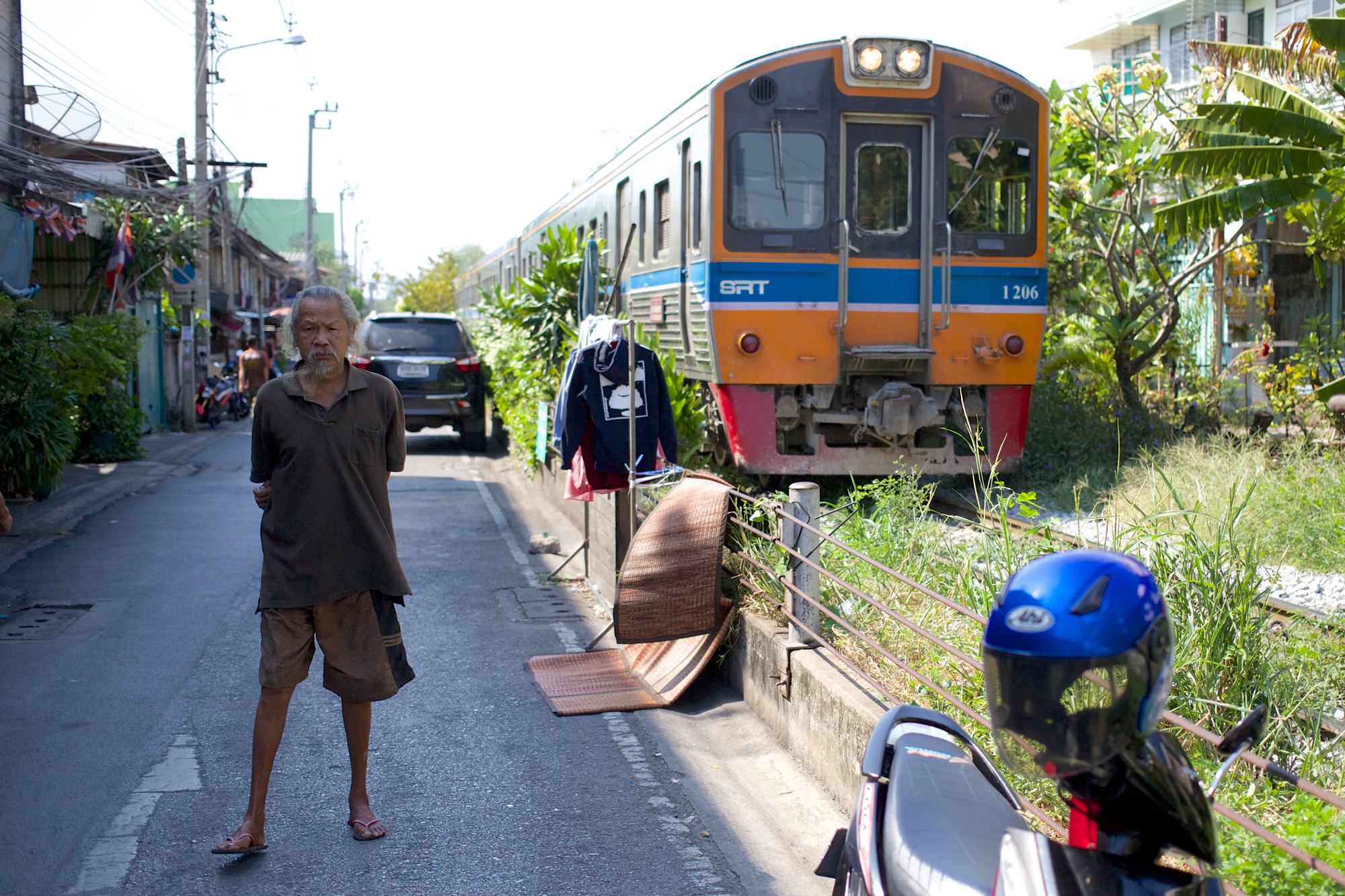
Most of us are accustomed to keeping trains at a distance, but in the Far East people have learned to live with them in close proximity. How close? Well, I suppose I’d have to call it “brushing-past close.”
The Mae Klong Train Market in Samut Songkhram Province, Thailand (an hour or two from Bangkok) is one of the best-known examples of intimate trains. It’s become a favourite tourist destination, ever since it appeared on YouTube in some stunning videos.
I’ve visited the market a couple of times and on both occasions have found it incredibly hard to get the perfect street photo. I admit I’m way out of my comfort zone, photographing a moving train from six inches away.
Fortunately, the Mae Klong Train Market also presents opportunities for regular street photos and indeed for other kinds of photography, from still lifes to portraits. While waiting for a train to arrive (there are only four each day) I took shots like the one above. It’s hard to image that a train will run along this track in a few minutes’ time, but that’s what happens.
See What I Mean? The train comes perilously close, but local people have learned to live with it. In fact, it’s been good for business.
Once vendors had figured out how to make full use of the tracks, by means of folding umbrellas and ingenious mechanisms for pulling their wares away from the train at the last moment, they were on to a winner. You could go shopping and be entertained at the same time. That’s a philosophy which has only recently been copied by modern shopping malls (and never by old-fashioned department stores in the UK).
The process of closing the umbrellas has given the Mae Klong Train Market its local name: “Hoop Rom” “umbrella/parasol-closing” Market. Honestly, the procedure is a whole lot more complicated than that, but you get the gist of it. If you want to see it: visit, but take care!
In the meantime, here’s some fish:
If you look closely at the above shot you’ll notice how the bowls of fish are directly on top of the rail. I know, it’s just a nice still life when it’s taken out of context, but the shaft of sunlight shining between the umbrellas takes the place of the almost unseen rail.
Wongwian Yai Station In Bangkok itself, another place where you can find what I’m calling “intimate trains” is Wongwian Yai Station and the little road which runs alongside the track.
This is a favourite haunt of street photographers, not just because of the trains, but also for its buildings which are picturesque or ramshackle, depending on how you choose to see them.
Personally, I love this area. The people are friendly and are clearly happy to be living in such an unusual neighbourhood: one that combines commerce with a certain amount of wilderness. Some of the ramshackle buildings even echo the design of a typical railway station:
People walk across the track, ride across it on motor scooters (below); and children sometimes play on it, despite being warned of the danger. Fortunately, the station is not far away, so trains are going quite slowly in the mile or two leading up to it.
Note: If you plan a visit, you can go to Wongwian Yai Skytrain Station, but that’s not it! You’ll need to walk several hundred yards to the old railway station on Somdet Phra Chao Taksin Road.
I’ll be making another trip to Wongwian Yai, determined to get more shots before the developers move in. I like it just the way it is.
If you were to ask me about the most significant development in street photography in the last thirty years, my reply would not be about digital cameras or photo editing software. It would be about what people are actually doing in the street.
These days, everyone is on the phone. Thirty years ago no one was on the phone. That’s the difference.
If Henri Cartier-Bresson were alive today and able to photograph a man leaping a puddle behind the Gare St Lazare, the man would definitely be chatting on a mobile phone.
I returned from a day’s shooting in London recently to discover that nearly every photo showed someone — either the main subject or a person in the background — using (what we used to call) a “mobile”. I wondered, will it be like this for the next hundred years, or will a new technology come along to displace the ubiquitous smartphone?
What’s Good About It? Given that the main subject of street photography has become “people on the phone,” is it possible to find anything good about it? After all, if we can’t find a way of making it appealing, we must either take laborious steps to avoid it — or turn it to our advantage.
One good thing about the mobile phone is its tendency to absorb the user, so enabling the street photographer to take a picture without being noticed. That’s really helpful. It allows us to get closer and take a more detailed but less cluttered photo.
Unfortunately, there’s one big snag: when they’re standing still, people either close their eyes, or, when they have a live video link, look directly at the phone.
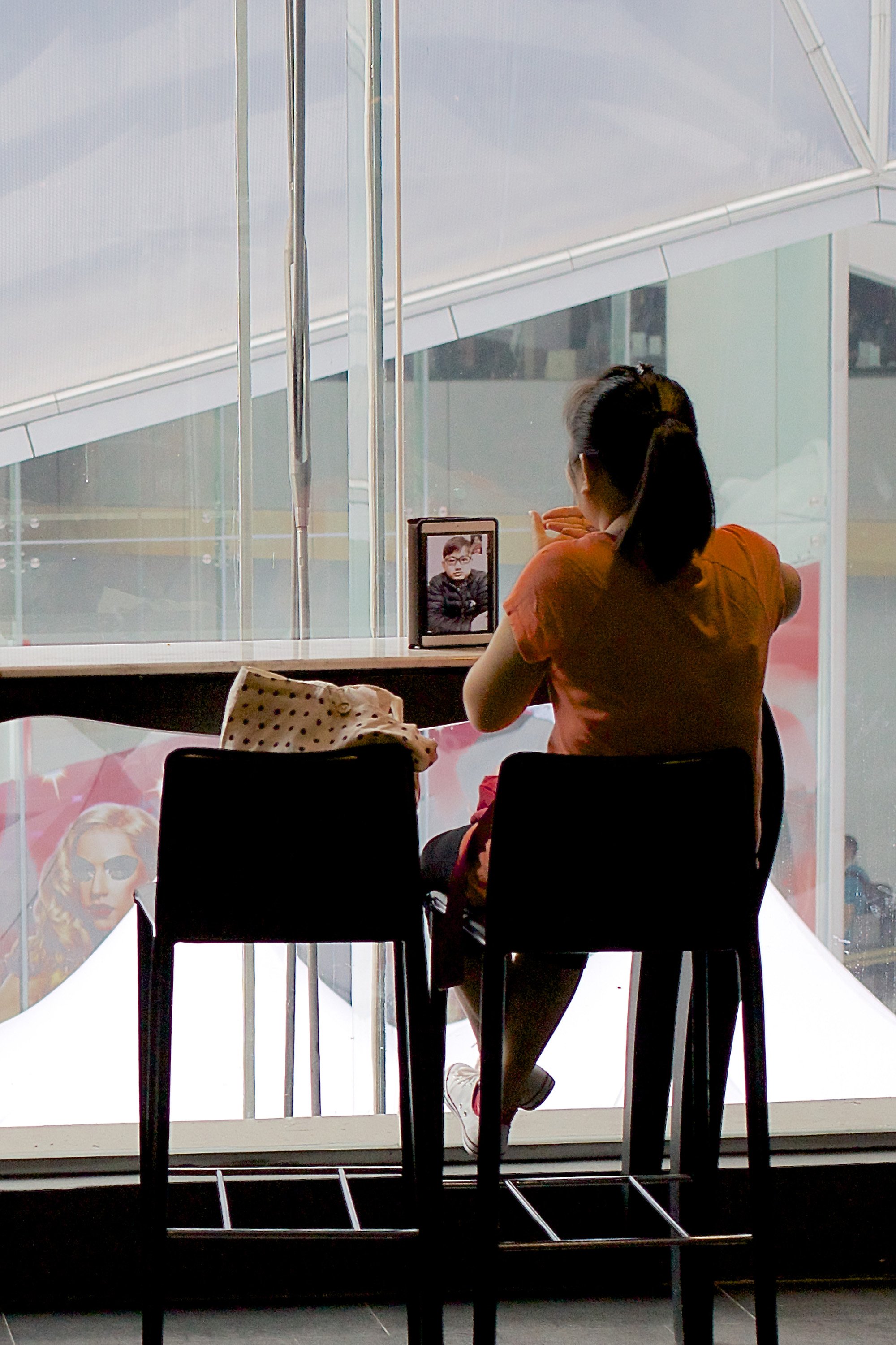
My featured image (above) shows the effect of closed eyes and phone absorption — and also makes a comment on it by including part of a poster featuring a woman with eyes wide open.
Relying on Context Again, I start with the premise that “everyone’s on the phone,” and this time I’m suggesting an approach which prioritises context above the subject. Here’s an example (below).
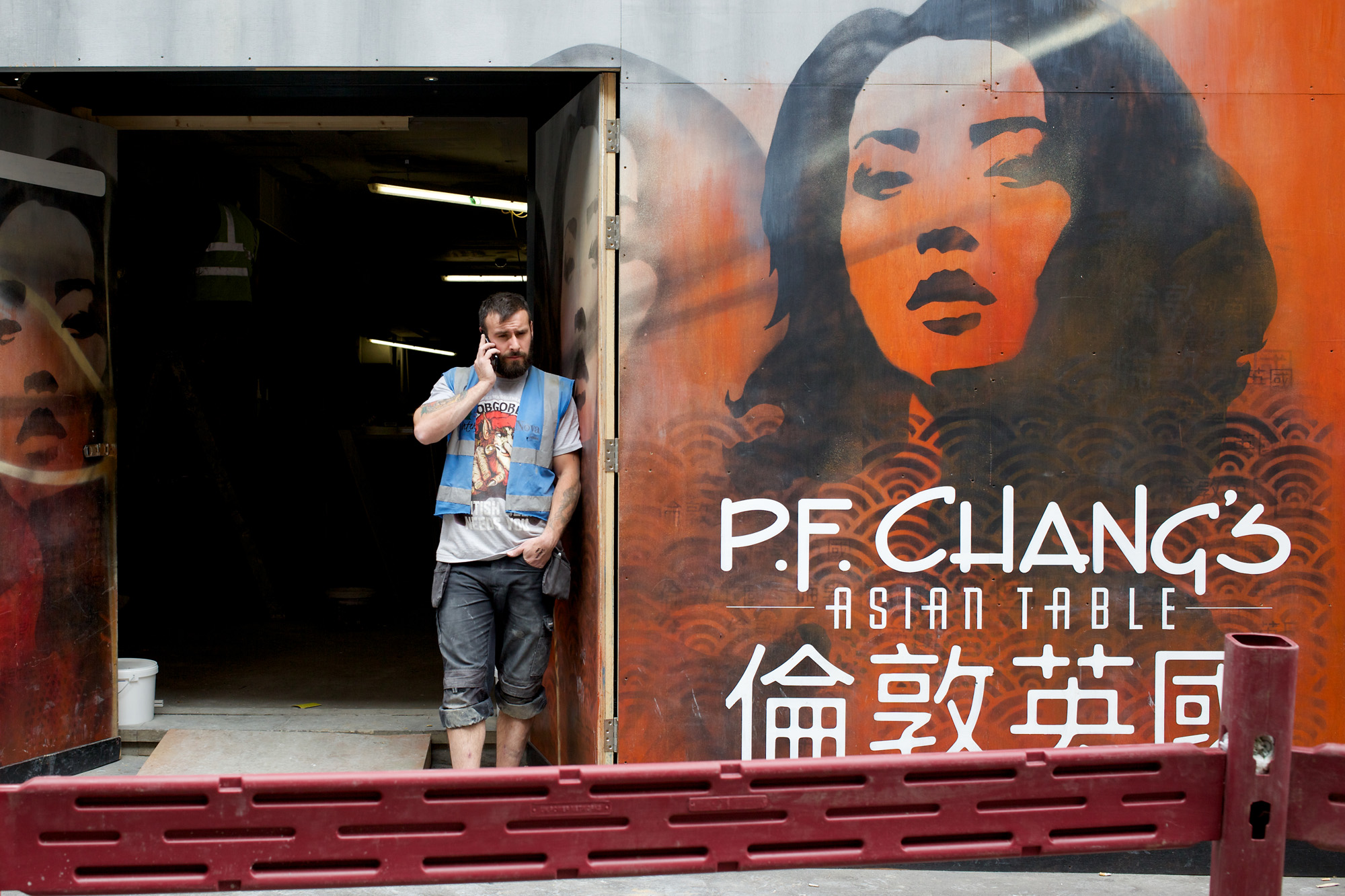
If there were no mobile phones, the subject of this image would have no reason to be lingering in the temporary doorway of the restaurant construction. But is he really the subject? The context — the colourful hoarding — is so noticeable as to dwarf the individual worker, however nicely lit he may have been in the sun of the late afternoon.
I’m a little bit worried that I may have been “played” by the company in question. It would be a good PR ploy — wouldn’t it? — to dress up the building site with huge, eye-catching graphics, then to make sure there was a photogenic builder on hand to pose outside whenever a street photographer walks past.
I understand that P.F. Chang’s is the “largest full service, casual dining Chinese restaurant chain in the United States,” so I wouldn’t be surprised if they didn’t pull out all stops for the London launch.
Incidentally, the name doesn’t refer to the sexy lady on the hoarding. She’s not the proprietress, unfortunately! P.F. Chang is Paul Fleming (hence P.F.) and Philip Chiang (now with simplified spelling). Well, it’s better than P.C. Fleming, especially in London.
Listening, Talking, Browsing, Snapping One reason why the phone has become so ubiquitous is because of its multi-purpose functionality. I recall the launch of the iPhone in 2007 (only twelve years ago!) by Steve Jobs: the first time the world heard about it.
Jobs pretended to be launching “three revolutionary products” – “a widescreen iPod,” “a revolutionary mobile phone,” and thirdly, “a breakthrough Internet communicator.” They were, of course, one and the same device, as he went on to demonstrate.
To say the iPhone became “transformative” is really an understatement. Arguably it’s transformed nearly everything, from popular photography to street navigation. The cellphone is an interactive diary, a notepad, a combined radio, record player, TV and cinema, a restaurant and entertainment guide, even a wallet from which we can spend money. We’re moving towards a cashless society, courtesy of the iPhone (and its imitators). We can run our entire lives from this one, handheld device.
The trouble is: our entire lives tend to consist of what we do with the mobile phone — all that listening, talking, browsing, snapping and spending. Although it connects us to each other, the phone has also become an intermediary standing between us and the real world.
Does anyone really look at Michelangelo’s David? No, they take a photo with a mobile phone in order to establish an entirely illusory connection, rather like sending a tape recorder to an orchestral concert instead of attending in person.
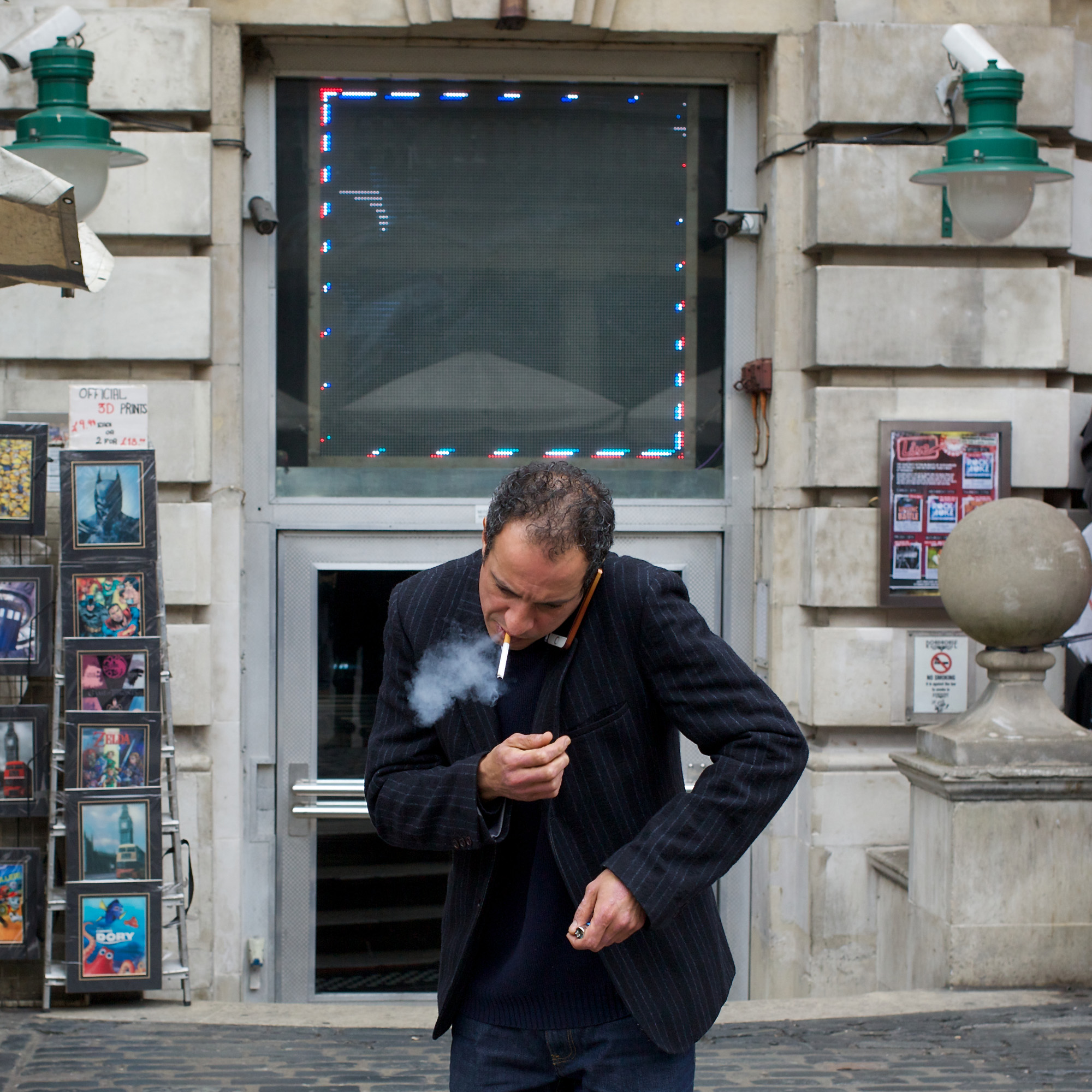
I’m not sure whether the man in my photo (above) is browsing, chatting or snapping. If he’s taking a photograph he’ll be disappointed. The baby seems have disappeared, leaving behind her “thick down warm rompers pink hooded ski suit” (or whatever its called).
In the same way we could be using the mobile phone to help us lead our lives, only to find that life has vanished, leaving the empty husk of virtual reality in its place.
It’s all very confusing. I’m still not sure whether the “smart phone” is the friend or the enemy of the street photographer. Just thinking about it is enough to make me want to take up smoking again.
There are plenty of things in the city that make life difficult for the street photographer: incessant traffic, fluorescent clothing, plastic bags — carried or discarded — to name but three. By contrast, tee-shirts are the photographer’s friend, especially the naughty ones.
If you see someone wearing an outrageously naughty tee-shirt you can be reasonably sure it’s OK to take a picture. The wearer is almost certainly an extrovert who struts around in provocative clothing in order to get noticed. It’s the extreme version of wearing fancy socks with a sober business suit, but thankfully more photogenic.
FCUK However, only a very small percentage of people have the temerity to display themselves in tee-shirts with salacious content. Several years ago in the UK, clothing retailer French Connection noticed this phenomenon and solved it by coming up with the edgy logo: FCUK. People could now pretend to be at the forefront of outrageousness while hiding behind a perfectly legitimate corporate logo. If it looked like an offensive word, well, that was in the mind of the spectator not the wearer.
Thinking up interesting stuff to put on the front of tee-shirts is the occupation of thousands of creative people, many of whom have made their fortunes in this way. Yet the market for truly naughty tee-shirts is relatively small, given the fact that nearly everyone wants to be accepted by the vast majority of others. If your tee-shirt shouts an obscenity, you are — in a sense — swearing at everyone you meet.
He Loves It My featured shot (above) is one of my favourite photos. The light is great in this Bangkok street market; there’s a happy smile from the stallholder in the background; and the wine coloured cardigan of the girl on the left goes well with the stripey tee-shirt on the right.
Ah yes, that one. You can’t avoid reading it. The arrow points to a non-existent companion (surely anyone would keep to the other side of her!). The spectator can only guess whether — like FCUK — the message is deliberately ambiguous. Maybe it comes from “down South” where cock fighting is a popular sport — and where the owners become quite attached to their ferocious birds, especially if they win.
When you’re in a country like Thailand, where English is not the main language, there’s always the possibility that the wearer doesn’t fully understand the ambiguities of the message. I don’t think that’s true in the above example, or in the one immediately below. When no words are involved, the message is pretty unambiguous — or just pretty.
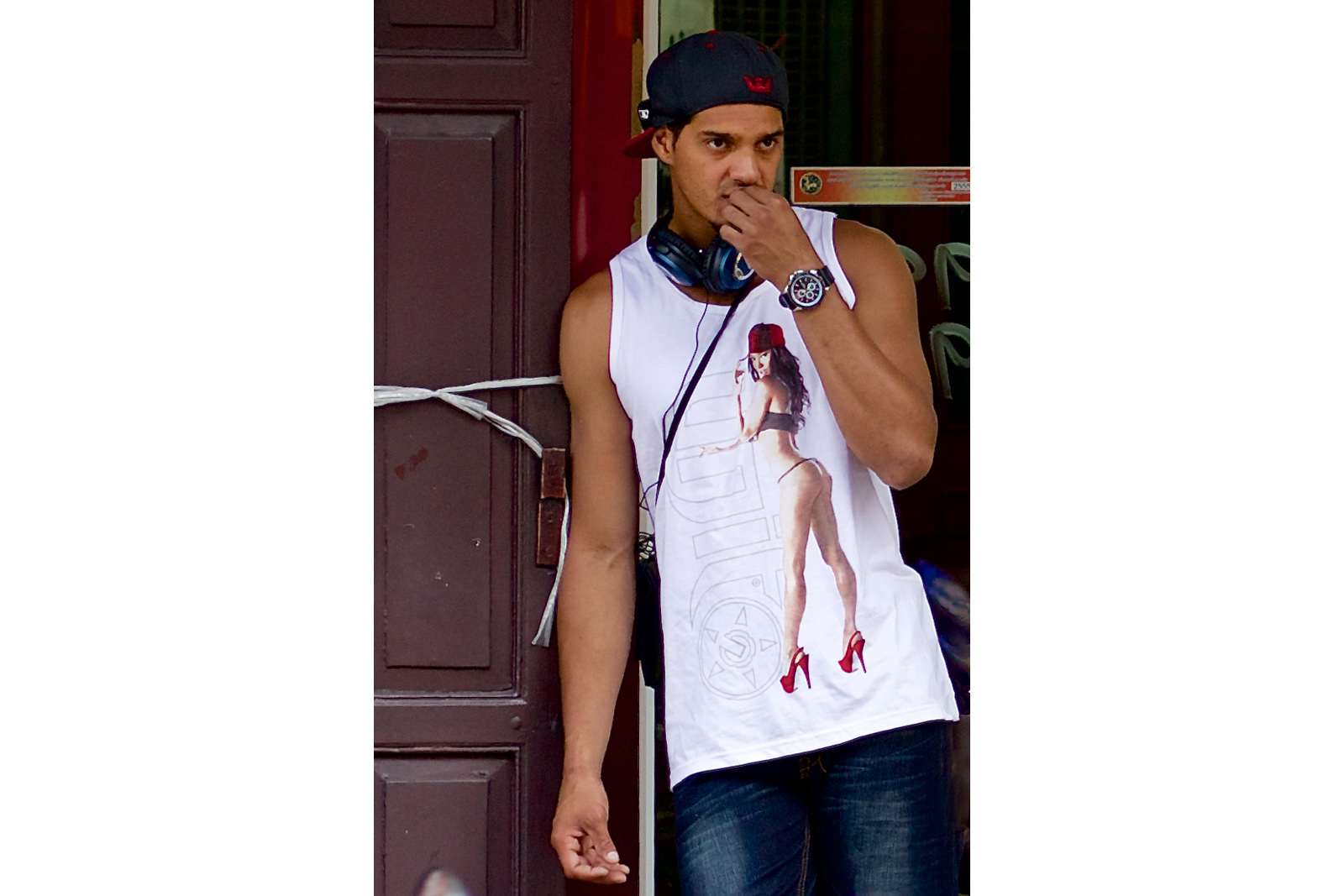
I’m not sure if women find this man’s soft-porn tee-shirt intimidating. Many will think it offensive, but the wearer doesn’t appear to mind if it hampers his chances to attract the opposite sex. Perhaps he’s so confident of his good looks he merely wants to signal his availability. Whatever his motives, he seems to have spotted someone out of frame, and the gesture with his right hand suggests even more wishful thinking.
It’s Just Decoration Sexual imagery can be stylised into cartoon form and worn with the complete confidence that it’s only a pattern — a cheerful, decorative motif which can be worn anywhere.
I love the three contrasting styles in the photo below. The image tells us more about human nature than do either of the two pictures above. Here, there’s no irony, no ambiguity. These people are practical and straightforward, yet scarcely keeping up with the pace of change in the city. Nonetheless, they have dreams of better things to come.
Where’s the best place for romance? Some would say “anywhere,” but romantic moments deserve romantic places, don’t they?
If you cut to the chase — or go even further to when the chase is over — the best place for romance is probably a hotel. At least, it’s certainly the most practical.
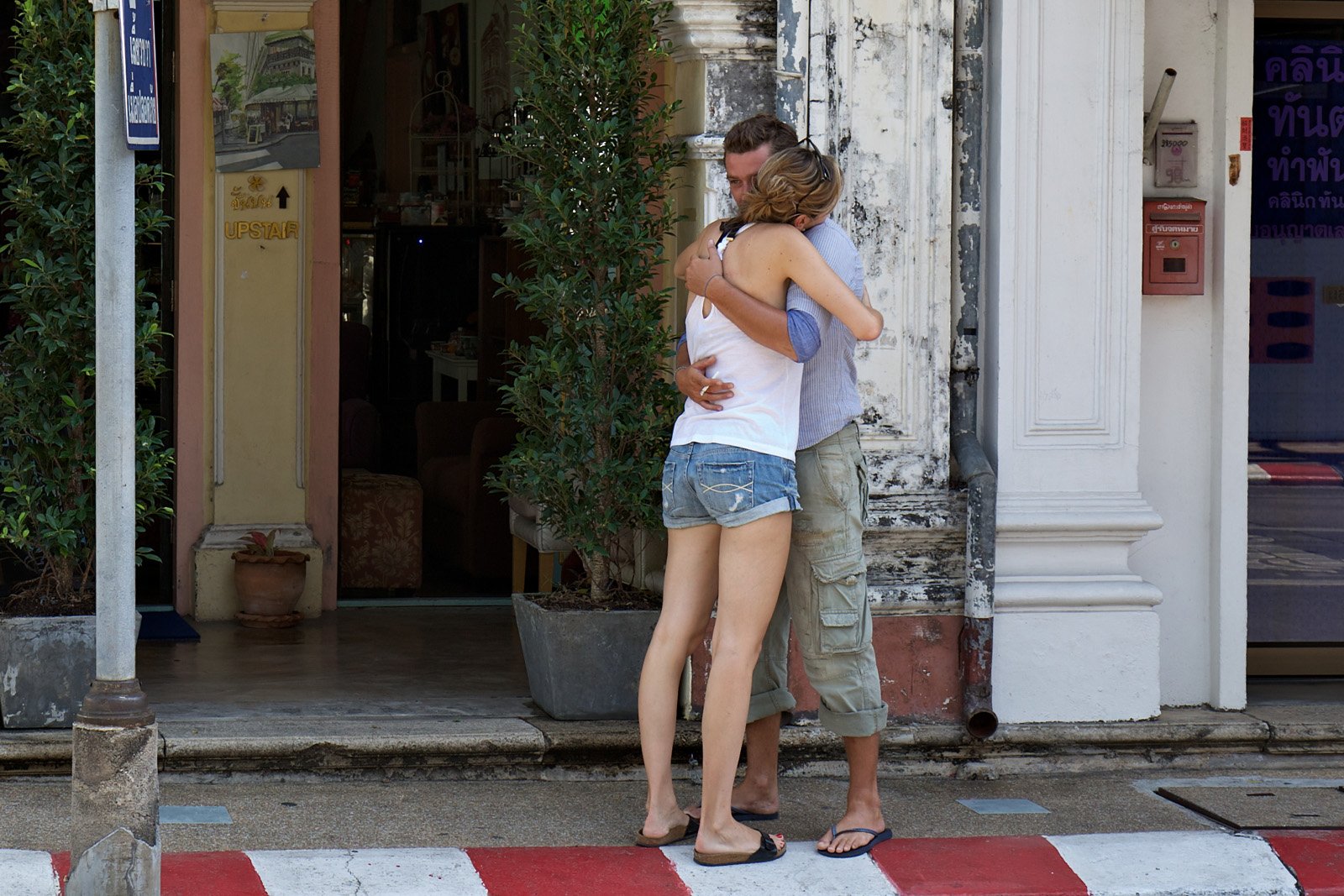
In my featured image (above) the hotel is not far away. However, this couple’s romantic moment is most likely a farewell embrace at the end of a holiday, rather than the start of something new.
Sex is a zillion years older than romance. Although I suspect human beings have always offered enticements to each other (which could be construed as a form of romance) what we think of as “romantic” behaviour is probably the legacy of courtly love from the Middle Ages. What a rigmarole that was!
A Long Tale At university I was obliged to read “The Romance of the Rose” — the complex allegory written by Guillaume de Lorris and Jean de Meun in the thirteenth century. In the event, I quite enjoyed it. It narrates the various attempts of a courtier, The Lover, to woo the target of his affections, the Lady — or, as the poem would have it, The Rose.
I shouldn’t tell you how it all ends, but the Lover must overcome many obstacles along the way, eventually to be rewarded by a single Kiss at the end of part one. In the second part, which is four times as long as the first, Jealousy imprisons the object of The Lover’s affections. There seems to be no limit to the frustrations this causes, but they are eventually defeated with the help of carnal love, represented by Venus. She sets fire to Jealousy’s castle, allowing the Lover — at last — to pluck The Rose.
Courtly love did not always culminate in consummation. It was essentially a game in which a knight performed arduous tasks to win the love of a noble lady, who, in all likelihood, was already wedded to someone else. Originating around the time of the First Crusade — when many noblemen were in danger of being killed in battle — the practice of courtly love was an excellent way for less wealthy, stay-at-home knights to advance their status.
One Thing Leads to Another In the culture of the west, courtly love was the precursor of the kind of romantic love which took over when arranged marriages went out of fashion. For a while, lengthy wooing became almost obligatory. Thank heavens for the Sixties and Rock ‘n Roll!
Today, people negotiate a minefield of mixed expectations and cultural practices when they embark on new relationships. Fortunately, Venus is never far away and always ready to lend a hand with some heavy artillery.
Now, here’s a thought. Is it possible that Venus herself is being defeated by our modern obsession with mobile phones? If there had been mobile phones at the time of the Crusades, noble ladies would have been constantly chatting with their husbands in the Holy Land, much to the distress of the poor knights who were trying to woo them.
The conference call in my picture (above) doesn’t look very romantic, but who knows?
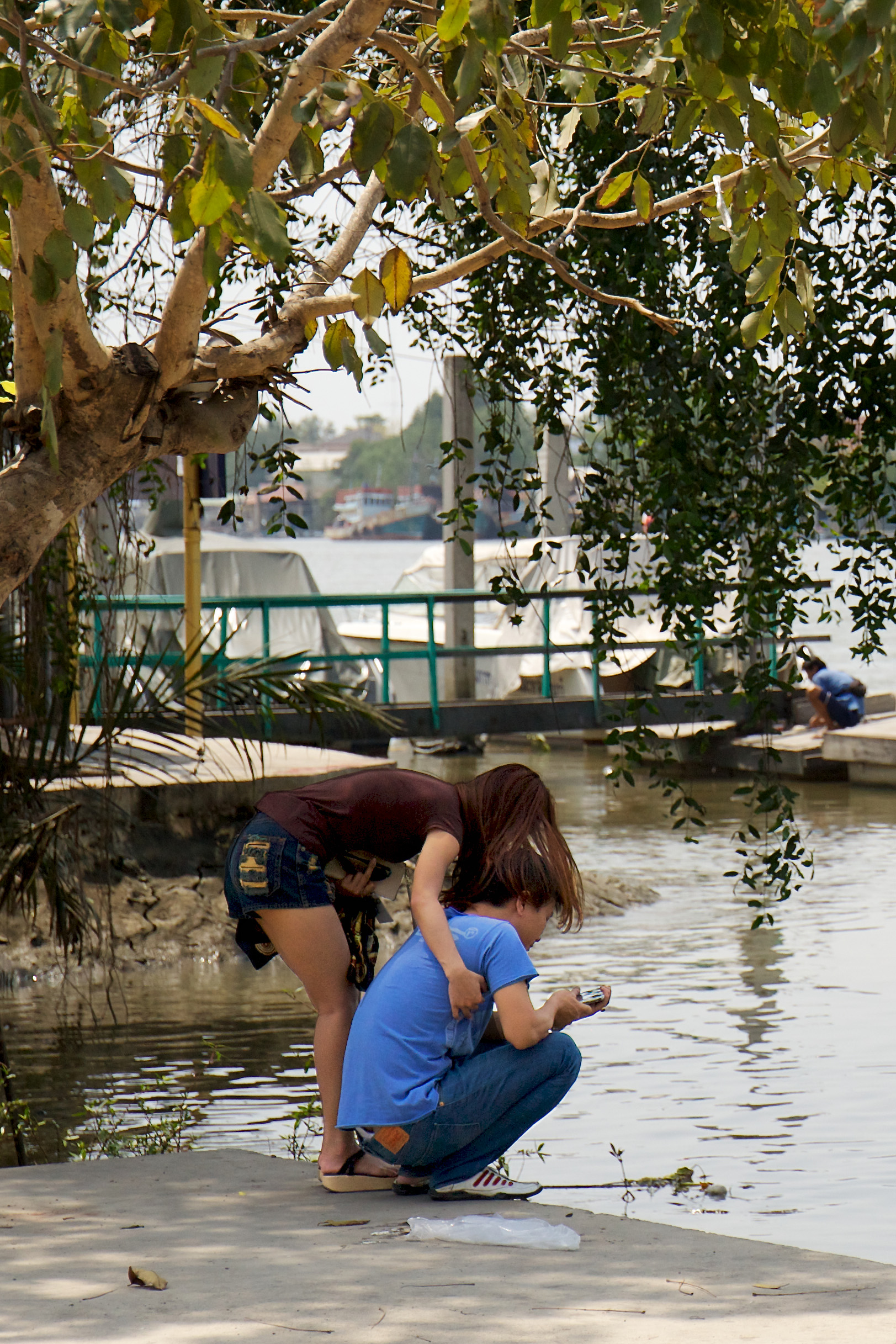
By contrast, here’s an image (below) which certainly does seem romantic: a young couple by the water’s edge on a perfect day. Oh no, they’re checking something on a mobile phone! At least it seems to bring them together rather than keep them apart.
Maybe it’s best to dispense with courtly love and mobile phones altogether and just enjoy the sunset in close proximity.
When the sun is sinking and you’re paying your debt to romance, Venus waits — none too patiently — back at the hotel.
“What are the chances?” That’s what I say to myself when I revisit a spot where I’ve taken a street photo that worked out well. Will it happen again? Will someone be there — in more or less the same place — enabling me to take another image, just as good as the first?
I’m constantly exploring new scenes and walking along streets I’ve never followed previously. I find that my confidence level changes according to the “lie of the land.” Let me explain what I mean.
In certain places I get the feeling I’m more likely to find reality arranging itself into a street photo than in other, less photo-friendly places. Sometimes it’s because there’s a confluence of streets: several streets meeting at a single junction. Or it could be because there’s a good vantage point, with perhaps an incline — up or down — opening a vista to another place beyond.
I particularly like places where people are obliged to jostle against each other or take exceptional steps to avoid collisions. Markets are great for finding busy spots where people are brought into close proximity. Not only do the inevitable interactions provide excellent photo opportunities, they also keep people sufficiently occupied to stop them noticing the camera.
Favoured Places One of my favourite locations is in Central London outside a café where I frequently grab lunch. I always take a few shots before going in, then a few more when I emerge, refreshed and raring to go. However, you’d never guess it was the same spot, so I have to find alternative examples for this article. After all, my main purpose in pursuing “Same Place, Different Time” is to show an identifiable background, transformed by variations in the foreground subject.
I took the featured image (above) with the aim of illustrating places “Where Bad Things Have Happened.” It was close to this corner on Gerrard Street where, some years ago, one of the London Triad gangs clashed with a rival Snakehead gang, newly arrived from mainland China. Machetes were used to chop up customers in a downstairs dining area and one person died.
In the end, I wrote the article without using pictures from Chinatown, so this image became surplus to requirements. It’s still one of my favourites — and probably better than the illustrations I used. It carries it’s own alternative message of hope and despair.
A woman pauses in front of a casino, carrying a bag which says: “Friends are more important than money.” A man sits behind her, smoking a cigarette — despite, it must be said, the nasty-looking spikes which seem to be positioned to deter squatting punters who’ve lost their money. “Breathe deeply,” says the bag. Really, there’s a whole unspoken conversation happening here.
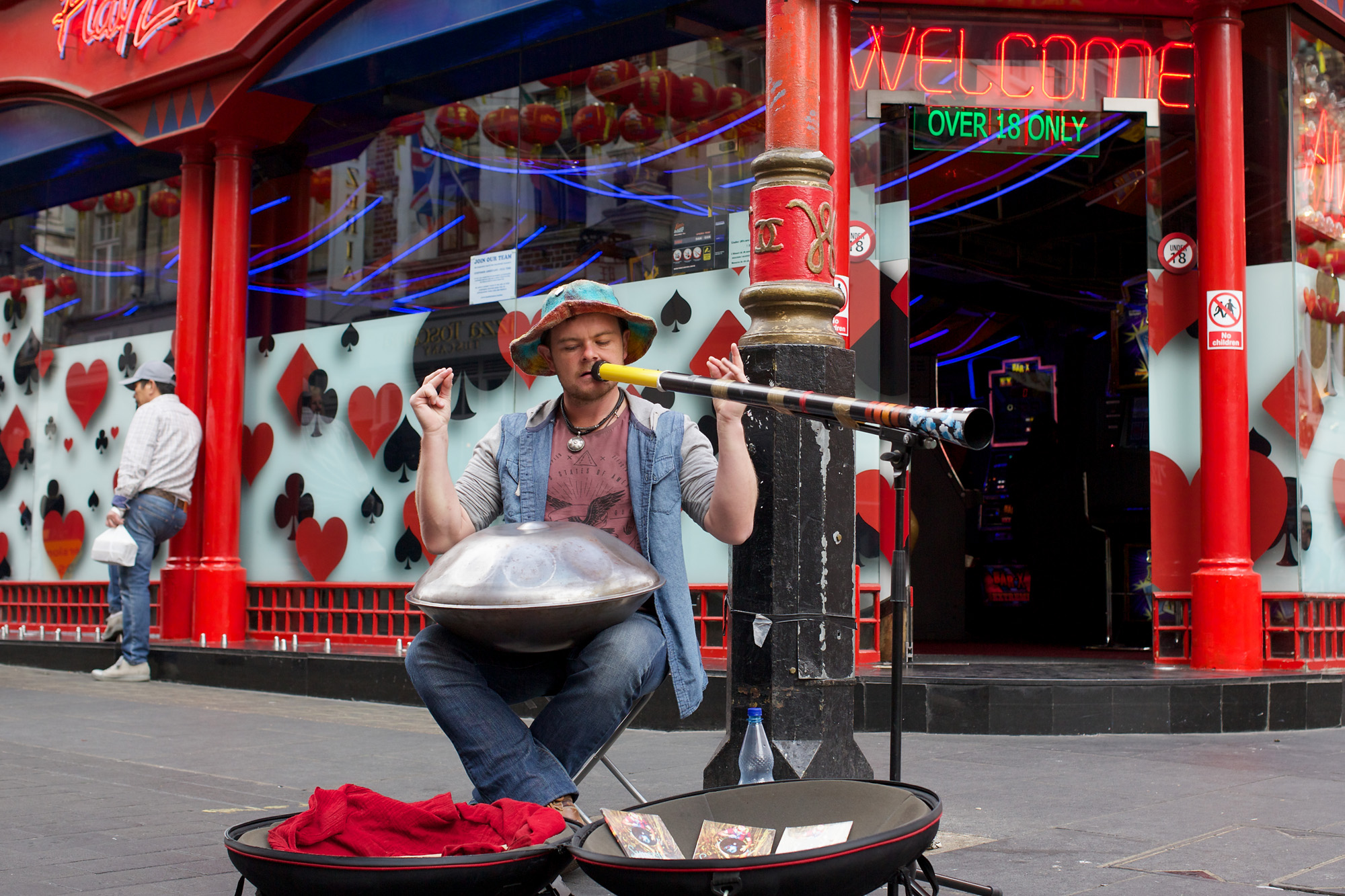
Returning to the Scene A few weeks later I found myself in the same place, wondering if I could get another shot using the same colourful background. This time there was a street musician outside the casino, playing a steel bongo drum and occasionally blowing on what appeared to be a miniature didgeridoo. I don’t normally photograph street musicians, but I could scarcely avoid him if I wanted to use this particular background.
The two pictures make an interesting pair. In the second one (just above) there’s another man leaning against the pillars on the left, not unlike the seated figure in the featured image at the top. He, too, is turning his back on the open door of the casino with its big “Welcome” sign. Are both men gambling addicts who’re trying to shake the habit?
Meanwhile, the musician appears to be warning other gamblers by blowing on the didgeridoo — happily positioned in the middle of doorway. Yes, it’s a fanciful interpretation, but I don’t think it’s too farfetched.
Luring the Punters The casino itself is covered in warning signs: “No Children,” “Over 18 Only” and so on. In a sense, these self-imposed warnings are actually adverts — “come on” signals for people who want to feel grown up and in charge of their own lives.
The messages are, of course, very misleading — as many punters discover to their cost. Fixed-odds betting terminals, such as those found in High Street casinos, can relieve punters of their entire year’s wages in a single session, as the charity GambleAware recently reported.
The idea that a gambler is ever “in charge” is a complete illusion because the casino always wins in the end. By contrast, a street musician is completely independent and this one seems to be in charge of his own destiny, at least for the time being.
So yes, as a street photographer you can return to the same location and get a second shot. It’s a gamble. But there’s no big money involved — and you can never lose your original stake.