Home or Away? Travel and the Street Photographer

Were you born and brought up in a city? Let us assume you were. You know every neighbourhood, every shortcut, every bridge and underpass. So who could be better than you to take street photos in this wonderful metropolis?

You have one or two big advantages. You’re there. That’s a good start. You know your way around. You know the look and feel of various districts, which ones are safe and where you need to take extra care. You also know what these places look like in different weather conditions: Washington Square under snow; Place de la République in the rain. All these advantages give you a head start.

Breezing In
But what happens? A street photographer breezes in from abroad and sees your city with fresh eyes. He finds artistic possibilities in places you’ve overlooked because of their familiarity, their ordinariness.

To the foreigner, everything in your city is exotic. A commonplace object or an activity that’s taken for granted may, to the foreigner, assume a symbolic meaning that’s completely lost on you. Let me give you an example.

No Offence Meant
I was travelling across the island of Phuket with a well-known Thai artist. I think one of my comments may have offended him.

We were overtaking lots of people on scooters: one, two, or three people on each one, and occasionally a family of five! I said: “I think the scooter symbolises something about Thailand. I wonder if I could get a classic shot to express that idea?”

I was expecting the artist to make some sort of comment in reply, or at least ask: “What does it symbolise?” But he acted as though I’d said nothing at all. Maybe he was thinking of all the more elevated concepts one could use to symbolise his country: the monarchy, the palaces, the native flora and fauna.

But as I tried to explain (still without any response), to my foreign eye the scooter symbolises the plucky determination of the Thai people, their almost contradictory ability to accept limitations while finding a way to circumvent them. No one in Europe or America transports a family of five on a Lambretta, do they? Yet in a vibrant, developing country where everyone’s an entrepreneur, the scooter is a symbol of progress and energy. It’s optimistic! You have to be optimistic when you’re five-up on a bike without crash helmets.

family transport

Thinking back on this episode I can understand it from the artist’s point of view. He probably felt I was belittling his country when in fact the opposite was true. You can’t belittle a country by drawing attention to some of its most admirable qualities. I was looking at something which he overlooks because it’s so commonplace. Ubiquitous subjects like scooters in Thailand or salarymen in Tokyo can tell us much about a society, if only we can see them with fresh eyes.

A Reason to Travel
My example gives you an excellent reason for travelling. Go to foreign places. Look at them objectively and try to figure out what’s going on. You don’t need a deep understanding of a country to take great street photos, but I think you do need a feel for the place and its people. Every city has different moods, depending on where you go. In Bangkok I can always get happy pictures in Asiatique, sad ones on Charoen Krung, gritty ones just about everywhere. The impression you give to those who look at your images will be governed by what catches your eye and the thought you put behind it.

Please don’t ask me: “Where should I go?” Any country, any city is a potential source of great subjects. I’m aware that some countries are much more favourable than others towards street photographers. If you’re in Vienna and you want to take a photo that has one or more Austrians in it you’re supposed, by law, to get their permission. Yes, that’s an absurd law, as is any law which is totally unenforceable — and it may have an inhibiting effect on street photography.

The French have passed a similar law, making Paris — once the home of street photography — another place where photographing strangers in public is deemed to be an invasion of their privacy. Frankly, I just ignore it. I doubt if this lady in the florist shop (below) would object to my candid picture of her, tending the flowers.
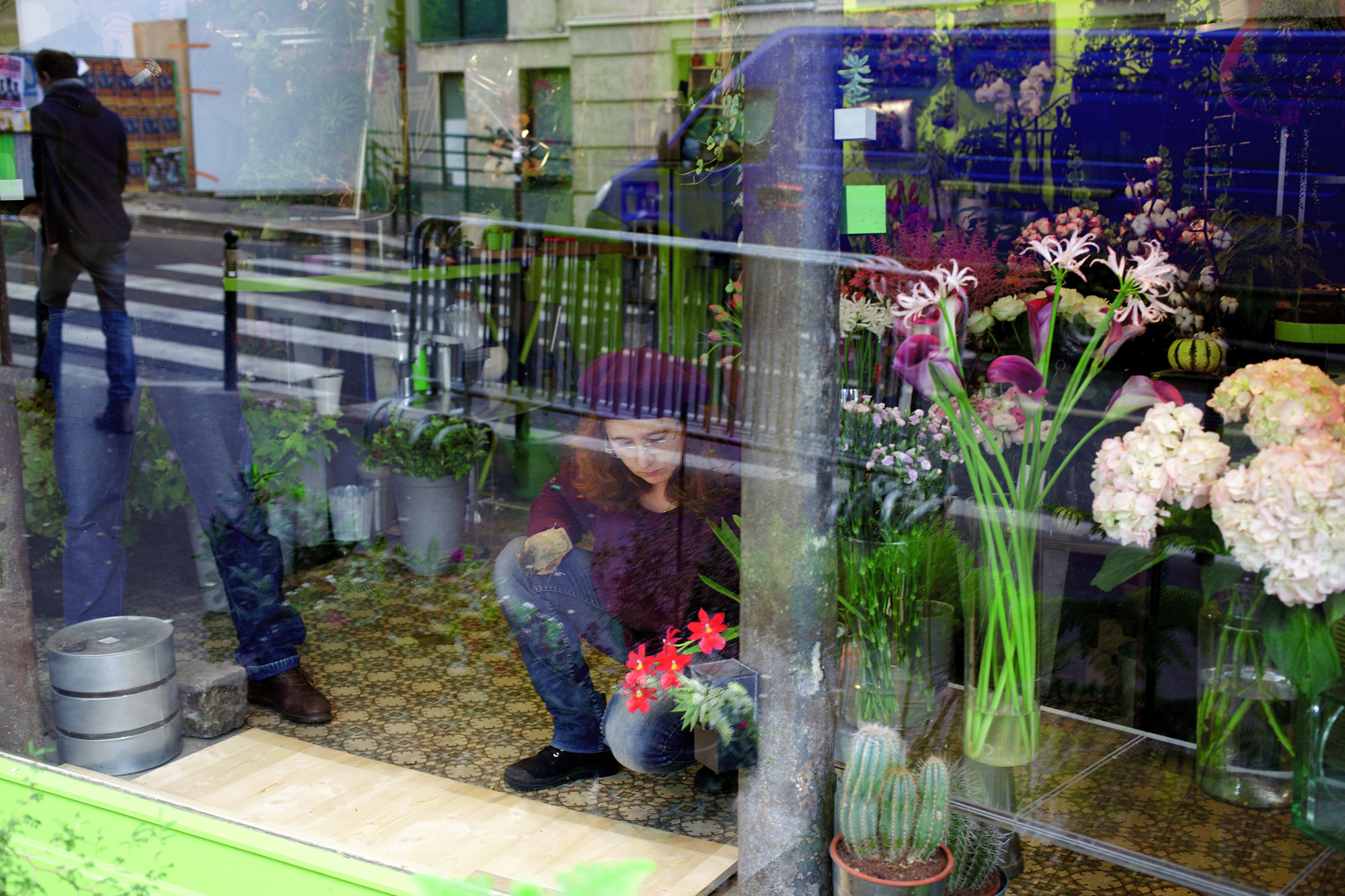
florist

Different Mindsets
My one word of warning is not about the law, or even about the dangers of venturing naively into tough areas, it’s this: Don’t confuse travel photography with street photography.

These two activities demand different mindsets. In a sense, the travel photographer never really leaves home: he or she simply brings back memories of foreign places. But the street photographer is really there: up close and personal, getting under the skin of a place and inside the minds of its people.

To practice street photography successfully in foreign cities you really need to extend your stay until you’re no longer a traveller. Settle down for a month or two, if time permits. Get to know the city. When your eyes become jaded, go home.

You’ll bring back more than memories.
Sharing Someone Else’s Quiet Moment

The more street photography I do — as well as thinking and writing about it — the more I become convinced that it’s an exercise in finding contrasts.

Even when the content is minimal, when the image is largely abstract, there’s visual contrast in shapes and tones. Among styles that are more, shall we say “literary” — where people and places are represented realistically — there’s contrast within the content.

This blog post is about one example of contrast: when you find an individual who is having a quiet moment amid the noise and activity of the city.

Why It Works
I like this subject because it plays on the pre-existing tension that always exists between subject and setting in street photography. Although the modern urban environment caters to the needs of the individual by providing food and shelter, its primary master is commerce. There’s no free lunch. Sometimes you have to fight for lunch — and you’re lucky if it doesn’t poison you (as it did me earlier this week in a London café).

With all the hassle of living or working in an urban setting, even the most active individual needs a break. I try not to intrude on anyone’s relaxing moment, but I can’t resist taking a picture, unobserved, if I think the subject and setting have the necessary contrast.

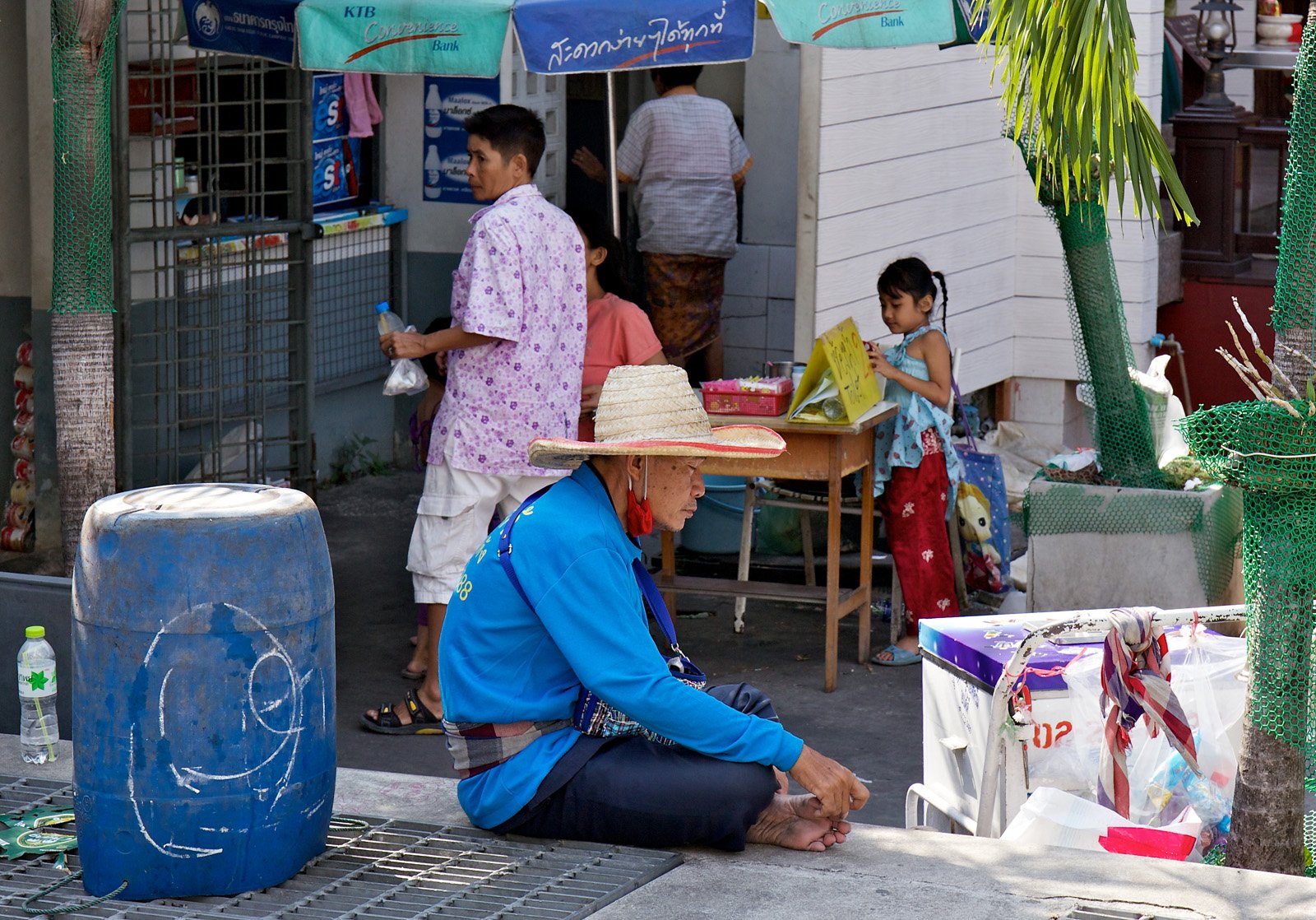
My featured image (above) demonstrates what I have in mind. There are few places on Earth more frenetic than the busiest parts of Bangkok. Here, a street seller takes time out to sit down, close his eyes, rub his feet, and enter a private world of meditation. All around him, people come and go, children play, and life goes on at its natural pace.

I took the picture because the subject seemed blissfully isolated in a world of his own, yet he’s clearly an integral part of the city when he’s at work.

I often like to give the impression that more is happening outside the frame than what we see within it. Here, a man in a patterned shirt stands up and looks at something off-camera, reinforcing the idea of activity continuing beyond the frame. No one looks at the man in blue. He no longer counts as a potential subject of interest for the others because he’s doing nothing. He’s no longer part of the city.

Perhaps I can best express it like this. People opt out. My photos reinstate them. That’s really all there is to it.

They’ll Step Over You
Some years ago when I moved to New York, the American director of the company I worked for (a man from the mid-West) warned me that NYC could be a really tough gig. He said: “If you lie down in the middle of the sidewalk they’ll just step over you. They won’t walk around you or stop to find out what’s wrong.”

I think he was just trying to tell me to get with the pace and stay on my feet. New Yorkers are among the warmest people once you get to know them. Their hard exterior is just another defence mechanism against the perils of big city life.

Girl sitting by roadside

Even a small town in England can become oppressive. The girl in my image (above) has opted out temporarily and chosen to park herself on the kerbside, inches from the traffic. I’d never seen anyone do this before, so I took the picture and managed to include the legs of passing pedestrians. Again, the world moves on, but the individual — in sharp contrast — opts out for reasons that are entirely personal and unknown to the onlooker.

There’s Always Something Odd
Most of us find a park or a café where we can get away from traffic and pedestrians and enjoy a quiet moment. There’s usually something odd — or at least, something out of the ordinary — about those who take their breaks by the roadside.

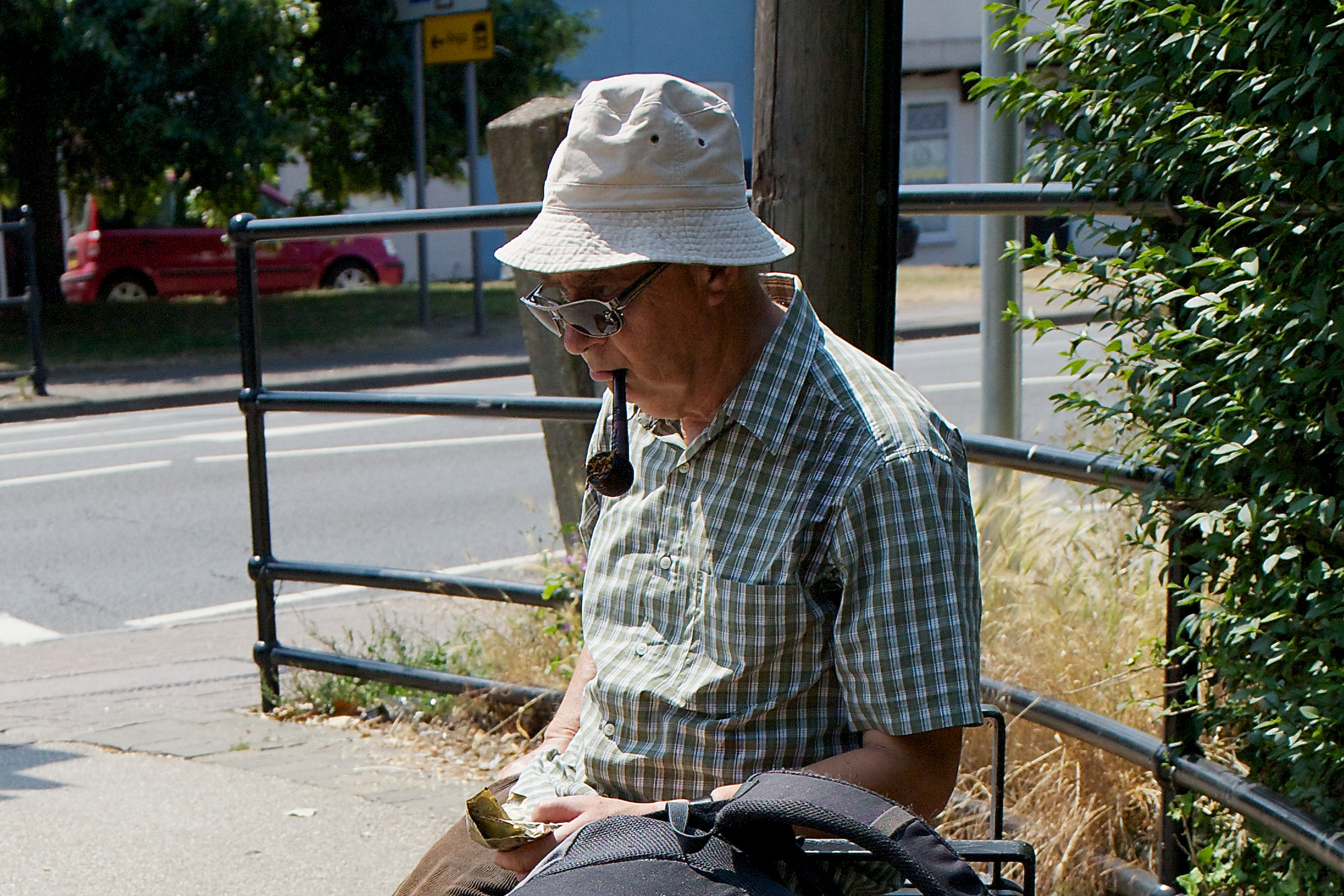
However, at first glance, there’s nothing at all odd about the gentleman (below), sitting by what appears to be a quiet roadside, about to light his pipe on a hot summer’s day. But even in a street photo, appearances can be deceptive.

Man smoking pipe

As the photographer who lives nearby, I know this road is always very busy. At the moment I took the picture there just happened to be a brief break in the traffic. You, the onlooker, were not aware of this until now — but no matter! If you scrutinise the picture carefully you will see its oddity. The man appears to be casting his eyes down, but in fact he’s looking up at the oncoming traffic. And he’s wearing two pairs of glasses.

You see: he hasn’t opted out at all. He’s probably on his way to — or, at this time of day, returning from — a cricket match. Or maybe he’s simply enjoying a holiday, or an early retirement. Like every street photo, this one abounds with unknowns — but its misleading content gives it a dimension it would otherwise lack.

It just goes to show: you mustn’t accept every subject at face value. Street photos are fleeting images of people about whom we know nothing, except what their appearance, actions and expression can tell us.

If you want to know the whole story — how they came to be in this position at this point in time — you’d need a lifetime’s acquaintance with them. Yet, even then…even then…


Does Quantity Beat Quality in Candid Photography?

The biggest problem facing any photographer today is the sheer quantity of visual representation flooding the world, filling up every waking moment of our lives and quite a few of our dreams.

So, at the end of ten years taking street photographs would you rather have ten great shots that are ignored by the world at large or one thousand merely good shots which bring you a measure of fame and fortune?

It’s a worrying thought — almost as worrisome as running a competition for best-kept gardens. (See my featured image above — not a street photo, but all the winning gardens have to be visible from the street. Smiley Face).

As regards my question, I think most people would opt for fame and fortune, bearing in mind how difficult it is to sustain enthusiasm for an activity if you’re rewarded for it so infrequently.

No, Never
I disagree. In any artistic endeavour, quantity never beats quality. Imagine you are a museum director and someone brings you a shoe box with a one-of-a-kind artefact, the only surviving product of a craftsman from the past. It’s a masterpiece and you put it on display. Then another person walks in with a large box full of similar, but less well executed works. These lesser works lack invention, show little variety, and all of them have minor flaws when compared to the masterpiece on display.

What do you do? It’s obvious. You put the lesser works into storage for examination by scholars and you keep showing the masterpiece. Scholars trawl through masses of documents and images seeking the truth. To make the point, here’s a shot I took of a crumpled figure (I call him “The Scholar”) emerging from a secondhand bookstore, laden with books. His is an arduous task, perhaps even more labour-intensive than that of the artist.

Man carrying a lot of books in a black bag

Minimal Output, Maximum Fame
Many painters have acquired huge reputations despite having produced a minimal amount of work. The Venetian painter Giorgione who died at the age of 32 left just over a dozen works, only five of which survive. Yet his impact on the history of art was so profound it reverberates to this day because we can see his influence in the work of later artists.

It’s easier to be prolific as a photographer than as a painter, even if you’re using large format film cameras. With a smaller camera, the street photographer can take a thousand images in a day. In digital there’s minimal cost — and the more pictures you take the easier it is to justify your initial expenditure on equipment.

Yet getting fifty great shots in a lifetime is a huge achievement. David Bailey (who took fashion photography out of the studio and on to the street) once said: “Everyone will take one great picture. I’ve done better because I’ve taken two.” Tongue-in-cheek, no doubt, but you get the point.

Image Overload
Now we come back to the phenomenon of “image overload” with which I introduced this post. Great photographers like David Bailey have the judgement to be selective, but Instagram users click and post repeatedly without regard to their pictures having either longevity or intrinsic quality. Snapchat is even more casual. Click, post, automatic delete. It’s as though the world of images has become as ephemeral as — more ephemeral than – life itself.

The old adage: “Ars longa, vita brevis” (Art is long, life is short) no longer applies. At least, it doesn’t apply if you classify the billions of photos taken every day as a form of “art.”

But now there’s another problem. Among billions of photos there are bound to be one or two — or even a hundred or two — that could be rescued, enlarged, put on a wall and widely acclaimed as art.

In fact, in the distant future, a man will walk into a museum with a dozen Instagram images taken by the same person — and the museum director will be shocked into silence. “How were these missed at the time? This artist is a genius! Let’s praise him to the skies!”

Two for the Price of One

I love to photograph people in pairs. There’s something poignant about a pair, not only of two people, but also of two animals, two birds — even two objects. When these pairs display certain similarities they indicate the possibility of sharing, of mutual support, of banishing loneliness in a large and often hostile world.

As I say, there has to be some resemblance between the individuals who make up the pair, whether they’re directly related or not. Maybe they just work for the same company and share an identical uniform. Or perhaps they are man and wife who have become so accustomed to each other they dress in a similar style and finish each other’s sentences.

Family resemblance, as between brothers and sisters, is photogenic — especially when taken out of context in the street, away from the family group. It’s great to stumble across twins, although, to tell you the truth, I prefer the two people to have physical differences as well as similarities. Variations in their appearance add visual interest to the photograph.

Musical Harmony
My featured image (above) is of two musicians going to work at the Royal Opera House, Covent Garden. What I like most about the picture is the contrast between their similarities and differences. You see: once again it’s “contrast” that lies at the heart of the image — and sometimes we notice it only when it’s pointed out to us.

The two musicians are probably not related, just friends or colleagues. But they dress in a similar style: dark clothes, narrow jeans, comfortable black trainers with white trim. They both carry a black bag, with a prominent zipper.

Yet their similarities are limited to their clothes, accessories and physical characteristics. Once we address their higher, cerebral capabilities, the differences become obvious: signified by the fact that one wears a hat on her head while the other doesn’t; and by the stark difference in the instruments they carry.

Here’s the point: the instruments may differ, but they’re both stringed instruments and the musicians play them in the same orchestra. It’s possible for people to celebrate their unique individuality while coming together in harmony, not despite but because of these differences.

Incidentally, I’m grateful to the cellist for having a “fragile” sticker on her carry case. A glass of red wine is ideal for celebrating the idea I’m trying to express.

The Same But Different
Continuing the musical theme — and still on the topic of “same but different” — here’s a shot I took an hour after photographing the musicians.

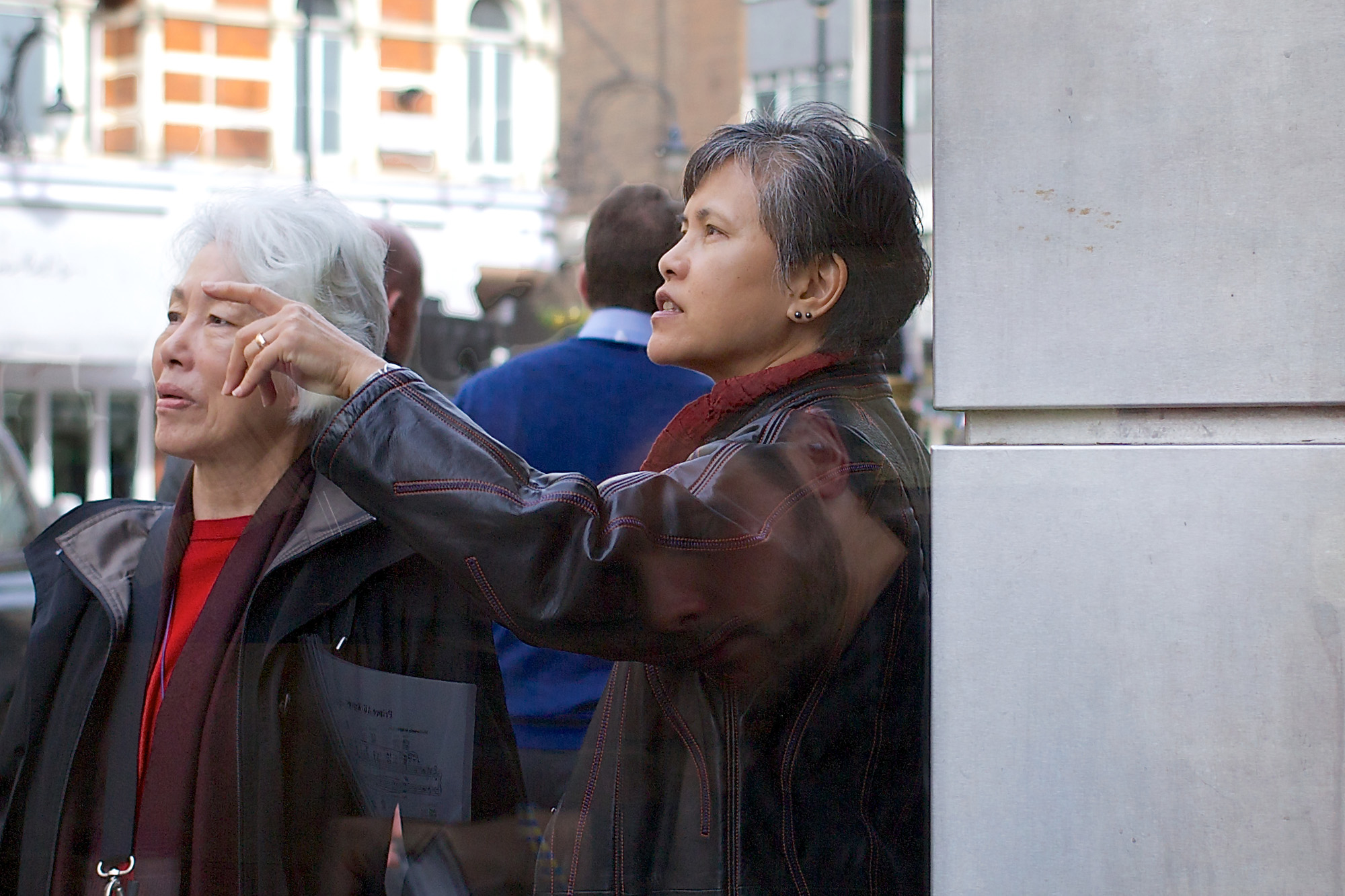
Woman outside cafe, pointing out something to her companion

The two subjects are on the other side of a plate glass window. Superimposed on their dark leather coats you can see the reflection of a musician reading a score. The two people outside are clearly related and share a very similar taste in clothes. Their scarves are identical and their jackets the same deep shade of maroon. By contrast, the people in the background are dressed very differently.

What you see in this image is essentially three or four layers of London life: the musician, the visitor, the passers-by, and the typically English architecture across the street. Yet it’s the pair who dominate the picture space. Are they trying to figure out the right way to get to Leicester Square? I think they look too confident to be lost. Maybe they’re evaluating the building opposite before putting in an offer for it.

The Joy of Pairs in Candid Photography
I hope you can see why I like candid photography from the two examples I’ve given. I can imagine that the people I’ve depicted have their own collections of posed photos, but I suspect they have few which show them going about their normal lives. With luck, an enterprising street photographer will take my own photo when I’m working. I won’t mind at all.

I guess I was “on a roll” that day — or else I was noticing every pair I came across. Certainly the light was particularly good and I was anxious to take full advantage of it.

My final image, therefore, is of the ultimate pair: the married couple (below).

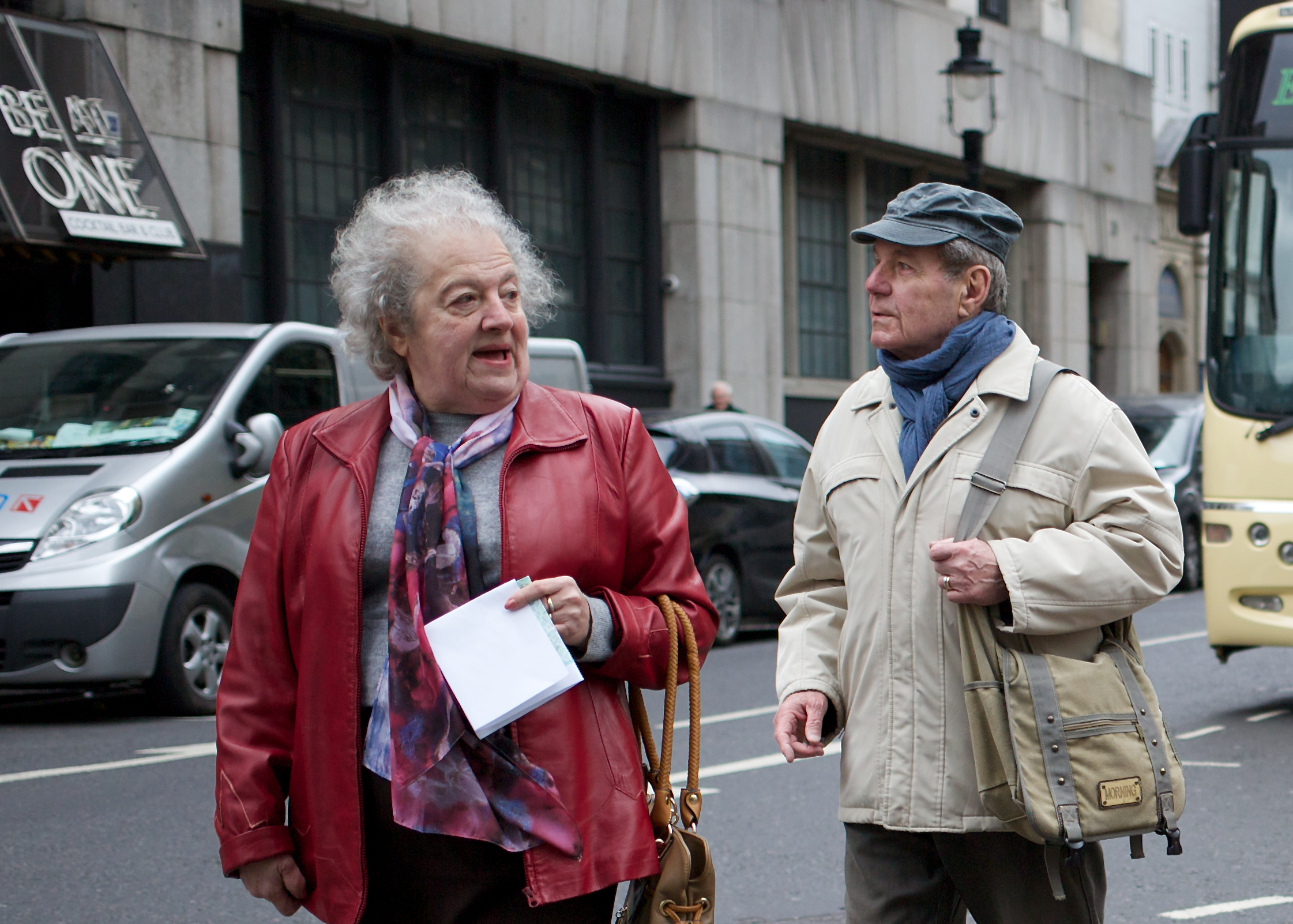
Couple in London's theatre district

I’m not sure what story I can spin for this image, but my guess is that the lady in red — a visitor from abroad — has just scored a couple of West End tickets to a musical production. (This is all sheer conjecture!) Her husband would rather be doing something else, but patiently he goes along with her wishes.

The woman turns to speak; the man makes a tentative gesture with his right hand. You can identify them as a pair from their body language. These people are aware both consciously and subconsciously of each other’s thoughts and movements. Every emanation demands — and gets — a response.

After all, being part of a successful pair is all about give and take. Isn’t it?

Most Photographers Don’t Take Photos, They Rearrange Reality

It’s taken me a while to make up my mind about this topic, but I think we need to be realistic about reality. We have to acknowledge an important fact about it. It’s there.

Most professional photography consists in rearranging really to suit the purposes of the photographer. Whether its portraiture, fashion, wedding, friends-and-family, advertising or corporate — the subject in front of the camera is primped, prettified, fussed over, and generally rearranged to look good in the eyes of the world.

Only landscape, travel, and truly candid photographs are (mostly) free of such deliberate distortion. Not incidentally, they are also more likely than the others to be free from the demands of commerce, taken by people for love rather than money.

No Objections
I have no objections in principle to rearranging reality for the purposes of art, but I don’t think it has any place in street photography. Any interference with the scene — such as attracting the attention of a person within it, or moving an object to suit the composition — destroys the illusion of the invisible camera. Without this illusion street photography has no magic and no identity. It is nothing at all.

Oddly enough, the artist who inspires me the most was one who acquired a reputation for obsessively altering the reality in front of the camera.

In the Movies
I have always admired the films of Michelangelo Antonioni, especially his later ones which were made in full colour with cinematography by Carlo Di Palma. It was Antonioni’s film “Il Deserto Rosso” (The Red Desert) which, several years ago, set me on a path to accepting the reality of the modern world.

In the movie, Giuliana (played by Monica Vitti) is the beautiful protagonist whose neurosis is brought about by having to cope with the hostile world of industrial Italy. She seems to be alone in responding negatively to the factories and shipyards where her husband’s work has taken her. She is a stranger in a strange land.

Only towards the end of the film is there a kind of resolution for her, when she reassures her young son, Valerio, that the birds in the area survive by learning to avoid the poisonous yellow smoke emitted from the chimneys.

Antonioni Speaks
The message of acceptance was underlined later by Antonioni when he said: “The line and curves of factories and their chimneys can be more beautiful than the outline of trees, which we are already too accustomed to seeing.” To get this feeling across, he used every possible photographic technique, including the use of telephoto lenses to foreshorten the distance between the central character and her environment.

The technique of melding subject and environment lies at the heart of street photography. That’s right. The film director who most exemplifies the aesthetic (as opposed to the candid spirit) of street photography was also one who liked to manipulate reality for photographic effect.

For this, his first colour film, Antonioni wanted to compose the colour relationships, so he gave us white steam, red pipes, blue railings, and painted the trees and grass white and grey to suppress any lingering colours of nature in this largely man-made world.

Undramatising, Rearranging
Antonioni’s films positively invite us to see reality in photographic terms. He embraces photography at the expense of theatre by undramatising his scenes, making them appear to be slices of life, although, of course, everything is meticulously orchestrated.

If you’re wondering how Antonioni himself saw reality, here’s another quote: “Every time I enter a strange office, public place or private home, I get the urge to rearrange the scene. I go out to meet someone and the conversation puts me ill at ease. Because I feel that neither of us is properly placed in the room.”

He adds: “Is this professional distortion or the instinctive urge to feel myself in physical harmony with my surroundings? I believe more in the second hypothesis. In fact, I cannot shoot a scene without first being alone in the room, or the set, in order to understand it and sense the various possible camera angles.” (Esquire, August 1970).

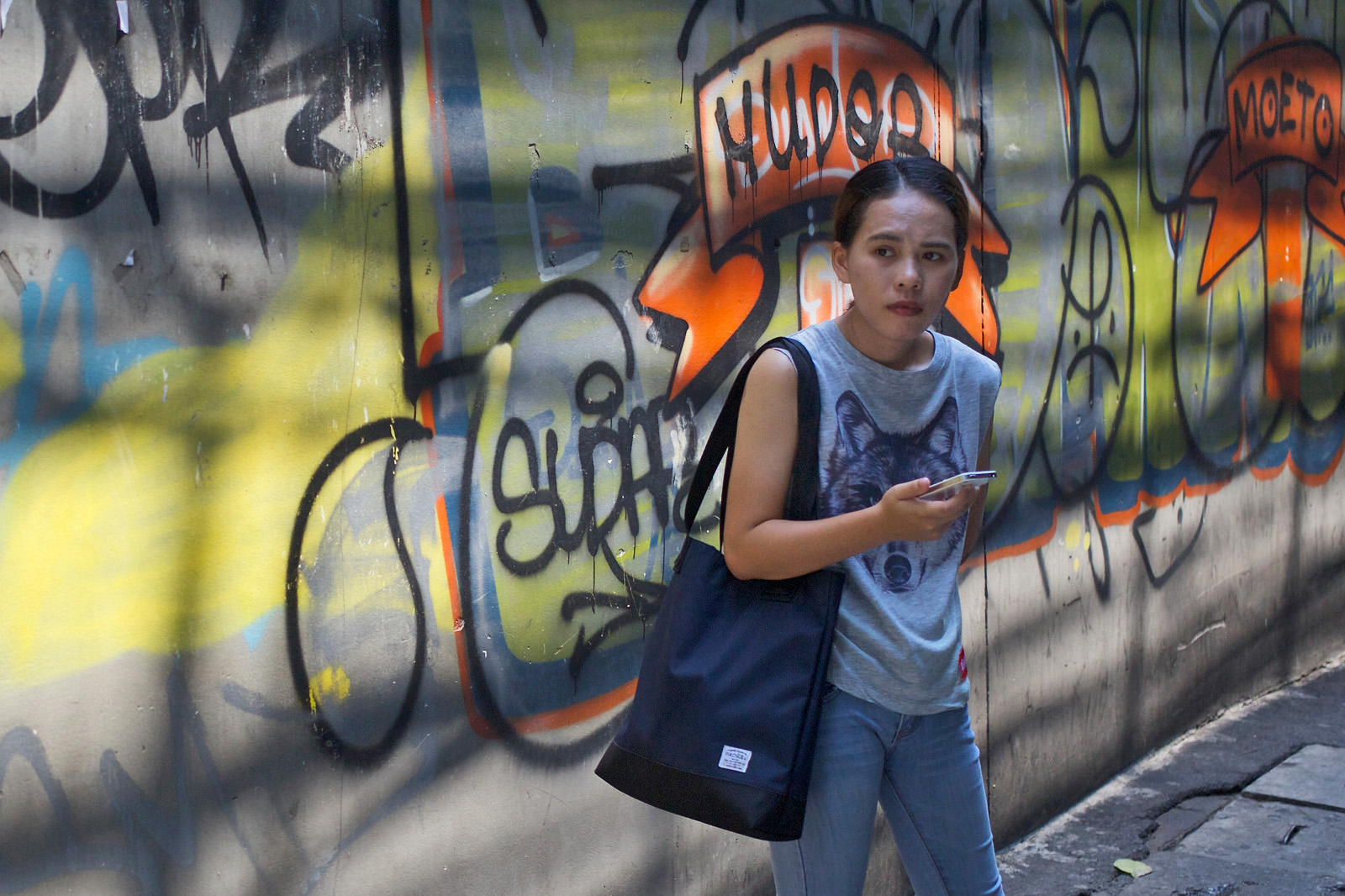
Woman looking anxious in front of graffiti scrawls

A Shared Neurosis
I must say, I’ve always shared the same neurosis: of wanting to feel in physical harmony with my surroundings and being uncomfortable with the “wrong” position.

Watching “Il Deserto Rosso” made me give up art history and go to film school, but I’ve since found that I don’t want to change the reality in front of the camera — I just want to change my viewpoint. In fact, working in environments where I feel out of place is of real benefit in compelling me to look for accidental or hard-to-find arrangements of forms, colours, and contrasts that make me feel better.

Street photography depends on our personal feelings about our relationship to reality. Do we love it? Hate it? Admire it? Do we feel dwarfed by it? Or do we feel superior to it? In awe of it? Amused by it? Puzzled by it?

There are endless questions we can ask, but we probably shouldn’t verbalise them. The extent to which we humanise the camera by controlling where and how we point it is a measure of how well we answer those questions without ever posing them overtly.

Moments of Puzzlement

If you’re building collections of street photographs based on themes, you can group them by emotion — joy, sadness, anger, and so on — or by reaction, such as surprise or puzzlement.

Moments of puzzlement are inherently ambiguous and mysterious if you can’t see what has prompted them. And as I’ve mentioned before in these articles, ambiguity and mystery are two of the most useful ingredients in street photography. I’d be lost without them.

If a subject looks puzzled, the onlooker viewing the image will also be puzzled. What’s going on? Why is this person questioning reality? Isn’t everything obvious once you’ve taken a photograph of it?

A False Assumption
The idea that photography reveals everything is one of the myths of the modern age. We look at scenes that are confusing in reality and we photograph them for later inspection. People do the same in art galleries. A great painting is far too elaborate and potentially meaningful to be absorbed in a few moments, so people photograph it “for later.”

It’s a comforting thought, isn’t it? It’s rather like having some kind of convenience snack-food, like a chocolate bar. “I can eat it later.” You’ll never suffer mental starvation if you have a camera. You can take a picture and tell yourself “I’ll understand it later.”

Outward Signs
To show puzzlement in a photograph you really need the subjects to display some evidence of it. After all, it’s possible to be quietly puzzled and give no external indication of it apart from a Roger Moore-stye raised eyebrow that would go completely unnoticed in a street photo.

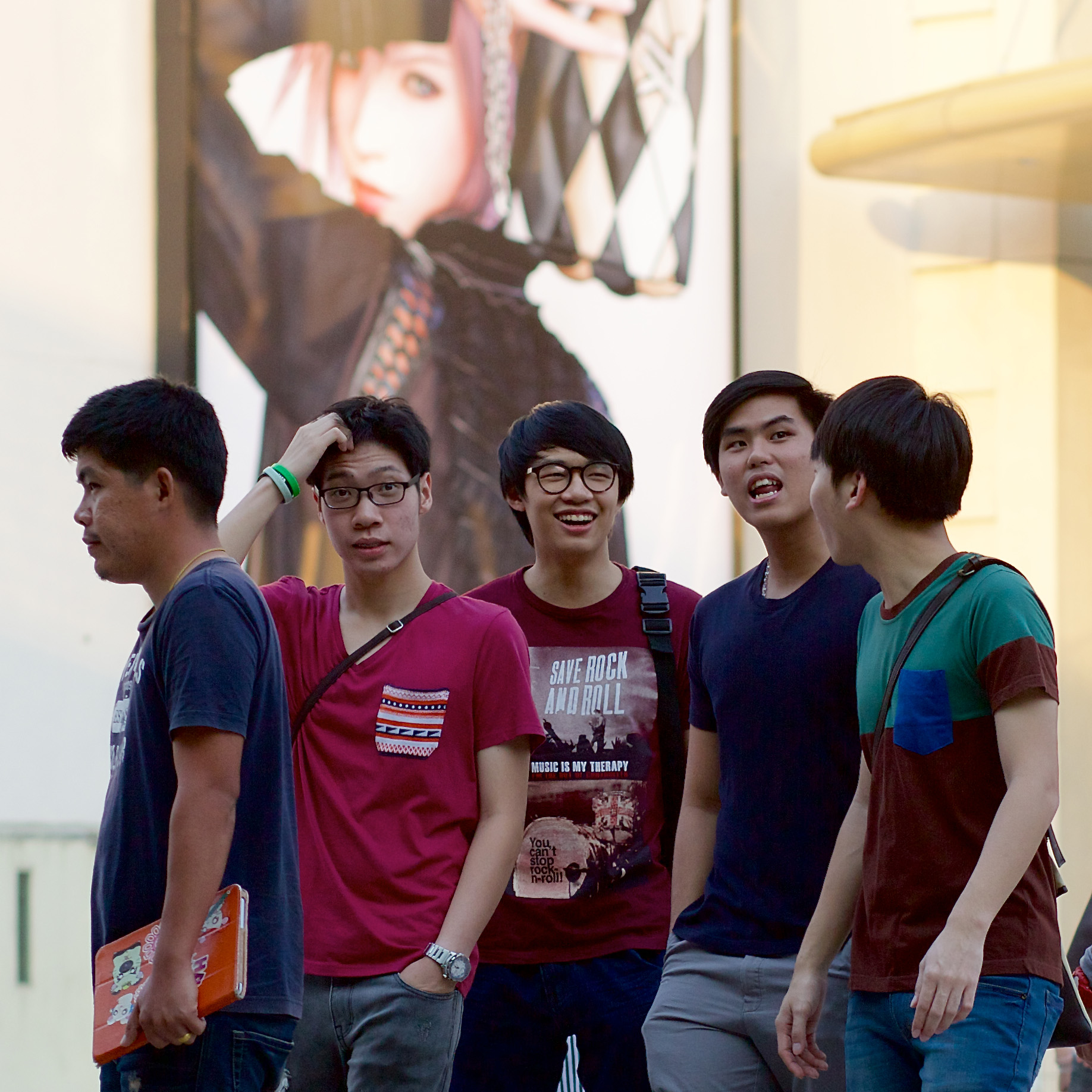
The most noticeable outward sign of puzzlement is a combination of frowning and head-scratching. When you see this, take a picture! You won’t be disappointed. The subject can be looking to one side, as in my featured image (above), or looking directly at the camera, as in the image below. It doesn’t matter. Something has puzzled the subject and the image prompts us to wonder what it is.

save rock and roll tee-shirt

More Ambiguity, More Mystery
Such images as those I’ve described (and offered) have further layers of ambiguity and mystery. For a start, they may be completely misleading.

For example, perhaps the subject only appears to be puzzled and is simply scratching his or her head because it itches — and the frown is nothing more than an expression of annoyance at the itch.

You must admit, that’s a possibility. Does it matter? Not really, because photographs are documents of appearances. They can’t contain full explanations of everything that seems to be happening in them. In fact, their charm is actually based on their inscrutability, on their steadfast refusal to disentangle ambiguity or shine a light on every mystery.

The featured image at the top is a good illustration of the point I’ve just made. The woman who is scratching her head also displays a bandaged wrist. We’ll never know how she injured it. The wrist is just “there” — an appearance without an explanation. Maybe she’s only pretending to have a bad wrist. I know that’s unlikely, but it’s within the realm of many possibilities.

So as you can see, the subject’s puzzlement is also our puzzlement — and we have our own reasons to be puzzled quite apart from worrying about whatever’s bugging the subject.

My second image (above), which I’ve called “Save Rock and Roll,” is not so mysterious as the first. It’s just a group of young men who are probably returning from a class (to judge by the notebook) and thinking about the evening ahead. Will they go out drinking — or share a meal? Certainly they all seem to share a similar taste in clothes.

Very obligingly, one of them touches his head in a gesture that seems to echo the pose of the model in the poster. At the time of taking the shot, I wondered whether he was doing it deliberately. Perhaps he’d seen the poster and had decided to give me one of those “correspondences” which always look interesting in a street photo.

Ah, now you see I’ve started digging up mysteries and ambiguities where probably none exist. I’m looking at these photos, scratching my head and frowning.

It’s all very puzzling.

Placing the Subject Off-Centre

If your first instinct is always to place the subject in the middle of the photo, think again. It’s often better in street photography to tuck the subject off to the left or the right, allowing the rest of the picture to counterbalance the composition.

I’m not talking about those impromptu street portraits which may very well have the subject somewhere near the middle of the frame. Rather, I’m talking about photos in which “the subject” is not just a single person or even a small group of people. It’s when the real subject is the whole scene: people in the context of their environment.

The Fortune Teller
For my featured image (above) I placed the three women in one quarter of the frame, letting the unusual background occupy most of the available space. I’m very glad I did. The small group is sufficiently engaging to hold our attention, yet the rest of the scene has its own charms which make us explore the image to see what’s there.

We can read the stickers, most of which are in English: “Whistle While You Work,” etc. We can check out the garden, which appears to be very well tended, complete with bird-feeders and neat pathways. Yet the eye constantly comes back to the group of three people, because each of them is caught mid-action while performing a particular activity.

Despite all the English stickers, unless you read Thai it’s hard to figure out exactly what’s happening in the photo. The two girls are deep in thought while enjoying their drinks because they’re having their fortune told for the very reasonable price of 39 baht. The sign on the left says they’ll learn all about what’s happening to them as regards work, money, luck, love, everyday life, enemies, partners, and the future. No wonder they look serious!

The image is another of those in which the real subject is “time.” This time it’s all about the future and what will happen in the future. By preserving the present moment, photography itself always has the concept of time embedded into it. Here, the present moment is full of life and movement, yet everyone is concerned about the future. Meanwhile, the past lingers in the stickers and in the can of discarded Nescafé in front of the fire hydrant.

Fifty Percent Off
The next image (below) has no messages about the passing of time, unless you count the limited time offer of a fifty percent discount.

Shoes Fifty Percent

Again, the subject is off to one side, leaving the large advert to dominate the image. Normally this would be an odd composition, but I think it works because of the unusual elevation of the camera. No, I wasn’t lying flat on the pavement to take the shot. Between me and the subject there was a steep flight of steps, enabling the style of shot you see.

Looking up at the subjects made the verticals converge, as you can see on the right. However, I’ve made the verticals truly upright on the left, so that the two figures can approach the entrance while seeming to be propelled towards it by the leaning verticals on the right. Meanwhile a mysterious, shadowy figure appears be reflected in the window at bottom right, helping to stop the image from tipping over completely.

Inside the Store
Having created such a lot of anticipation about entering the store, I guess we should go inside. You can tell this is Robinson’s Department Store from the above image, as the name appears in the large advert — and the reflected road sign says: “Charoen Krung Road.”

Star Product

This store always makes me think of green and turquoise blue because these always seem to be the dominant colours whenever I visit. In the pharmaceutical area especially, there’s a clinical feel of newly squeezed toothpaste, with very few warm shades to enliven the scene.

I was fortunate to find contrast in the figures on the right: flesh and blood human beings in the midst of an otherwise sterile environment. They can be at the side of the image because what matters is the contrast between them and the rest of the shop.

Placing the subject off-centre is a way of avoiding what’s obvious in favour of creating a more complete image. You still have to balance the composition, but there’s often something you can use. In the picture above I’ve chosen the glaring white of the displayed products to counterbalance the figures standing in shade. The distant figure in the background links the two halves of the picture.

Tea Lounge or Coffee Shop?

One of the supposed clichés of candid photography is the coffee shop interior, usually somewhere in Paris, with a woman sitting beneath a mirror, looking wistfully at the street outside.

I try to avoid cliché, so my solution is to add tea lounges to the repertoire. You could scarcely have a subject that’s more different.

Greater formality surrounds the drinking of tea, probably because it was the preferred drink of the English upper classes at the end of the eighteenth century when formality was at its height. However, let’s not forget the traditions of tea drinking in Japan where the ritual of making and drinking tea became a rarified art form.

Invitation to a Ritual
Why does tea invite ritual? I have no idea. It must be something to do with the subtlety of its flavour. To obtain the correct flavour you have to follow a certain ritual: warming the pot, letting it stand, and so on. One thing leads to another — and eventually an entire pattern of behaviour emerges, not only in the preparation of tea but also in the drinking of it.

Today, typical up-market tea lounges don’t specify how customers should behave. They simply impose control through the formality of their design. For example, there’s no question of chairs and tables being scattered, higgledy-piggledy (a word I’ve never written before!) around the room. They’re laid out in regular fashion, where customers can sit comfortably but not slumped.

Coffee shops are quite the opposite. They’re relaxed places where casual behaviour is positively encouraged. If you want to do homework or office work in a branch of Starbucks, like the young people in my photo below — that’s fine. You don’t even have to drink coffee: a milk shake will do.

Collaboration

Traditional
It’s hard to find a really traditional tea lounge, especially one where you can take photographs without people objecting. I took my featured image (at the top) in the Foreign Correspondents Club in Hong Kong. It’s not a tea lounge, as such, but a combined tea/bar/café where journalists sit, talk and write. I think photography was forbidden, but I couldn’t resist. I told myself I was working undercover.

The image is entirely candid. I was taking it to remind myself of the English club-like atmosphere when a waitress showed up with a tray. It’s the nearest I could get to recreating the past at five o’clock in the afternoon.

We are now, of course, a world away from the dirt and dust of the street — because clubs and tea lounges keep themselves apart. They rarely have outdoor tables like the coffee shop. To drink tea and enjoy hushed conversation you need the peace and quiet of being enclosed, preferably on all four sides.

Modern
Genuinely old interiors in the Far East are rapidly disappearing, but there are plenty of new, purpose-built tea lounges in malls and hotels. They tend to be “design-intensive,” using a plethora of decorative items to signal their function.

The photo below shows an “1823 Tea Lounge” belonging to the Ronnefeldt group, a company that has adopted the epithet: “Serving the world’s finest tea since 1823.” As you can deduce, even a modern tea lounge needs traditional credentials to attract customers, despite having over fifty teapots arranged in rows along the walls and counter.

Tea Lounge

I took the above shot from public space — the mall equivalent of “the street” — without entering the lounge itself. You can see right through the room to further public space beyond.

The image demonstrates all kinds of contradictions, as confirmed by the deceptive reflection of the woman in the centre. It almost looks as though she’s sitting alone, like the man behind her, but she’s actually photographing her partner’s tea. They didn’t do that in…1823.

People from All Angles

If the proper subject of street photography is people, then it stands to reason we should photograph them from all angles. This means from above and below, as well as from left and right, back and front, when they’re standing up, lying down, or squatting on all fours.

Sometimes I succeed in getting a picture that incorporates a lot of angles all at the same time. For example, the featured image (above) shows four women sitting down, enjoying a dessert in the late afternoon. One of them is facing us, another is sitting sideways to the camera, the other two have their backs towards us — but one is looking to the left, giving us a glimpse of her profile.

Is it a satisfying composition? In many respects it is. I like the way the two people on the left overlap each other, whereas the others remain separate. Is it possible that the first pair are related while the others are just friends? I was also fortunate in taking the image at the moment the woman on the right turned her head. It directs the eye back to the main subject — the pair on the left (the major key), away from the pair on the right (the minor key).

You may not agree about the composition. Our eyes have become accustomed to seeing fashion and advertising photographs in which the subjects have been perfectly arranged. The onlooker — like the photographer — needs to be able see the subject from all angles. Here, in the picture of the four women, there’s a dividing line (the bench) above which everything is perfectly ordered, but below which the composition is non-existent.

Personally, I like the contrast between the upper and lower levels of the image. The discarded bag of food, the awkwardly placed pot plant, the diagonal lines of the bench supports and the A-sign on the left — they’re all trying to “mess up” the picture. Whether they succeed or not is entirely up to the onlooker. Frankly, I don’t mind, and neither do the subjects. We’re all above that kind of thing, aren’t we?

Looking Down
It’s fun to get right up above people and look down, but what we see normally is the tops of their heads. To solve this problem we need to contrive a situation in which the subjects — or at least one or two of the subjects — have to look up.

River cruise

One day, I’ll try to take this image properly. I’m sure others have done it successfully but I’d like finish the job.

When packed boats pass under the bridges on the River Thames the tourists usually look up. One or two people may wave, which can ruin the shot, but if they can’t see your face they’ll remain in natural positions. Only one person is waving in my photo — and fortunately she’s out-of-frame, so the only thing that’s visible is the shadow waving.

As you can see, I’ve turned the image on its side in order to give the shadows greater prominence. They’re the most interesting feature in an otherwise nondescript collection of people, viewed from too far away to reveal anything much about their individual characters. Yet even from this angle — and using an unsuitable lens (the 40mm I normally use for street photography) — we can still see fragments of personality in the passengers.

Personality is revealed in still photos by pose, gesture, expression, dress and possessions. Some of the passengers are bored, others are paying active attention to what they’re seeing. One guy wears a hood on a warm summer’s day. Only in the shadows does personality completely disappear, turning all of the figures into hunchbacks, except for the single shadow that takes a photo.

On the Level
In photographing “people from all angles” the two main factors are the angle of the camera (high/low, etc.) and the angle of the subject (facing, sideways, and so on). Most good street photography is conducted on the street itself, at the same level as the subjects. After all, we’re all in this together (as politicians love to tell us in a crisis of their own making).

The shot below is less about angles and more about “direction of travel.” Three people have just rounded a corner and are heading towards us, fully alert to the new scene. A man smoking a cigar struts rapidly from right to left, soon to encounter the group.

Covent Garden

Who’ll get to the bar first? Alas, the green tiled building which was clearly once a public house (a “London pub”) is now a clothes shop. The people on the bench have nothing to drink, so they carry on working. They’ve decided on their own direction of travel and it involves remaining where they are.

Nothing in the city stays in position for very long. I took the above shot at London’s Seven Dials intersection, where seven roads meet at a roundabout. In fact, each of the corner buildings at all seven of the apexes was once a pub where you could get a drink.

The whole Seven Dials area was known as one of the most notorious slums in London during the nineteenth century, being part of the so-called “rookery” of St Giles, a popular haunt of criminals and prostitutes. It figures frequently in literature: in Neil Gaiman’s short story “A Study in Emerald,” in Agatha Christie’s novel “The Seven Dials Mystery,” and, most famously, in Charles Dickens’ collection “Sketches by Boz.”

“The stranger who finds himself in the Dials for the first time…at the entrance of Seven obscure passages, uncertain which to take, will see enough around him to keep his curiosity awake for no inconsiderable time…”

Do I detect a hint of Dickensian London in my photo? Or have all the actors left, along with most of the stage? You could read Dickens’ sketch to find out. It’s street photography in prose.

Off the Street and Into the Park

When I wander off the street and into the park I find the act of taking street photos goes up by a couple of levels of difficulty. People are relaxing and watchful. They notice you more easily and don’t like their downtime interrupted. What’s more: everything’s green.

Nothing looks good against a green background, except tiny patches of intense red and a different shade of green. I guess black’s OK, too, but people rarely dress in black when they go to the park. They put on their “glad rags” and — in my locality at least — go fully armed with the pram, the kids, and the balloons.

The Park Event
If everyday shooting in the park is difficult you have to wait for an event, such as a fair, or “fun run,” before you can feel free enough to take candid snaps. However, the trouble with organised events is the way in which they present you with ready-made subjects that may not be to your liking.

Here in Colchester we have food fairs, “town and country fairs,” medieval fairs (“fayres”), music fairs, Scottish marching band competitions, fireworks displays and 21-gun salutes to celebrate H.M. the Queen’s birthday. Honestly, there are so many events in the park I sometimes wonder how the grass stays as green as it does.

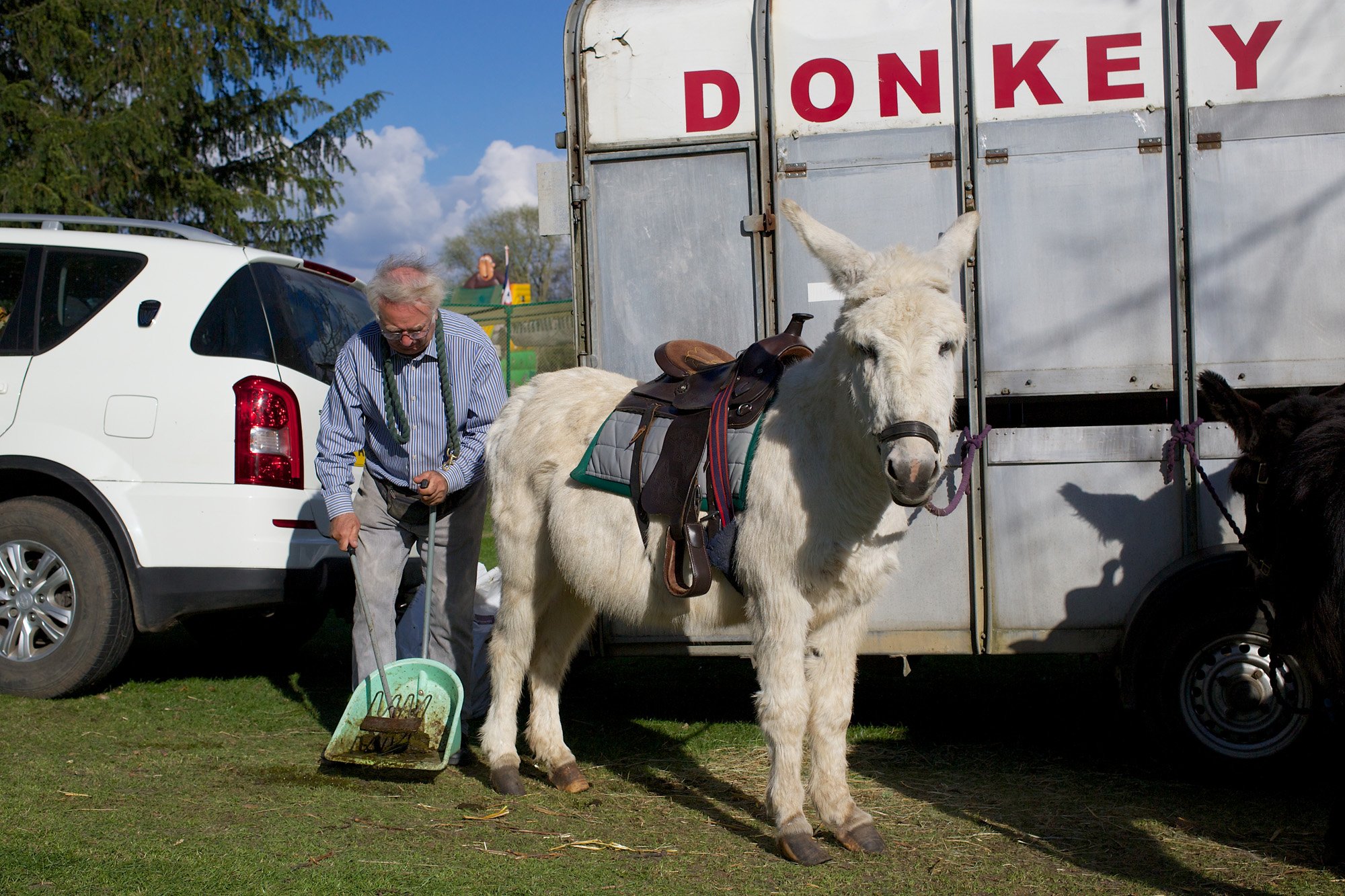
I made a flying visit to the Town and Country Fair, just before closing time when they let you in for free. It’s by far the best time to get decent pictures. The sun is low in the sky, the participants are letting down their hair, and the donkeys are having a well deserved sh*t (featured image, above).

I was surprised to get a nice series of pictures, particularly since I’ve often paid full price on previous occasions and spent the entire afternoon getting nothing. Yes, there was a cute shot of a dog looking out from under a tent — and another of a horse, which I’ll append to the foot of this blog post. But those were exceptions. Organised events, especially when they’re in full swing, don’t seem to yield the kind of subject I like to take.

The Park Non-Event
I really like to photograph people when they’re doing lots of different things, not when they’re spectators of organised sports and entertainments. Left to their own devices, people reveal more about themselves than when a staged event dictates their reactions.

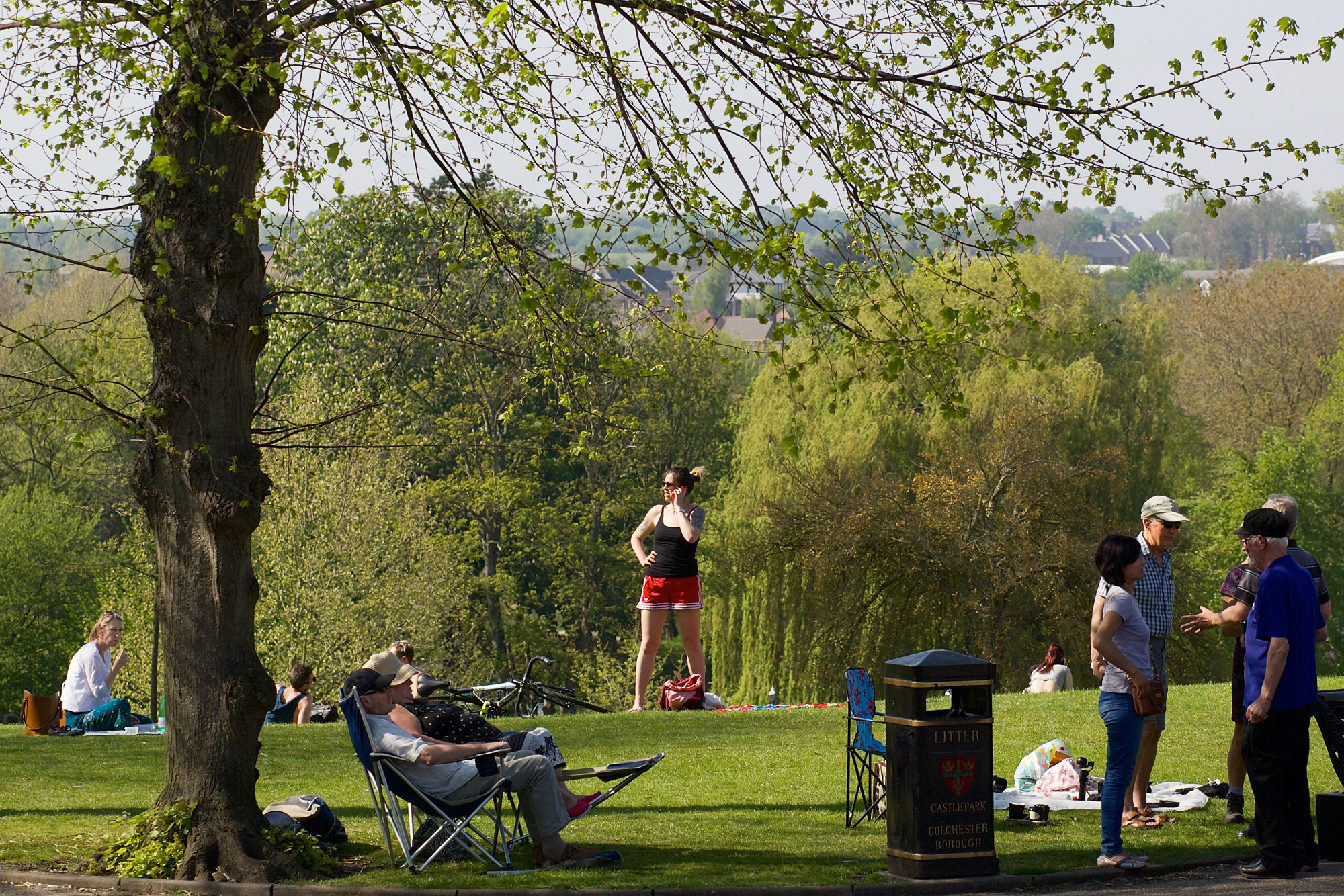
Here (below), for example, is a picture of a typical Sunday afternoon in Castle Park, Colchester. People are sitting, eating, and chatting. Some have gathered together in groups, debating the issues of the day. They’ve brought bicycles, folding chairs, footstools, table cloths — everything for “Le Déjeuner sur l’herbe” (Luncheon on the Grass), if not quite in the style of Edouard Manet.

Sunday in the Park

You see what I mean about the small patch of red? The woman making a phone call was fortunately wearing bright red shorts which form a natural focal point at the centre of the picture. Seen against the subtle greenery of Spring (it was early May) the red is particularly striking. Later in the year the green will become more intense and far less photogenic.

The Same Strategies Apply
When you’re taking pictures in the park you can use the same strategies you normally use on the street. You can “work the scene” when you find something that demands it — such as some people engaged in breakdancing or playing “boules.” Or you can try to remain invisible and get candid pictures, like the one above.

As a backdrop, Colchester’s Castle Park offers amazing props for the off-road street photographer. It has the remains of a Roman villa, a medieval castle built on the ruins of a Roman temple, a wall (Roman, of course), and an extraordinary collection of rare trees — including an oak that looks like a poplar.

Inevitably, any pictures you take in a park — particularly one as beautiful as Castle Park — will be “picturesque.” You can’t keep avoiding the trees, walls, and winding pathways which tend to make the image look more suitable for a calendar than for a portfolio of street photography. Yet the park is a public place, full of pedestrians, and it’s undeniably photogenic.

Winter in the Park
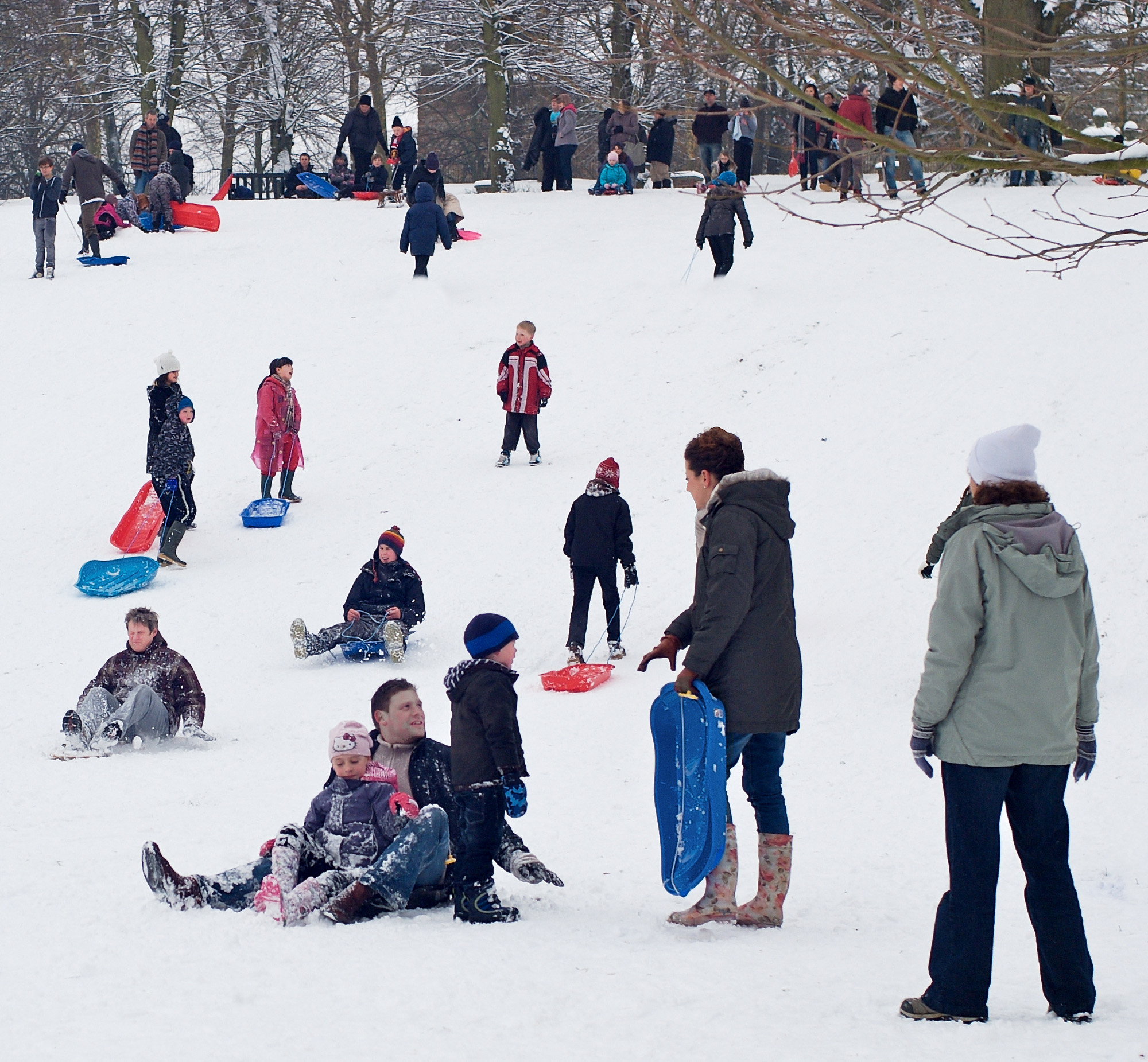
Every year the shops stock up with sledges and shovels, but snow falls about once every two or three years. When it does, everyone goes mad with excitement (especially the shopkeepers). The park really comes to life after a snowfall.

As you could see from the previous image, Castle Park has a very steep hill (as does the whole town), making it ideal for messing around on sledges. By ambulance, the local hospital is only a few minutes away, so there’s no need to slow down before you hit the Roman wall at the bottom of the hill.

It's his turn with the sledge

And Back to Summer
Looking at my final shot you’ll probably think I’ve wandered as far away from the city streets as it’s possible to go. But in fact we’re still in Castle Park, surrounded by thousands of buildings, streets, shops, schools, colleges and a university.

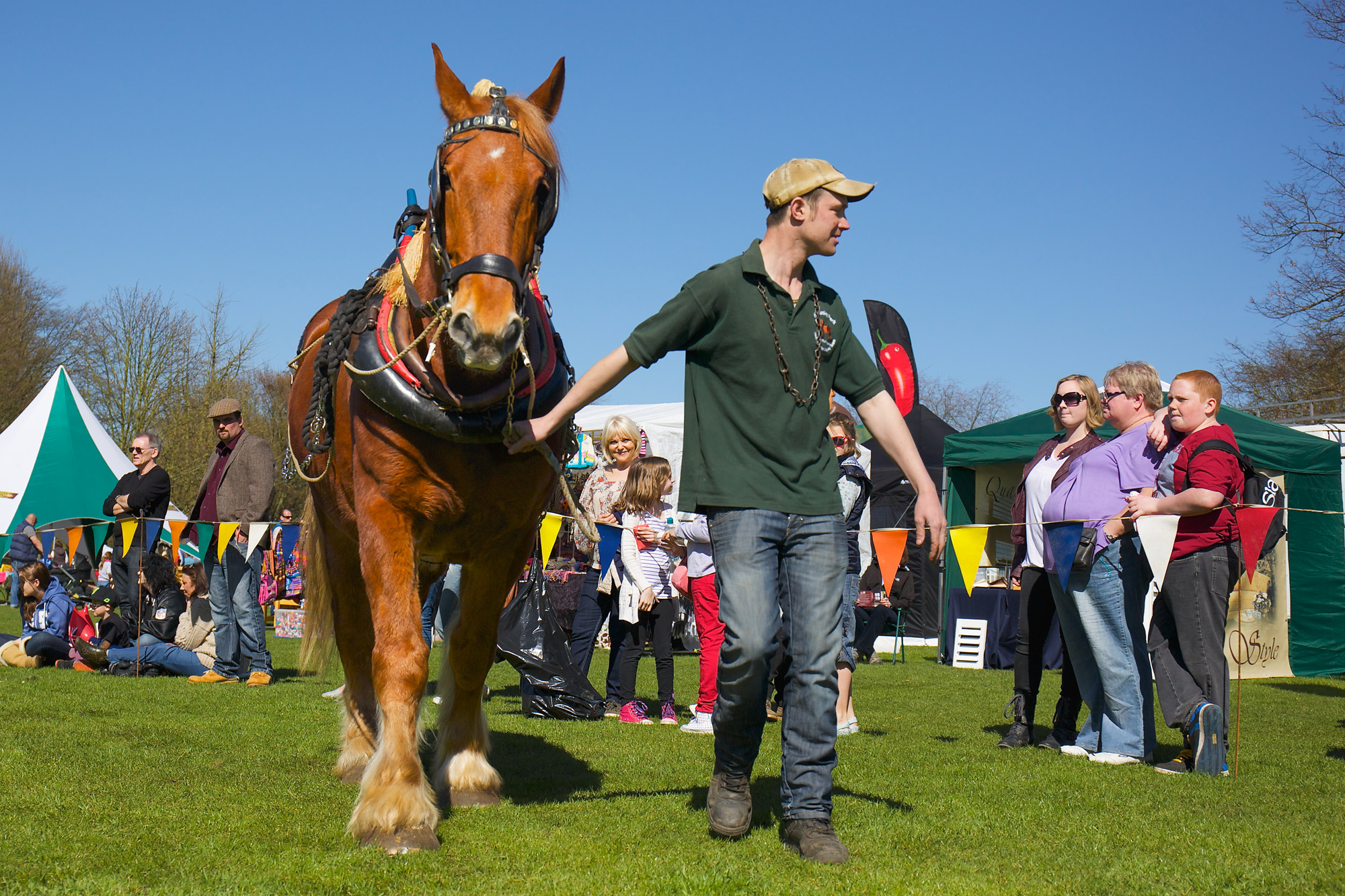
Horses and donkeys are always kind enough to look directly at me, while diverting the glances of spectators away from the camera. That works in my favour. I think this shot captures the moment: both horse and minder are putting their best foot forward. I like the word “style” on the right hand edge of the picture.

Man leading horse

My own style of taking pictures in the park seems to revert to classical compositions, quite unlike those I usually take on the street. They sometimes strike me as quaintly old-fashioned, but I don’t really care.

It’s good to have a change. Even a street photographer needs the occasional day off. Our occupation is not always a walk in the park.