Passing Moments

They’re one grade down from those “decisive moments” — the hypercritical instances captured by Henri Cartier-Bresson. Certain actions are so commonplace, so casual and unremarkable in themselves, that it’s pointless to call them “decisive,” even though they may be critical to the image. What are they?

I call them “passing moments.”

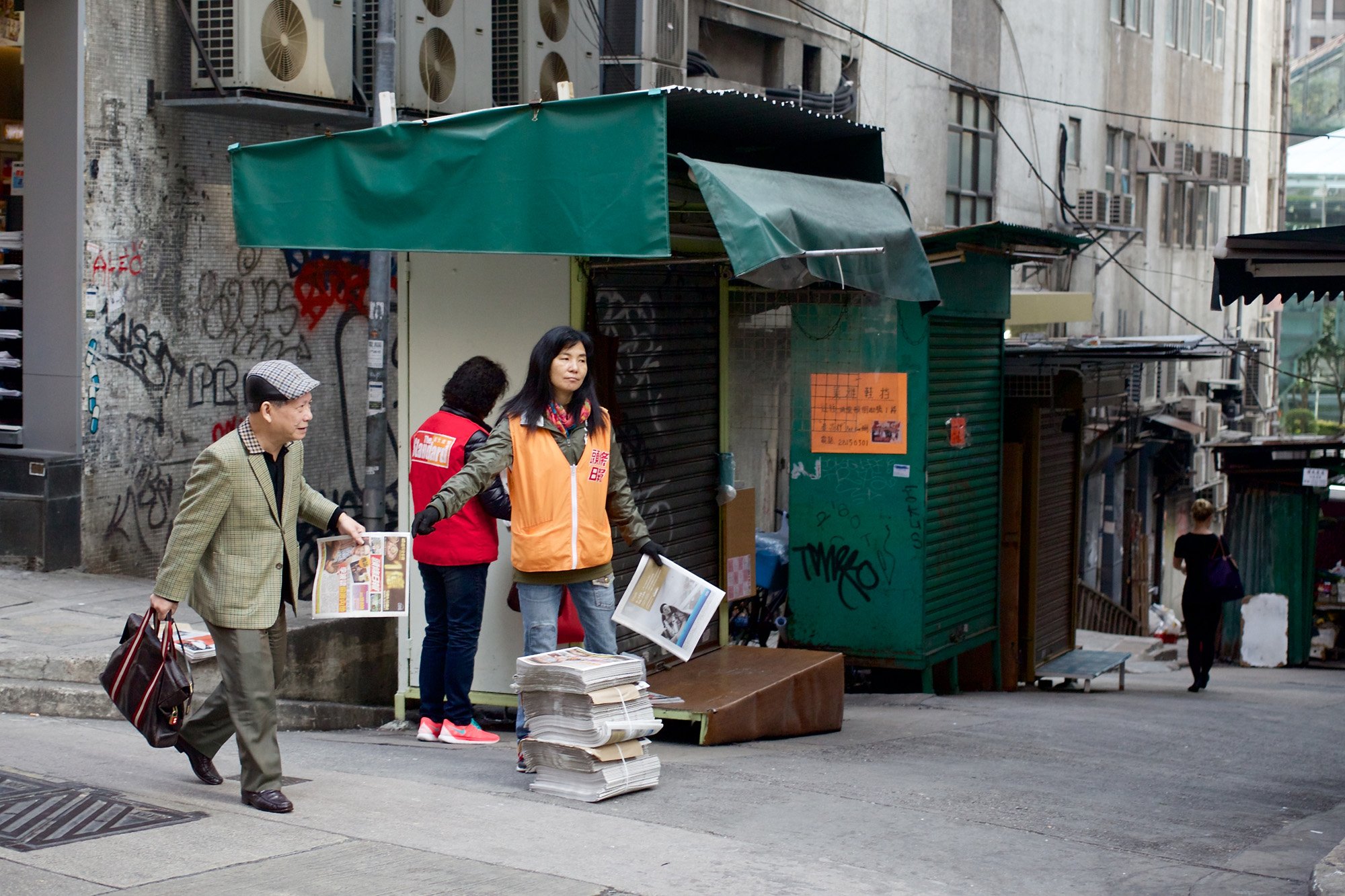
My featured image is a good example of a passing moment. The woman in the orange jacket is standing on a street corner in Hong Kong, handing out free newspapers to commuters on their way to work. She repeats her action time and again with each person who passes.

There’s nothing “decisive” about the moment of delivery. In fact, it seems to happen over a period of one or two seconds rather than in an instant. The man approaches; the woman readies the paper. The man gets closer; the woman offers the paper. The man never breaks stride; the woman doesn’t even look at him. The long moment has passed.

I like these passing moments. They give a sense of “life continuing,” rather than “life frozen.” I actually prefer them to Cartier-Bresson’s decisive moments, which are surely an attempt to identify a phenomenon that doesn’t exist beyond the confines of photography.

You can find actual “decisive moments” only in the realm of science fiction. I remember watching a BBC TV serial called “Quatermass and the Pit” in which scientists dig up an alien space craft which has crashed near a Tube station. When they eventually break through the super-hard metal exterior of the craft they discover what appear to be dead, but perfectly preserved (and very frightening) insects, almost as tall as men. Then Dr Quatermass offers a key insight. These space-voyaging insects are actually alive. They’re simply existing in a different dimension, caught between two micro-seconds of time.

Life Continues
You see, we human beings don’t exist in decisive moments. For us, one moment blends imperceptibly into another. Even if we pause mid-air for a micro-second — like the gentlemen (below) who’s checking his recent purchase of some fresh cakes — we’re not really stuck there for eternity. We delight in swimming through the flux of time — and I really think the happiest people are those who “go with the flow” and enjoy it.

Looking at cakes

I grant you one thing: photography fixes our appearance for eternity, or at least for as long as the image can survive on disk, paper or computer memory. But there’s a huge gap between the reality of the image and the reality of the material world. It’s a gap that doesn’t exist in, say, literature, in which the flow of time is recreated by the act of reading the poem or novel.

If you concentrate on a single, isolated incident in street photography, you can certainly reduce the scene to a single instant. Yet I really prefer to see a contrast between this briefest of moments (the man looking at the bag) and the wider context of the image (people walking past in the background). When you put the single instant into its context you get…the passing moment.

In the photo below, a shopper examines a dress on a shop dummy. The woman is undemonstrative, pausing for a moment or two before moving on. The inanimate dummy, on the other hand, appears to be much more lively, holding up one hand in a gesture that would yield a “decisive moment” if made by a real person.

Looking at dummy

My photo therefore contains a fake decisive moment, simulated by the dummy, but sufficiently convincing nonetheless to give the image a sense of “rightness.” I’m not sure if I can even call it a “passing moment,” because the mannequin is poised in such an insistent, transitory position, in imitation of real life.

Yet the formula remains the same. There is a point of focus which appears to be pivotal in the flux of time, around which you can see time still flowing naturally.

That’s a passing moment: not particularly decisive, but a key element of street photography.

Uncomfortable Cafés

London is full of uncomfortable cafés. That’s a pity because if there’s one thing I enjoy more than walking around taking street photos it’s sitting in a café looking through my morning’s work.

Sometimes I like to take revenge by photographing the cafés themselves, just to remind myself why I always go the nearest Caffé Nero with its assortment of sofas and easy chairs. I wonder, are comfortable seats so expensive as to be beyond the budgets of independent coffee houses?

Take my featured image (above), for example. If you’re out on a date with your girlfriend would you really consider taking the middle table? “This one will be fine, darling. Let’s have lunch here.”

Shabby Chic
Or how about the one below? I think this is taking “shabby chic” a bit too far. “Bloomin’ shabby cheek, if you ask me, mister.”

Comfort cafe

As you can see, my personal likes and dislikes do tend to influence my street photography. They direct my attention. I look at the scene for incidents, activities, combinations of forms and colours, interesting people — and so on — but what catches my eye is often something that triggers thoughts of approval or disapproval. In this sense my photography has the characteristic of being a kind of diary, not entirely unlike Sei Shonagon’s “Pillow Book” with its occasional lists of “Annoying Things,” “Very Tiresome Things” and “Pretty Things.”

There’s nothing wrong with finding a personal connection with the scene you’re taking. Any motivation is better than none. Perhaps a person in the street reminds you of someone you once knew. Or you see a name on a building that resonates in your mind because of some personal link to it. Or the subject of your photo can simply be “the sort of thing” you find fascinating, puzzling, attractive, beautiful, surprising, revealing — the adjectives could continue indefinitely. What they indicate is your reaction to the subject and its setting, your underlying motivation for taking the shot.

However, this initial impetus — the provocation which attracts your attention and draws you into the shot — is only a tiny part of the process of taking a street photo. You still have to figure out how to take the photo, how to make the subject and its surrounding context fit the frame in a way that will be most pleasing to you when you check your pictures back home.

A Clear Example
I hope you can grasp this difficult concept. Let me give you an example.

Man with ferret

London is full of people walking their dogs on a lead. However, it’s a bit unusual to see a man with a ferret on a lead. Who is he? Why does he have a ferret in the West End? I had to take a shot, but he was sitting on a window-ledge by himself and would see me if I approached.

Circling round the block I approached him from another angle, by which time he’d fallen into conversation with a passer-by. Now here’s the point. My shot makes the passer-by the centre of the image because his profile stands out sharply against the stone building. A bollard and some tourists balance the image on the right. The keeper of the ferret is tucked away on the left, and the ferret itself…well, that’s been relegated to a very minor role at the bottom of the image.

This is exactly how it should be. Ferrets are only a very small part of London’s cornucopia of photographic subjects. They can’t have a starring role, but they can provide the initial impetus for taking a picture. I’m just glad this one didn’t meet that lady with the rabbits I once photographed in Bangkok.

Birds of a Feather Flock Together

So many factors work against the best interests of the street photographer! There’s the constantly changing light, the hostile attitude of people who hate to be photographed, and the incessant movement that causes perfect compositions to disintegrate before our eyes before we can press the button.

How delightful it is, therefore, when something works in our favour! One such factor is the tendency of people to dress in similar ways whenever they join a group.

I guess this harks back to our prehistoric past when we all belonged to a particular tribe. Some of us still do. If we join a company that has a corporate uniform, or if we’re in the armed services, or simply working at a job that demands a certain kind of clothing — then we’re behaving tribally once again. It’s all to do with identification, of being part of something greater than ourselves.

Couples
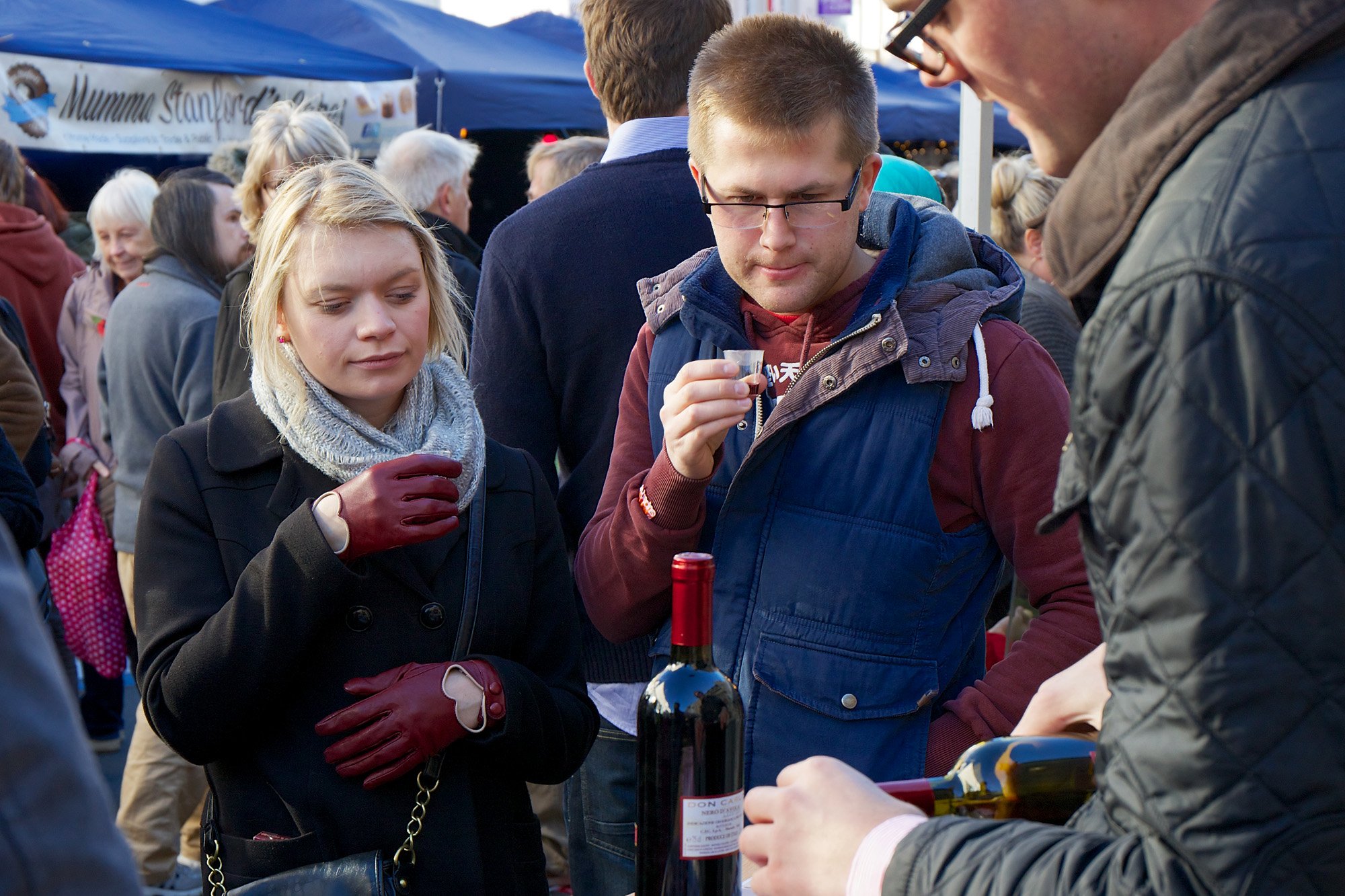
Young couples often dress like each other, not because they don’t have individual taste but because they like to demonstrate what they have in common. Perhaps they go shopping together and express a liking for certain materials, styles and colour combinations.

The two people in my featured photo (above) make a harmonious composition with their shared love of burgundy red. I was fortunate to come across them when they were enjoying a wine tasting at a winter street market — and luckier still to see them sampling red wine rather than white. Spanish burgundy?

Larger Groups
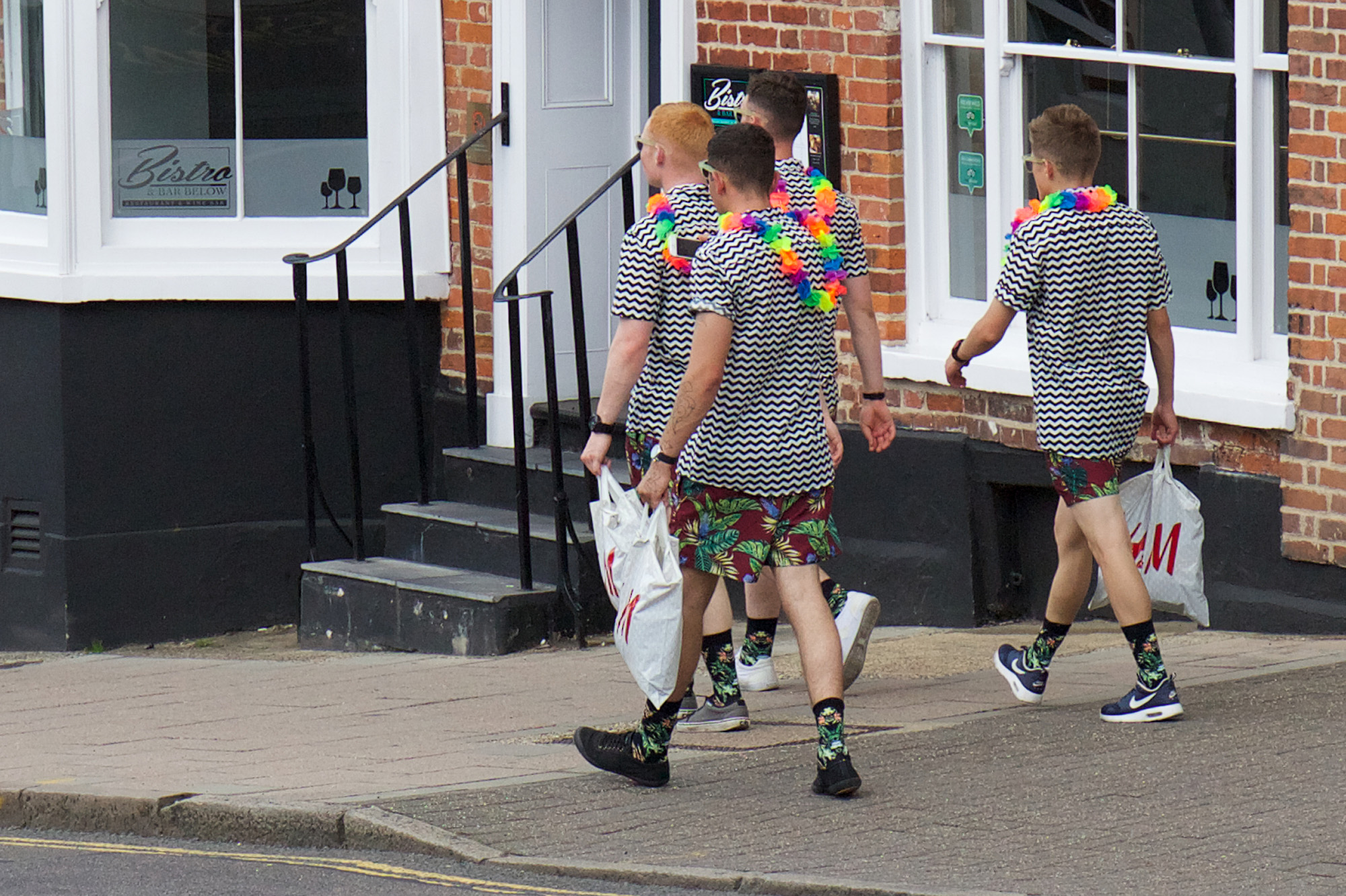
It’s a little more unusual to find larger groups of people wearing similar clothes unless they share the same occupation. I saw these four guys (below) walking away from a street carnival at the end of the day. I have no idea who they are, but for that very reason I find them thoroughly intriguing.

four guys

As you may know if you read this blog regularly, I like pictures that compel the onlooker to make up a story to account for the content of the image. Here’s my own version. It may or may not be true.

Four friends, possibly members of a boy band, came to town dressed in their normal clothes (not the ones you see here) and discovered there was a carnival in the afternoon.

It was a bright day, so they all bought sunglasses in matching styles, then one person had the bright idea of buying matching clothes as well. As a result, they popped into clothing retailer H&M where they picked out identical tee-shirts, shorts and socks.

The town is full of party stores, so it was easy to find some colourful, carnival-style garlands. The only problem — apart from non-matching trainers — was having to carry their regular clothes in the H&M shopping bags. Maybe next time they’ll come fully prepared!

Working Parties
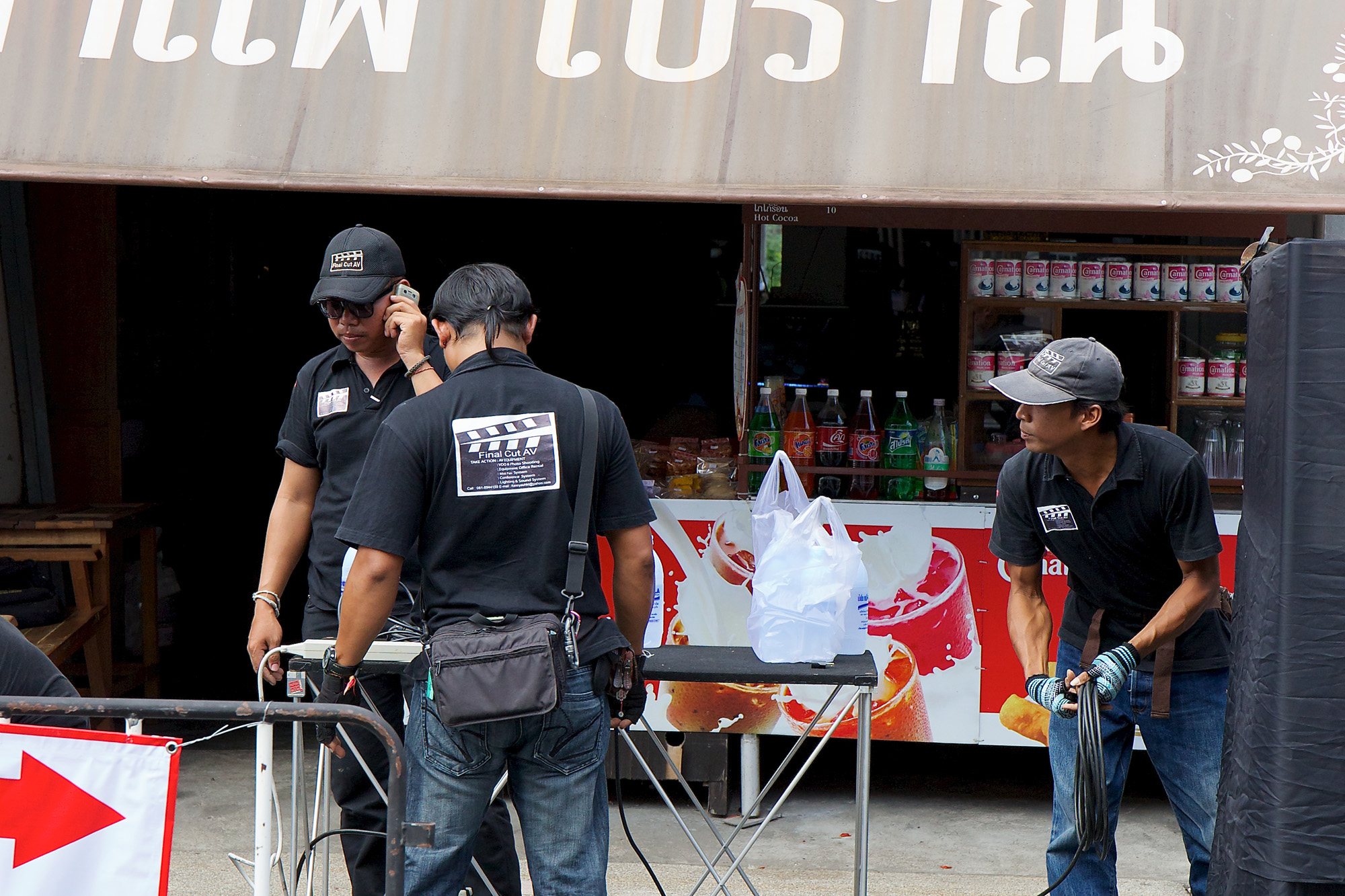
If you’re looking for colour repetition among groups of people you could do worse than photograph men and women at work. When people are obliged to wear a uniform they automatically make a harmonious picture. I hasten to add: it’s up to the photographer to make sure there are also other reasons for taking the shot.

working party

The group shot of people at work seems to be most successful when the individuals clearly show their unique personalities, despite wearing identical dress. Such an effect does not come across when you see, for example, a distant shot of soldiers on parade. They all look very much alike. But in civilian life, people are free to express themselves in different ways while still being able to work together effectively.

I have a couple of shots to support this theory. The first (immediately above) shows three guys setting up an outdoor sound system. They all look pretty efficient, dressed in the corporate tee-shirt, with two of them wearing the corporate baseball cap as well.

However, each man has a separate task to perform while communicating with colleagues, including someone else at the end of the telephone, presumably back at base. Individual personalities are apparent, making a contrast with the similarity of dress. The red arrow and stark white of the untouched water bottles suggest a sense of urgency, but the man with his back to us — with the jaunty pigtail — provides a calm, stabilising influence.

I took a similar, but more humourous shot on a later date (below). Again, there are three guys making preparations for an event, putting name-tags on seats. A passing TV cameraman is not part of their “tribe” because he wears a different corporate outfit and works without any reference to the others.

panda theatre

The photo would not be as amusing without the family of pandas in the background. They’re all part of their own tribe: Mum, Dad, and the two Cubs.

Yet like each of the men in the photo, the pandas seem to have individual personalities. The young male has a zany hairstyle and is the only one expressing any concern. Likewise, the man in charge — who points with his finger and seems to be saying “that’s where it goes” — is equally self-conscious about his hair. What appears to be a colourful comb juts out from his back pocket. The young panda looks aghast!

One Person, Centre Frame

One of the most difficult candid shots to get is the classic “one person, centre frame” composition, with the subject facing the camera. In this scenario, the likelihood of the subject looking up and reacting with alarm, delight, or some other emotion (most likely embarrassment or irritation) is probably around ninety percent.

I think it’s easy to underestimate the appeal of this basic style of composition. Although it’s identical to the composition used by millions of people every day when they snap each other with their mobile phones, it still has the power to hold our attention in a photograph taken with artistic intent.

Personally I don’t think there’s any need to “big up” the subject by getting close with a wide angle lens. That’s what street photographers do when they go over to the other side and start collaborating with the subject. My own motto is “Never Ask Permission,” a slogan I once found on a sticker in London (no, I didn’t put it there!)

How To Do It
The only way to get such a shot is to find a subject who is absorbed in some activity — or else sitting dreamily, staring into space and taking no notice of the camera whatsoever.

My featured shot (above) is an example. For obvious reasons I’ve called it “Relax Time.” The woman is sitting in a comfy and partly open-air bar which faces directly on to the street. Hence she is lit entirely by natural light, which is slightly unusual for an interior setting.

In the “one person, centre frame” composition the setting is every bit as important as the subject. Street photos — even those taken a couple of yards off the street like this one — show people in the context of an urban environment. For this particular shot I found a mini-environment, a true haven, adjacent to one of the main thoroughfares in Bangkok. I took the shot just as I was leaving — and the subject was completely unaware that she’d become part of my day’s work.

I doubt if I’d be able to get a similar shot unless I were in the mood for taking pictures. On this occasion I’d been sitting at the open window, observing pedestrians and photographing them in close-up as they passed the bar’s welcome sign. I was pleased with the results. Then, pausing just a yard or two away from the “Relax Time” subject I noticed this entirely new composition at once.

It’s divided into a “busy” half on the right and a “relaxing” half on the left. The jumble of decorations are confined to one corner and below them are the brightly lit table and cushion. On the other side are brown stools, a brown chair, a light brown wall and the edge of a picture frame.

In the late afternoon the bar is at its quietest, my partner and I being the only customers. Once the drinkers start arriving the subject of my photo will soon find that her “relax time” has come to an end. Her working day is divided into busy and relaxing spells — and my photo, similarly divided, encapsulates the story.

Another Example
I’ve been looking through my pictures to find other examples, but they are few and far between. Most of the time I’m not trying to place the subject centre frame and I tend to include several people in each shot.

However, here’s another one (below), taken in a busy street, with the subject in the centre of the frame. Like the other shot this one deliberately places the subject in context. People hurry past; I linger for a moment to take the shot. The man at his makeshift desk doesn’t take any notice, He’s completely absorbed in reading a message on his phone.

Broken Specs

I’m tempted to say: “That’s the best thing about mobile phones!” They distract people sufficiently to enable us to get a full frontal shot without being noticed. The downside is that you end up with a gallery of mobile phone shots — but that’s OK if they have some genuine quality.

I like to think this is the case with the image above. I took it partly because the light was particularly good at this location on the street. The red table was striking and I liked the glimpse of the stool to the right, plus the yellow sign which enlivens the image. I deliberately waited to catch a passer-by in mid-step, which adds a decisive moment to an otherwise static image. There’s also a sense of depth, added by the scene in the background where someone has paused, holding a blue suitcase.

Yet none of these qualities makes the image truly unique. There’s one detail which elevates it to my Chosen Few folder. Can you see what it is?

The subject has quizzical eyebrows which curl up at an angle. As if in sympathy, his spectacles do the same. One side of them is broken and the plastic rim points up at a noticeable angle. It looks as though it’s part of the man’s expression, perhaps one of shock or surprise at what he’s reading on the phone.

I’ve called the image “Broken Glasses” to draw attention to the detail. Many people who enjoy looking at photos don’t actually linger long enough to read them.

That’s really the secret of street photography. Look, linger, and see the image. Afterwards, you can only hope viewers of your image will do the same.
If You Borrow a Poster, Put It To Good Use

Do advertisers mind if you include their posters in your street shots? No, they encourage it. They like to see their adverts reproduced in as many places as possible. It’s one reason why so many posters are amusing and “high impact” — and why they positively invite selfies and photo ops of people standing next to them.

This is especially true of posters located close to the ground, at bus stops and waiting areas. There’s much to be gained by having everyman and everywoman displayed in close proximity to the image in a poster. It connects the public to the product. In this way, the product insinuates itself into our collective consciousness and becomes part of the fabric of daily life.

In my street photography I take it for granted that this devious process is taking place, but I don’t attempt to fight it by ignoring the posters. What’s the point? In a hundred years time the product being advertised may have long gone out of fashion, its manufacturer bankrupted by changing tastes. The world moves on, but street photography is forever.

The Eternal Triangle
In my featured image (above) there are several elements playing their separate roles and the Kurt Geiger poster is just one of them. The shape of the poster is repeated in the white rectangles at the top of the frame. Huge columns separate the two real-life figures, a workman in overalls who’s just bought a sandwich and a pregant woman who’s taking a distant photo into the bright sun.

Please don’t ask me for the “meaning” of this picture. While I certainly don’t think its meaningless, I can’t quite put into words any precise explanation of it, other than to analyse the composition. At the time of taking the shot, I saw the image as a whole and composed it deliberately to achieve the effect you see.

When I saw that the model in the poster was wearing sunglasses and appeared to be looking directly at me (and my camera) I was naturally interested. I had to wait for the two figures to move into position and they duly obliged. I had in mind the idea of contrasting real-life people with the image of the glamourous model, but I think the picture has turned out differently. It’s really about photography.

The glamourous model, the pregnant photographer in pink, and me (or you the onlooker) form a triangle that almost encloses the worker and the two huge columns. The whole composition hinges on the man who is closest to the centre of the image. In particular, the whitest and brightest feature is the man’s overalls which identify him with the workers who built and now maintain the magnificent setting.

In other words, the workman is actually part of the background, despite his visual prominence. The real subject is the photographic triangle: us, the model and the woman in pink.

At least, that’s one way of looking at it.

Big Yawn

The next picture (above) is not nearly as complicated. It’s just two woman texting while the little girl in the poster gives a big, exaggerated yawn. It’s my simple way of stating that I’m getting a little bored with seeing — and photographing — so many people staring at their phones. Henri Cartier-Bresson never had this problem!

Too Good to Ignore
Images in posters are far too good to ignore. The photographers who take the original shots are highly paid professionals and have gone to a lot of trouble to create the most stunning images possible. If you include their images within your street photo, you owe it to the fraternity of photographers to make a significant contribution of your own. That’s why I say: “If you borrow a poster, put it to good use.”

Keep Looking, You’re Shooting for History

A street photograph consists of two major components: people and an urban setting. If you like, you can call these components “subject” and “context” and you can think about them separately or together.

Sometimes the human subject looms large; in other shots the surrounding context is so dominant it becomes, in a sense, the true subject of the image despite the presence of one or two small figures.

Both subject and context need the photographer’s full attention. It’s all too easy to concentrate on one at the expense of the other. In my own work I usually try to create a balance between the two, rarely taking distant shots of the city but not often getting in so close as to exclude the city altogether.

The Third Component
Arguably, there’s a third component in the street photo, the significance of which easily escapes us in the heat of the moment. Did I just say “moment”? Well, there’s the clue: the component so easily forgotten is time itself.

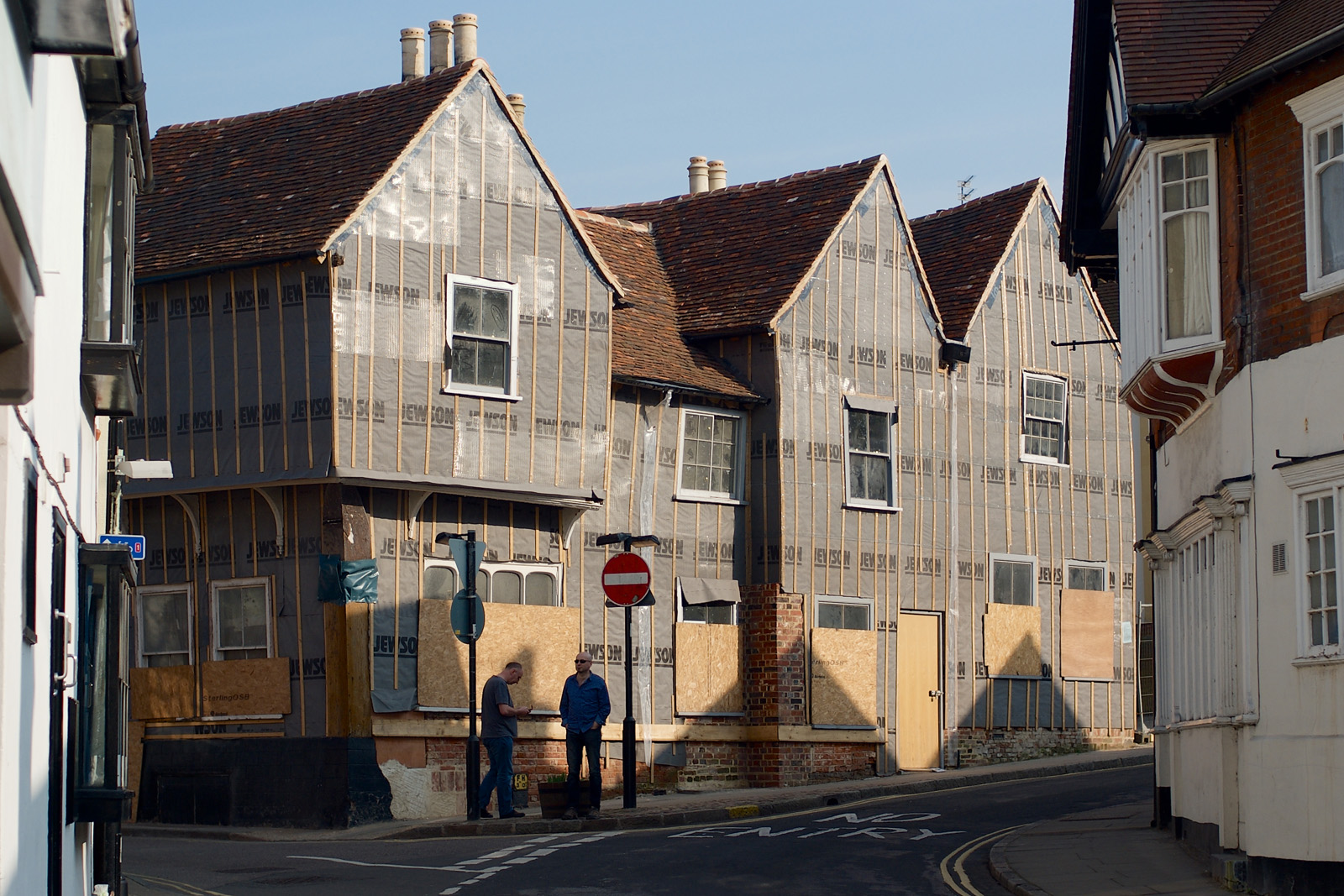
Every street photo is taken at a precise moment in time. Twenty-four minutes past four on the twenty-first of August 2013. Nineteen minutes past four on the twenty-fourth of March 2012. Those are the times at which I took the featured image (above) and the building under reconstruction (below).

So why am I showing pictures from five or six years ago?

I want to make the point that our street photographs are not only to be shared among our contemporaries, they’ll be viewed by people in the future — perhaps for different reasons. One reason may simply be our descendents’ curiosity about the past. When you freeze a moment in time you can return to that moment at a later date and find an insight into the way people lived, worked, dressed, moved, traded and dwelt. If only we had such images from a thousand — two thousand, fifty thousand — years ago, wouldn’t that be great?

The Hardware Store
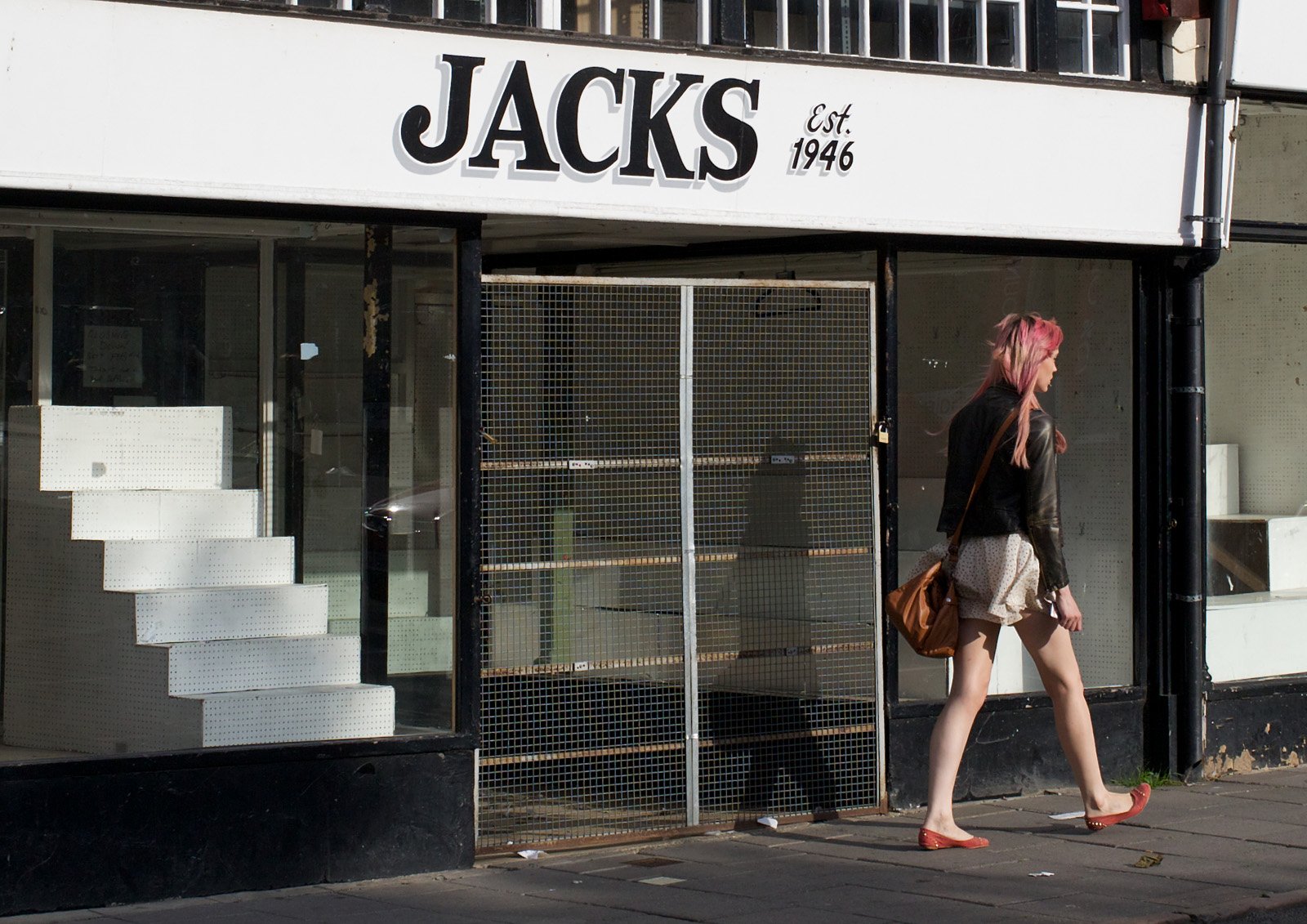
Apostrophes were the only things they didn’t stock. My featured image (above) is what was once Jacks hardware store in Colchester. By the time it closed it had long since been left behind by B&Q, Homebase, and the growing businesses of online commerce. Note how proudly the shop displayed the date of its origin: 1946. You can just imagine how briskly they traded in the years after the Second World War. First there was post-war reconstruction, then the boom of the ‘Fifties. It probably continued to prosper through the Beatle years, the Thatcher years, then, somewhere around the turn of the century it went into decline, followed by closure a few months before my shot was taken.

The girl in the photo clearly does not belong to any of the eras I’ve mentioned. To her, 1946 is “great grandpa” territory, and I doubt if she remembers much about the turmoil of the twentieth century. There’s something slightly retro about her style of dress (the shoes and the short leather jacket) but the large shoulder bag and the coloured hair were very “now” in 2013 and the whole outfit would still look good today.

Layers of Time
My photo has within it several “layers of time” which I’ve tried to disentangle in the above explanation. As always, the human figure is the most up-to-date element in the shot, but in her appearance even she carries references to the past, as we all do.

Because I’ve shown the building during its relatively brief period of emptiness (vendors of second-hand goods moved in fairly swiftly) the image can be located in time fairly easily, as least by local residents. Others can look at the EXIF file for the precise time and date.

For once, I think I’ve brought together subject, context and layers of time into a single image without any one of them being dominant. A casual glance may dismiss it as yet another photo of someone walking past an old shop, but you can scrutinise it and unravel the story without my telling it. The narrative is there, in figure, setting and time.

The Stockwell Arms
In the picture below, the figures are smaller, the building larger, so you can surmise that this is more about the context than the figures themselves. You’d be right.

I believe the figures may in some way be related to the building, although I don’t know them personally. Standing in Colchester’s West Stockwell Street, The Stockwell Arms was once an inn, where, many years ago, the first novelist in the English language, Daniel Defoe (author of “Robinson Crusoe,” “Moll Flanders,” etc.) stayed for a while. It’s close to where I live now, so I kept an eye on it during its much-needed reconstruction by the late Robert Morgan (a major player in the computer outsourcing industry).

Again, because the building was undergoing reconstruction, the image can be located with reasonable precision in the flow of time. True, it looked like this for a few months because the whole project took two or three years — but what’s that in the history of such an old building?

I like the incongruous way in which the name “Jewson” is displayed over and over again on the modern plasterboard, now adorning the medieval structure. There’s a personal connection here in that my father served as a captain in World War One with Captain (later Colonel) Jewson, a member of the family which founded the building supplies business. Maybe the timespan is not so great after all. Leap backwards a few more generations and you can imagine Daniel Defoe standing outside the building, wondering what to write next.

Time Waits for No One
When I took these shots I was aware of their historical references. However, I could not have predicted the changes that have already taken place in the four or five years which have already elapsed.

For example, the venue, now called The Stockwell, reopened as a high class restaurant, seemed to prosper for a while, then closed. Sadly, the strain had taken its toll on the owner. His widow transferred her successful quilting supplies business to it, running it for a year or two as a meeting place and tea-room, but recently put it up for sale. We await developments.

You see, history starts being woven again from the very moment we press the shutter button in our vain attempt to stop time in its tracks. As street photographers we have to be aware that we are part of the flux of time and try to find ways of using this awareness to make our images more meaningful.

When you recognise the ephemerality of things, you tend to find certain subjects (and their contexts) more intriguing, more visually interesting — more emotive.

So keep looking, and remember: you’re shooting for history.

The Anxiety of the Street Photographer

I sometimes get the impression that photographers — even a few street photographers — never feel anxiety when they’re shooting. They look so comfortable, strolling around, casually glancing to the left or the right. They seem to be waiting for the perfect photo opportunity, perhaps a two-headed cow ridden bareback down the High Street by a naked dancer.

The other day I saw a man, camera in hand, looking for pictures on the right side of the street while a delightful two-second scene was being played out on the left. The light was perfect, the gestures demonstrative, the woman captivating. But the photographer was still checking out a minor architectural feature and wondering whether to record it.

Going Offline
Personally, I was not in shooting mode at the time. As I’ve explained elsewhere, I don’t carry a camera “at the ready” at all times; only when I’m seriously hunting for pictures. It’s the only way to do it. You need to have total alertness or just be content living a normal life without constantly taking pictures.

Along with “total alertness” — the state of readiness needed on the street when you’re shooting — comes anxiety. It’s part of the Faustian bargain you make with the devil (so to speak) when you take up this occupation of street photography. You sell part of your soul, or at least your peace of mind, in order to get decent pictures.
It’s not just me who feels anxiety on the street.

Henri Cartier-Bresson said in an interview (you can find it on YouTube): “It develops a great anxiety, this profession, because you’re always waiting: what’s going to happen? What, what, what?”

That’s it precisely! You become worried about what’s going to happen next. Or rather, you start to worry that nothing whatsoever is going to happen for the rest of day. You’ll just be stuck in limbo, wandering aimlessly around the streets, feeling — knowing — that all the action is going on elsewhere.

You start to wonder: “Why am I doing this? Couldn’t I be sitting at home reading a novel, or having a drink with a friend? Why do I feel compelled to tramp the streets of this goddam city when it would be so easy to get a flight to Peru and take some great photos of people wearing peculiar hats. A trip like that would yield sure-fire results.”

Only the voice of experience can calm your fears.

Good Days, Bad Days
The fact is: there are good days and bad days on the street. Some days I’ve gone out in my home town when the light has been great, only to find nothing to inspire me whatsoever. I return with a few desultory images that are barely worth loading on to my computer.

By contrast, I popped into London a few weeks ago — with the lowest possible expectations — and returned with around thirty shots that I wouldn’t mind showing.

Perhaps I respond more readily to life in the big city. I lived in London for many years and I know the feel of most of the streets in the West End and all of its surrounding areas. It’s possible to be both anonymous and invisible in London whereas neither is possible in a small town. It’s harder to photograph strangers in the street when you’ve seen most of them before.

Now you’re wondering: can you turn a bad day into a good day by using a different strategy or by trying to change your mood? Maybe it’s your anxiety that’s actually causing the lack of photo opportunities. Perhaps there are opportunities happening all around you, but your negative mood is preventing you from seeing them.

The Best Tip of All
I don’t subscribe to the view that anxiety is negative. It’s quite the opposite. It’s what induces the state of “total alertness,” when you’re able to take in everything that’s going on around you and respond to it quickly. Getting some potentially good pictures reduces your anxiety; failing to get them increases it. Fortunately, I do have a tip that may help you keep your anxiety level down to manageable proportions.

It’s simple: just move to a busier area where there are more opportunities.

While it’s true that you may get some of your best images in the quieter streets, especially when the light is good, you’ll find it frustrating to work in these areas for long periods. As Cartier-Bresson says, “you’re always waiting” — and it’s the waiting that causes frustration and anxiety to build.

So when that happens, give yourself a break (and if necessary change your style) and move to where there’s more action.

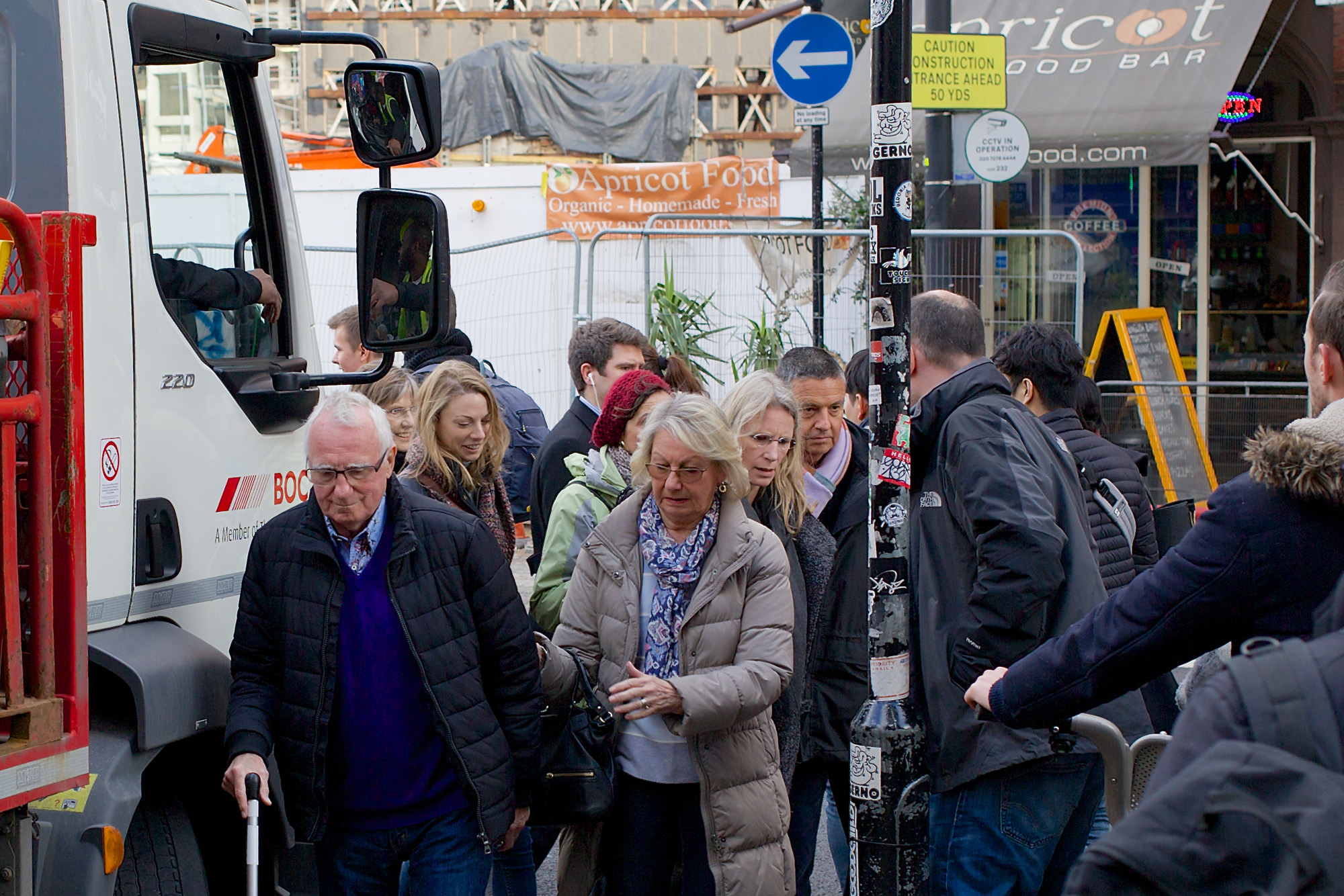
This is what I did after taking shots in the Seven Dials area of Covent Garden. It’s a great spot: a confluence of streets with attractive buildings such as pubs, restaurants and vendors of theatre tickets. However, there’s only a trickle of passers-by, making it difficult to compose meaningful shots in which people play the major role.

Time was marching past quicker than the pedestrians and I was becoming increasing aware of my lack of success. The solution was to walk the short distance to Tottenham Court Road, a major artery heading north, where I found some building works causing chaos on the pavement. Pedestrians were having to walk around the trucks that were pulling out on to the main road into the path of oncoming buses. You can see one of the shots I took just above this section.

Breathing a sigh of relief, I was able to head back towards the quieter areas and continue the day’s shooting (such as the featured image, at the top). I found that alternating between backstreets and main thoroughfares was a good way to engineer a positive outcome. The build-up of anxiety in the quiet areas made me bolder in the busy areas, resulting in better pictures.

My message is this: don’t worry about anxiety. Just use it to your advantage.

Sculpting Buddhas

For every Saint sculpted by European artists I reckon there must be a thousand Buddhas sculpted in the Orient. It’s almost impossible to perform street photography without including them. Alternatively, you may decide to make them your primary subject. After all, the image of the Buddha is not a stage prop and shouldn’t be treated as such, despite being as much a part of the eastern environment as the ground itself.

Images of the Buddha are not representational in the same way that images of Christ, or the Saints, represent an individual human being who is nonetheless divine. A sculpture of the Buddha has an abstract, symbolic quality. It represents both an idea and an ideal. The idea is eternity and the ideal is the possibility of achieving oneness with eternity and liberation from the otherwise endless cycle of death and rebirth.

Eternity and Ephemerality
Street photography is all about capturing the ephemeral moment and preserving it for eternity — or at least for as long as people wish to view it. Unlike the sculptor, the photographer can’t separate these concepts of eternity and ephemerality. The conflict — or contrast, if you prefer — is built into the medium.

Move, point, click, eternity. That’s the photographer at work. Is it entirely coincidental that more cameras are manufactured in Buddhist countries (Japan, Thailand) than elsewhere? It’s interesting to reflect on this thought. We could be forgiven for thinking that the camera is a tool of Buddhist teaching.

All Buddhist sculptures are highly finished and smoothly polished, whether made of bronze or stone. They seem to be so self-contained and other-worldly you could almost believe they arrive in the world fully formed, without human assistance.

I love to see ancient Buddhist sculptures, standing or sitting in rows — especially in the rain. Repeatedly, they weather the storms yet succeed in maintaining their posture, even when the substance of which they’re made begins to erode.

Buddhas in the Making
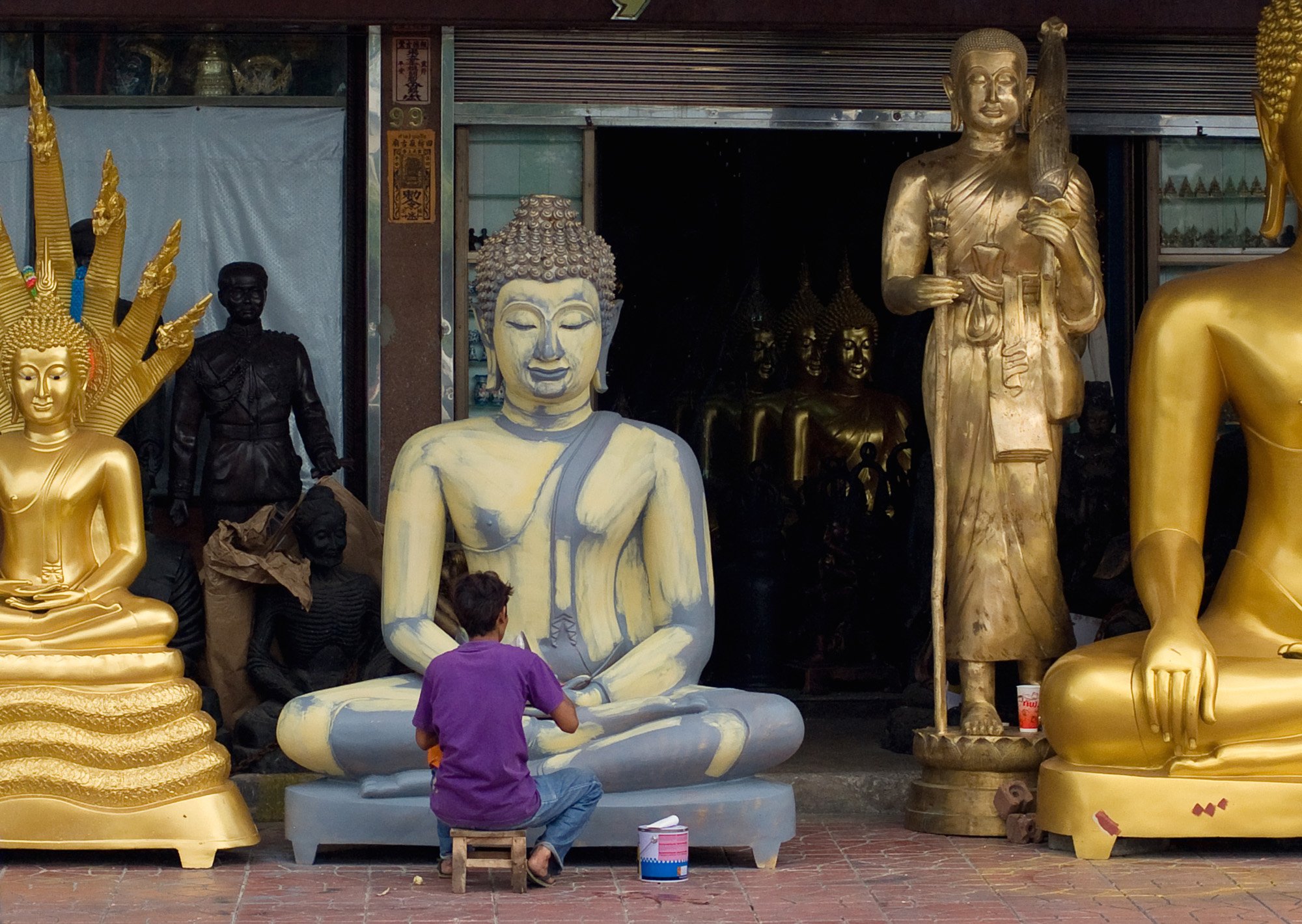
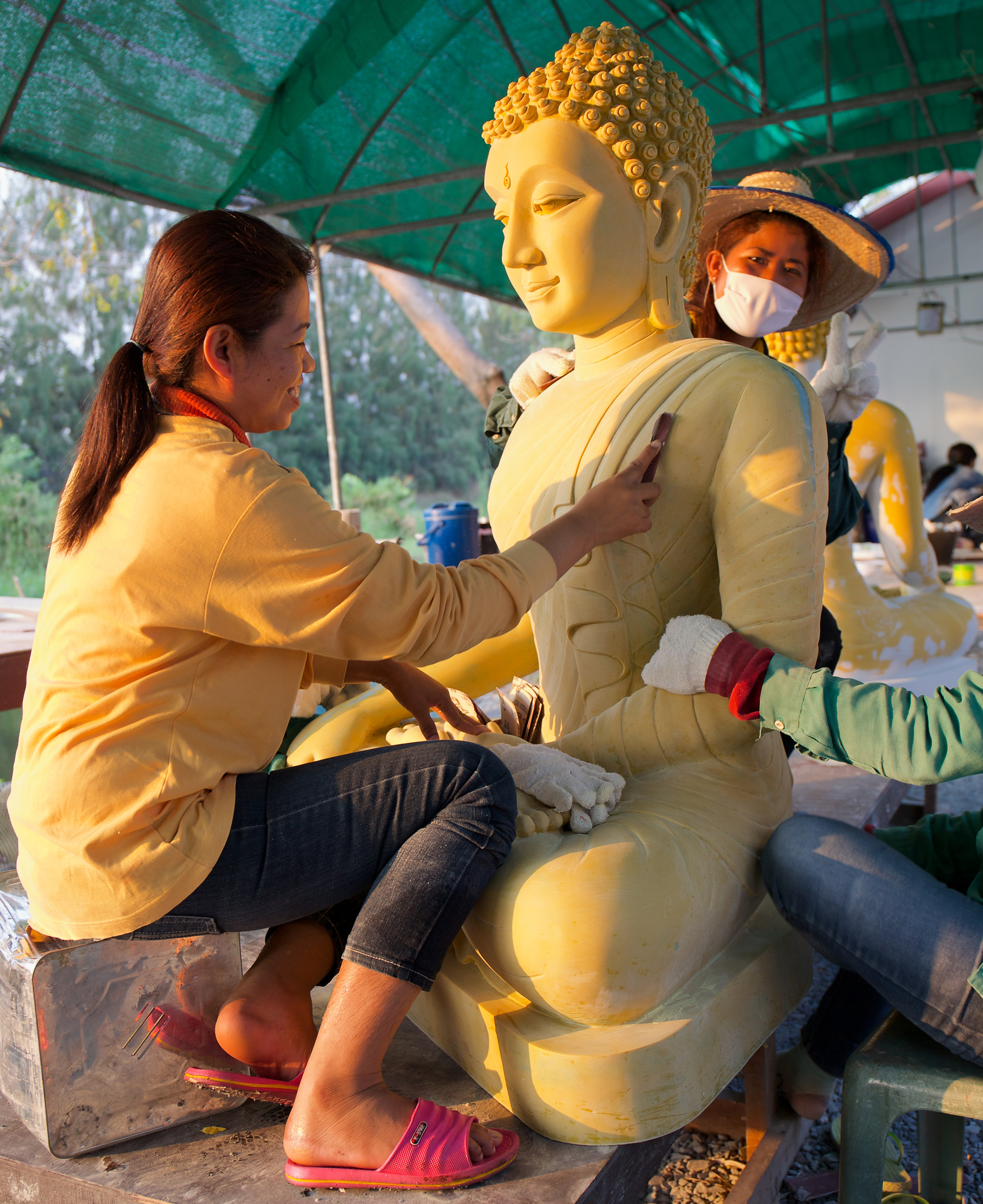
Only during the sculpting or painting of a Buddhist figure do you get a sense of “process” rather than fixed, eternal serenity. I think my photo (above) of the craftsman in the purple shirt, who is smoothing the surface of the figure with some kind of resin, shows the process — but the moulded statue is already fully formed. Even here, the Buddha seems to be perfect, despite any ongoing activity to finish the work.

I took the shot from across a major road in a particularly busy part of Bangkok, near the Giant Swing — the huge wooden structure on which young men would perform the dangerous religious ceremony of “Lo Jin Ja.” Rooted in Hindu traditions, Buddhism is not all contemplation and quiet reflection!

To the Western mind, Buddhism appears to have been born out of a human desire for permanence in an impermanent world. Buddhists counter this view by eliminating desire itself. They set themselves on a path which, they believe, leads to freedom (from reincarnation), oneness (with the rest of existence), and eternity. You won’t get there, they say, if you desire it.

As a result, Buddhist societies have an easy acceptance of life in all its forms. I can’t be uncritical of the religion as a whole, because — as in all religions — cults and breakaway groups have a habit of making sudden appearances, enriching their founders and enslaving their adherents. Yet there are so many positive aspects, especially respect for life, tolerance shown to others, and reverence for the enormity of existence — that I can’t ignore it either.

In Thailand, what I value most about Buddhism is the way in which it interweaves with the everyday lives of the people. As I write, my 96-year-old father-in-law is celebrating his birthday by inviting a number of monks into his home for prayers and a meal. Younger people rarely have special birthday celebrations, but older people like to mark the big occasions: those that correspond with the 12-year-cycles.

Hence, 60, 72, 84, 96 are all occasions on which monks are needed, especially when you’re 72 and have completed your “six cycles” according to Eastern tradition — a tad longer than our “three score years and ten.”

The Forest, the City, and the Monastery
As I understand it, there are three environments in which the Buddhist adept — the Bodhisattva — can reside. They are the forest, the city, and the monastery.

Bodhisattvas have placed themselves on the path to enlightenment — and could achieve it with ease but stay to help others along the way. To me, those in the city seem to have the most noble calling, while those in the monastery have the advantage of peace and tranquility for reflection. Yet it’s the forest dwelling monks who are the most highly regarded, with their tradition consistently promoted as superior to the others.

sculpting Buddha

Back to Nature
Away from the normal city, I like to take pictures in Thailand’s Ancient City, the 200-acre park just to the south of Bangkok. Its construction began in the early 1960s but it’s filled with accurate reproductions of many ancient temples as well as with several original buildings, moved here to enhance the sense of authenticity.

“Ancient Siam” (as it’s now called) is not in the forest, as such, but set in splendid gardens with hundreds of trees and pathways. It gives you a real insight into the variety of Buddhist tradition and all the mythological events and narratives that support it.

Just above is my shot of people working cheerfully on their very latest sculpture. The woman has discarded her gloves to get a better grip of her spatula for carefully smoothing the torso. The Buddhist figure smiles back at her.

Homage to Jacques Tati

If you try to find an exact word to describe the humour of the French comic artist Jacques Tati (1907-1982) you’d probably be most accurate with the English word “dotty.” I prefer it to “whimsical,” or “wistful,” or even “bumbling” — all of which spring to mind, but which seem to place too much emphasis on the person and not enough on the humour.

Tati’s humour is all about the ordinary “man in the street” who is living — and trying to survive in — a world gone slightly dotty. In movies such as “Traffic,” “Mon Oncle,” “Monsieur Hulot’s Holiday,” and above all “Playtime” he explores what the film review site Rotten Tomatoes calls “the infinite mysteries of the modern world.”

When I walk around the streets of modern towns and cities taking street photos I’m constantly reminded of the wonderfully inventive humour of Jacques Tati. Even my current hometown, Colchester, becomes more Tatiesque day by day. A couple of years ago the council installed two cut-out metallic elephants in the High Street, making it more difficult to cross the road to get to the Post Office. Last year they gave us a seven-foot-high sculpture of a running woman who bears a striking resemblance to ousted South Korean president Park Geun-hye. Just what we needed!

Absurdification
Writing about Tati’s 1967 film “Playtime” in “The Guardian” newspaper, Jonathan Romney says: “Tati creates a universe entirely defined by absurdism.” Whereas “Mon Oncle” (1958) showed Tati “scratching his head at the excesses of gadget-crazed lifestyle-modernism,” the later film “pushed the observation of contemporary life further” and placed him in a city where modern design interferes maliciously with every aspect of the inhabitants’ lives.

Half a century later, the absurdification of modern cities is more advanced than ever. If we see a man chattering away to himself while slouching along the street — head down, hands in pockets — we no longer feel sympathy. We just assume he’s using the latest, cordless iPhone. Nine times out of ten we’d be right.

In Singapore, whole areas have been sacrificed to modern design and the entire city is headed in the same direction. It’s a strange process: a vicious circle of self-fulfilling prophecy. Artists and architects tune into the zeitgeist (the spirit of the age) and echo it in their work. In turn, their creations reinforce the zeitgeist to such an extent that everyone becomes governed by it in their daily lives.

That Awkward Moment

That Awkward Moment
For example, take the image immediately above. It shows a public space outside a cinema in Singapore. It’s populated with a surfeit of street lamps — far more than necessary — which assume crazy, twisted shapes, arranged around trees in groups of five. Beneath them are some hard, stone benches that are positively hostile to the user’s comfort, each one designed to hold three people.

The couple in my photo (if they are indeed a couple) look ill at ease. Maybe they’re on a first date. The man reaches into his pocket and stares at the bare paving stones in front of him. Perhaps they’re waiting for a third person to turn up.

I was delighted to see that the film being shown was “That Awkward Moment.” To find a poster with the word “moment” is a gift for the street photographer, let alone the word “awkward” in such a location — at such a moment.

Oh, My Poor Little Feet
As you move around Singapore, the city becomes curiouser and curiouser. It’s long been among the first to get the latest architectural fad, such as vertical gardens and artificial trees. Then there’s the iconic Marina Bay Sands hotel with its three towers spanned by a ship-like structure. To cap it all, Louis Vuitton chips in with a steel and glass space ship where you can buy a new suitcase, if you’re thinking of going somewhere else.

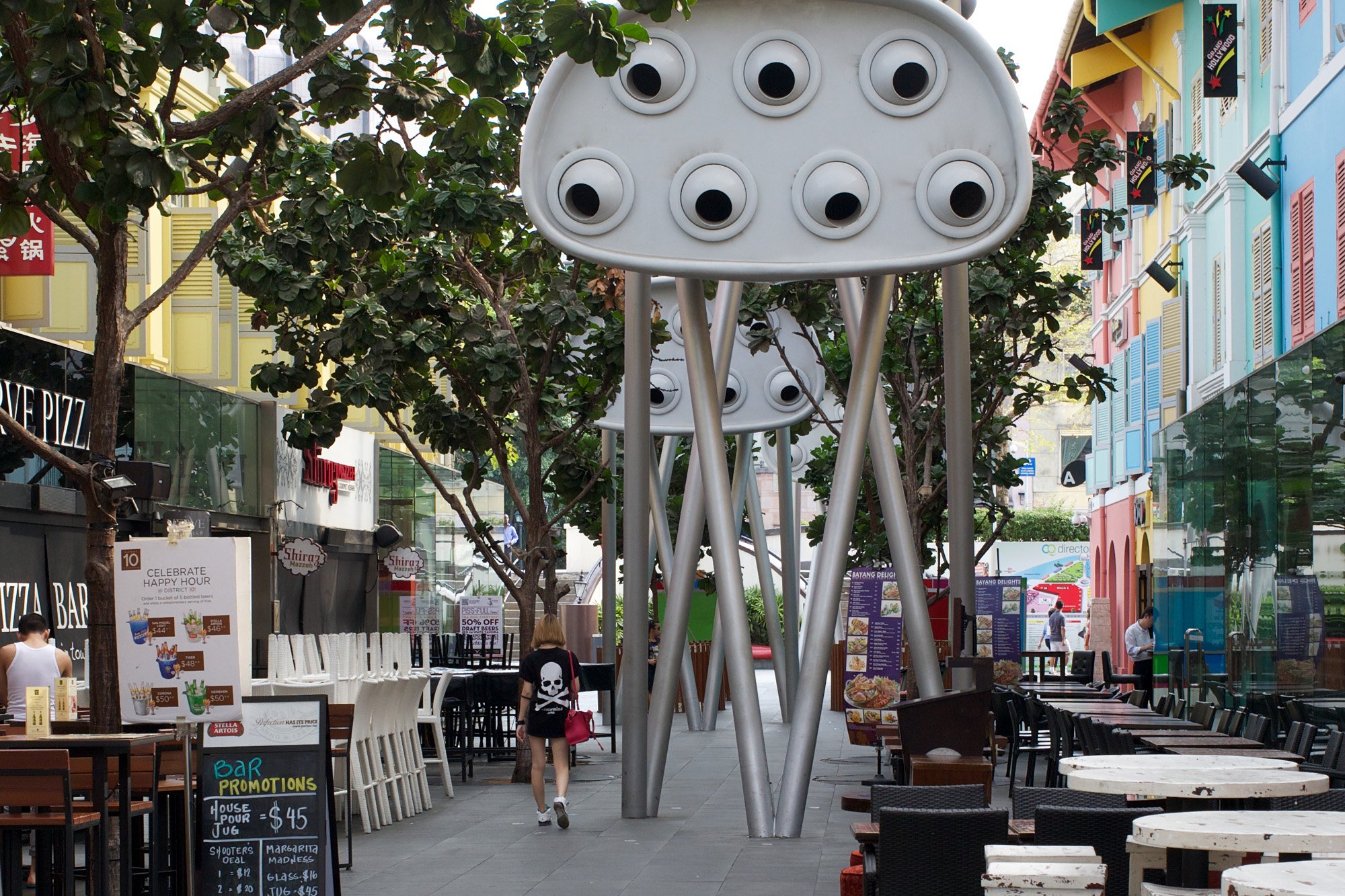
Personally, I love the dottiness of it all, but that’s because I walk around taking street photographs. If I was a citizen trying to live a normal life in these theatrical surroundings I think I might become as eccentric as Monsieur Hulot appears to be. I might start wearing a skull and crossbones on my back, like the girl in my featured image at the top of this article.

At Clarke Quay, one of the most theatrical areas of Singapore, I noticed this girl who was wearing a striking tee-shirt with a skull and crossbones motif. I was so fascinated by her I almost forgot to take the photo. By the time I pressed the button she had receded into the middle distance — where she was obliged to walk around the huge three-legged structures (lights? loudspeakers? surveillance cameras?) in between the open-air restaurants.

Immediately, I was reminded of Jacques Tati zig-zagging his way through the garden of the ultra-modern home where he’s staying in “Playtime,” forced to walk those extra steps because of the absurd design of the pathway. All our lives are now governed by our inventions and environments. As the trailer proclaimed: “Whatever your personality, whatever your job…you are in Playtime.”

If you’re a street photographer– or if you just like looking at street photos — I urge you to get a copy of Tati’s greatest film. It sank into obscurity until its revival in 2014, having never been on general release in the United States. When you view it I’ll think you’ll agree. We’re all in Playtime now.

Don’t Be Afraid of Colour

Colour is both joyful and exhausting. It’s the signature of life: a signal to living creatures that we’re here on Earth instead of far away on a remote, monochrome moon.

Think of how the world would look if everything were in black and white, the two neutral colours of a legal document. It would look dead and lifeless.

Most animals, together with birds and insects, have colour vision. Dogs tend to confuse red and green, but they can certainly distinguish red from blue. Even cats — once thought to see only in black and white — can detect more colours than was once thought.

Our Colourful Vision
Human beings have sophisticated colour vision because of the number of cones in the eye. As a result, we can see that trees have a hundred shades of green in the spring and a thousand shades of red, yellow and brown in the fall. If we wait until winter, when life is hibernating, we see the countryside drained of brilliant colour, leaving brown branches, blue smoke, white snow and little else apart from evergreen trees, colourful man-made objects, and, of course, the birds.

Birds have better colour vision than we do. They see more colours and they have additional color cones in their retina, making them more sensitive to ultraviolet. Even to our eyes, birds appear to have colourful plumage, but to them the feathers of another bird are quite remarkable — and well worth a compliment in birdsong.

We’re Outclassed by the Birds
Don’t just take my word for it. Scientists have studied the colour vision of birds, comparing it to our own. Richard Prum, professor of ornithology, ecology, and evolutionary biology at Yale University, noted: “The startling thing to realise is that although the colors of birds look so incredibly diverse and beautiful to us, we are colorblind compared to birds.”

It appears that birds can see far more colours than they make in their plumage. However, over millions of years of evolution they’re gradually catching up, becoming more and more colourful. The same phenomenon is happening, not in human evolution (as far as we know) but in human culture — and far more quickly.

Professor Prum, with Mary Caswell Stoddard of the University of Cambridge, authored the 2011 paper: “How colorful are birds? Evolution of the avian plumage color gamut.

It’s a fascinating read and raises all kinds of questions that are relevant to photography. For example, at the time of its publication, Professor Prum said: “Our clothes were pretty drab before the invention of aniline dyes, but then color became cheap and there was an explosion in the colorful clothes we wear today.” He added: “The same type of thing seemed to have happened with birds.”

Birds use colour for different purposes: not only as camouflage but also for social signalling and choosing a mate. But what came first: the avian visual system or the complex communication signals which led, via evolution, to increasingly colourful plumage? It’s not a “chicken and egg” situation! Scientists are reasonably sure the visual system evolved first and all the rest followed.

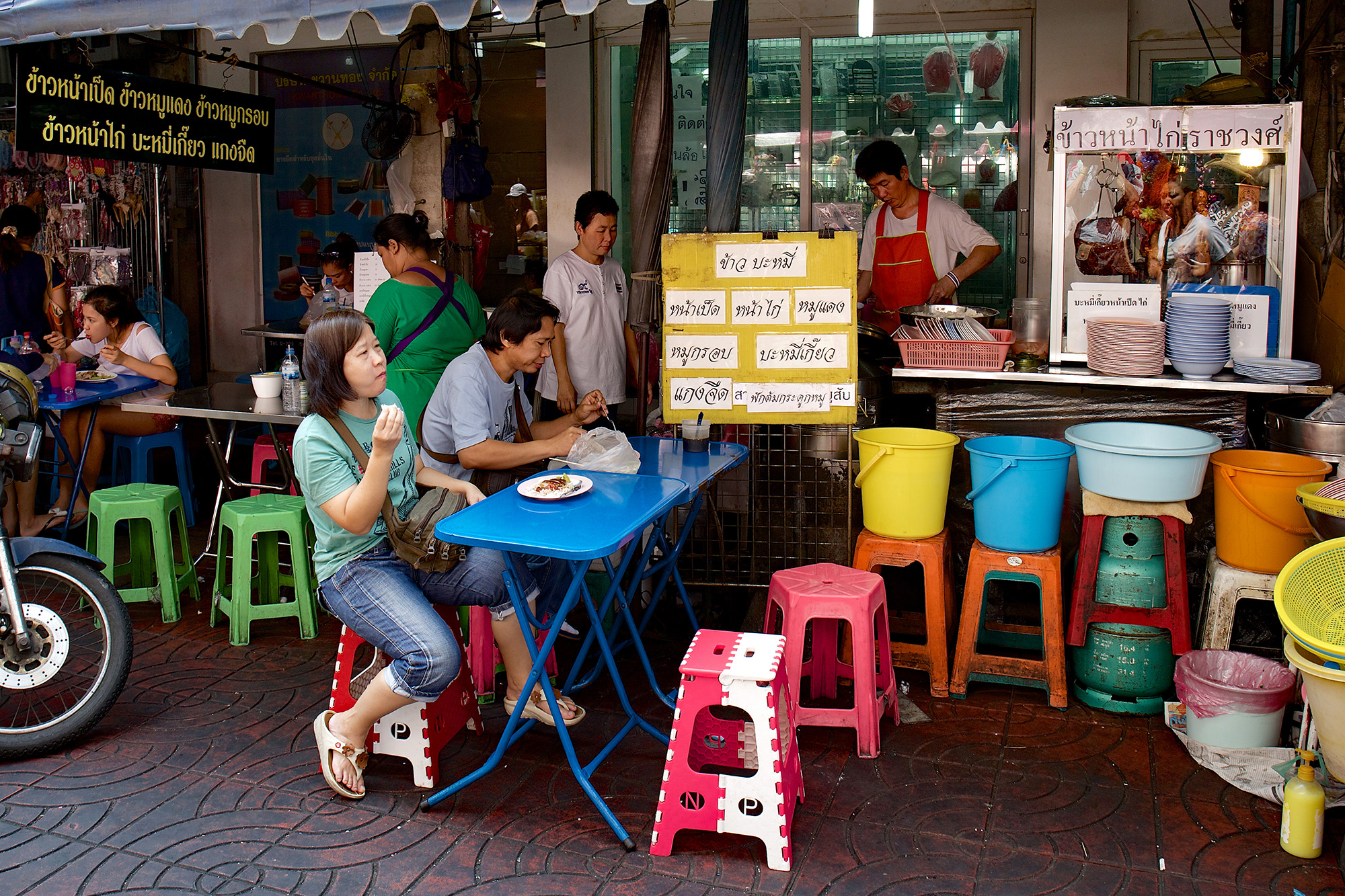
Likewise, we are filling our world with increasingly colourful objects: murals, paintings, bright plastic chairs, anoraks, tee-shirts, mailboxs, and brightly coloured vehicles. When Henry Ford said the customer could have a car painted any colour as long as it was black, he must have realised the policy would eventually have to change. We see colour and we yearn for colour, even when it’s garish and in questionable taste.

The Yellow Car
A while back there was an illustration of our modern attitude towards colour when hundreds of motorists driving bright yellow cars descended on the Cotswold village of Bilbury, in Gloucestershire. They were there in support of Peter Maddox, 84, a resident whose own yellow car had been vandalised by people who thought it looked out of place in the picture-postcard village.

Mr Maddox had no wish to offend and replaced the car with a grey one, but not before news of the dispute spread on the Internet. Hearing that tourists had deprived a pensioner of his car simply because it ruined their photos was more than other yellow car owners could bear. Like a swarm of angry bumble bees they arrived at Bilbury to make “a celebration of anything yellow“.

The story ends happily for some, but not for all. Today in England, you can have your car sprayed in “Maddox Yellow.” Thank you, Mr. Ford.

And the Conclusion Is?
For the street photographer, the only possible conclusion is that the world is getting ever more colourful — often in ways we find hard to accept. We can exclude colour and stick to black and white photography. Or we can embrace it joyfully, like the motorists who went to Bilbury in support of Mr. Maddox.

In my own experience I find a similar conflict between the subtle grey tones of traditional architecture and the garish additions of street signs, posters, graffiti, and brightly coloured hairstyles, clothes and accessories. This is especially true in the northern cities of Europe and North America, where the best policy for the street photographer is to be selective with colour, using it for contrast and emphasis.

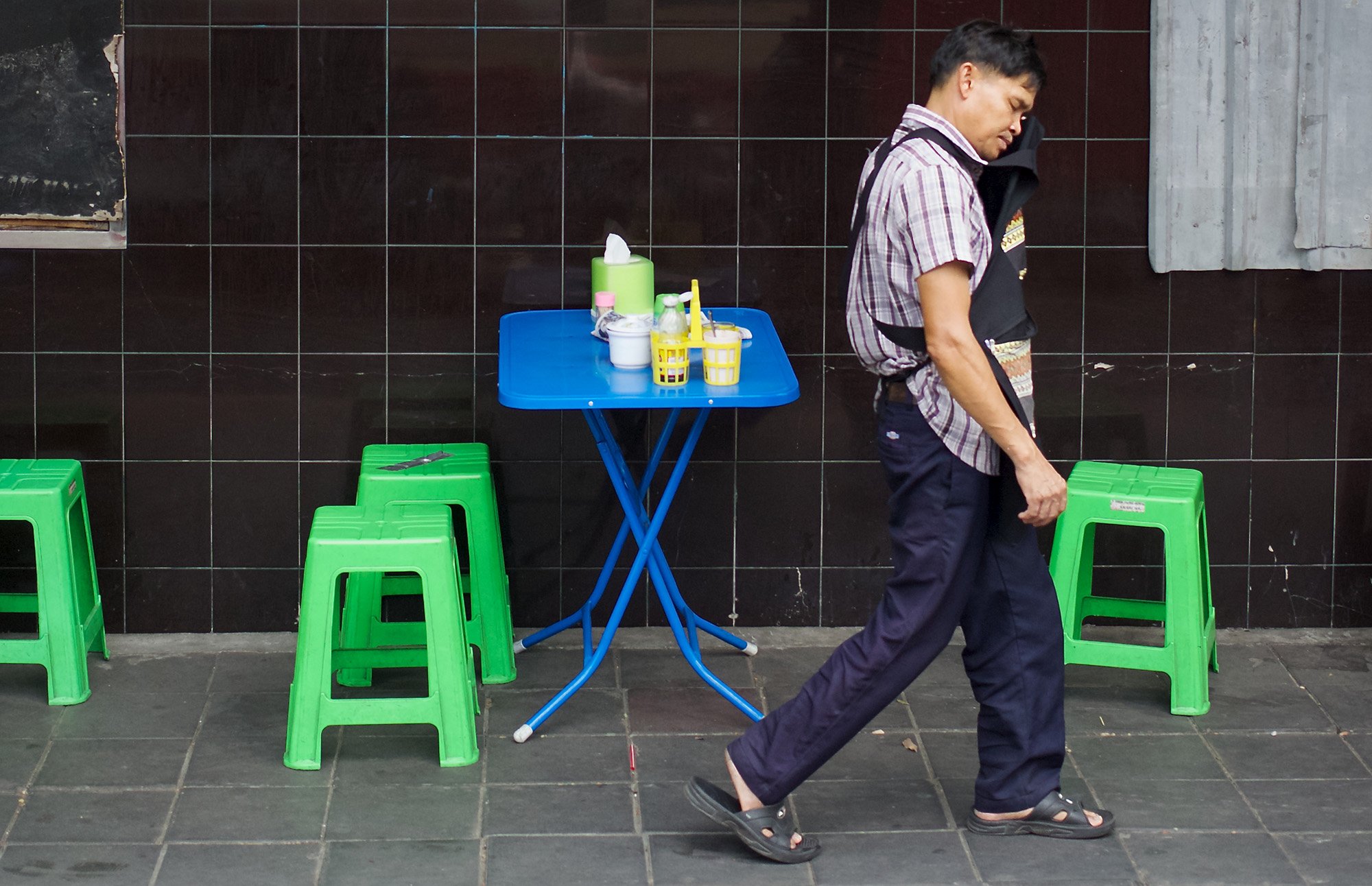
In tropical countries, colour becomes more prevalent in human culture — as it does among birds. I still try to make sense of it when taking pictures in South-East Asia where I’m obliged to see the world primarily in terms of colour. I sometimes limit the range of colour within a single image, as in the featured photo (at the top). At other times I “let it all hang out” and include every colour in front of me (as below).

I don’t expect everyone to approve.